タグ

電磁波

22 件の記事

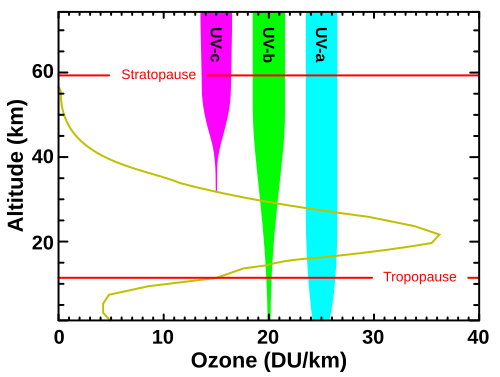
Levels of ozone at various altitudes (DU/km) and blocking of different bands of ultraviolet radiation: In essence, all UVC is blocked by diatomic oxygen (100–200 nm) or by ozone (triatomic oxygen) (200–280 nm) in the atmosphere. The ozone layer then blocks most UVB. Meanwhile, UVA is hardly affected by ozone, and most of it reaches the ground. UVA makes up almost all UV light that penetrates the Earth's atmosphere.

紫外線(UV)の性質と影響科学的メカニズムから実用的な応用まで

紫外線UVAUVBUVC

Thermal radiation in visible light can be seen on this hot metalwork. Its emission in the infrared is invisible to the human eye. Infrared cameras are capable of capturing this infrared emission (see Thermography).

熱放射の仕組みと科学温度が光に変わる物理現象

熱放射赤外線黒体放射プランクの法則
Levels of ozone at various altitudes (DU/km) and blocking of different bands of ultraviolet radiation: In essence, all UVC is blocked by diatomic oxygen (100–200 nm) or by ozone (triatomic oxygen) (200–280 nm) in the atmosphere. The ozone layer then blocks most UVB. Meanwhile, UVA is hardly affected by ozone, and most of it reaches the ground. UVA makes up almost all UV light that penetrates the Earth's atmosphere.

紫外線(UV)の性質と影響光の科学から実用的な応用まで

紫外線UVAUVBUVC
Thermal radiation in visible light can be seen on this hot metalwork. Its emission in the infrared is invisible to the human eye. Infrared cameras are capable of capturing this infrared emission (see Thermography).

熱放射の仕組みと物理学温度が光に変わる原理

熱放射赤外線黒体放射プランクの法則
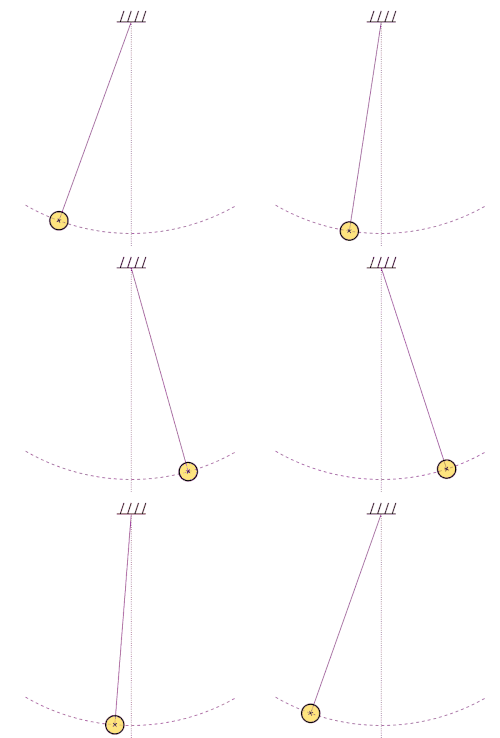
A pendulum with a period of 2.8 s and a frequency of 0.36 Hz

周波数とは何か?基礎知識から測定方法、身近な応用例までを解説

周波数ヘルツ周期電磁波
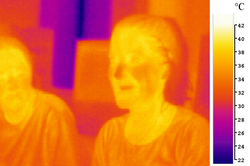
A false-color image of two people taken in long-wavelength infrared (body-temperature thermal) radiation

赤外線(IR)の基礎知識性質から最新の応用技術まで

赤外線電磁波サーモグラフィ近赤外線
An illustration of the relative abilities of three different types of ionizing radiation to penetrate solid matter. Typical alpha particles (α) are stopped by a sheet of paper, while beta particles (β) are stopped by 3mm aluminum foil. Gamma radiation (γ) is dampened when it penetrates lead. Note caveats in the text about this simplified diagram.[clarification needed]

放射線とは何か?電磁波と粒子線の種類から人体への影響までを解説

放射線電磁波電離放射線非電離放射線
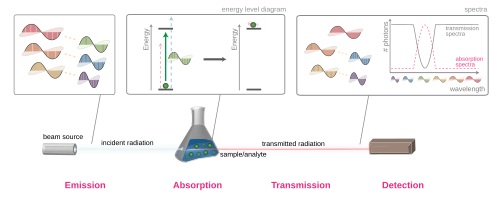
An overview of electromagnetic radiation absorption. This example discusses the general principle using visible light. A white beam source – emitting light of multiple wavelengths – is focused on a sample (the complementary color pairs are indicated by the yellow dotted lines). Upon striking the sample, photons that match the energy gap of the molecules present (green light in this example) are absorbed in order to excite the molecule. Other photons transmit unaffected and, if the radiation is in the visible region (400–700 nm), the sample color is the complementary color of the absorbed light. By comparing the attenuation of the transmitted light with the incident, an absorption spectrum can be obtained.

吸収分光法物質の正体を明かす光の解析技術

吸収分光法電磁波分光分析量子状態
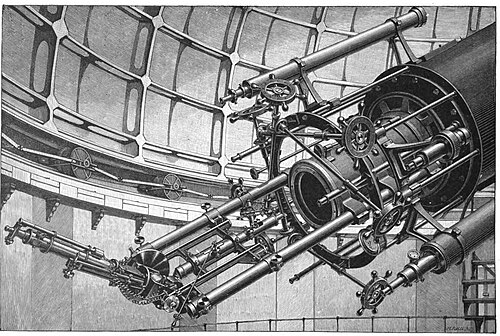
The Star-Spectroscope of the Lick Observatory in 1898. Designed by James Keeler and constructed by John Brashear.

天体分光法光のスペクトルで読み解く宇宙の正体

天体分光法スペクトル分析ドップラーシフト赤方偏移
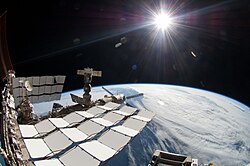
The Sun, as seen from low Earth orbit overlooking the International Space Station. This sunlight is not filtered by the lower atmosphere, which blocks much of the solar spectrum.

太陽光の科学地球の生命を支えるエネルギーの正体

太陽光電磁波可視光線赤外線
An overview of electromagnetic radiation absorption. This example discusses the general principle using visible light. A white beam source – emitting light of multiple wavelengths – is focused on a sample (the complementary color pairs are indicated by the yellow dotted lines). Upon striking the sample, photons that match the energy gap of the molecules present (green light in this example) are absorbed in order to excite the molecule. Other photons transmit unaffected and, if the radiation is in the visible region (400–700 nm), the sample color is the complementary color of the absorbed light. By comparing the attenuation of the transmitted light with the incident, an absorption spectrum can be obtained.

吸収分光法光の吸収から物質の正体を突き止める分析技術

吸収分光法電磁波分光分析Beer-Lambert法
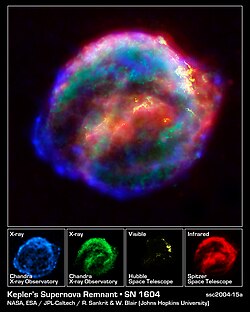
Kepler's Supernova observed in visible light, infrared, and X-rays by NASA's three Great Observatories

宇宙望遠鏡の優位性と天体観測のメカニズム

宇宙望遠鏡地上望遠鏡電磁波大気揺らぎ