The Sun, as seen from low Earth orbit overlooking the International Space Station. This sunlight is not filtered by the lower atmosphere, which blocks much of the solar spectrum.
← ホームへ戻る
太陽光電磁波可視光線赤外線紫外線

太陽光の科学地球の生命を支えるエネルギーの正体

🗓 2026年8月11日

私たちが日々当たり前のように浴びている太陽光は、単なる「明るさ」ではなく、太陽から放出される電磁波の一種です。このエネルギーは、地球上のあらゆる生命活動の根源となっており、植物の成長から人間の健康、そして地球全体の気候システムに至るまで、決定的な役割を果たしています。

太陽光は、人間の目で捉えることができる「可視光線」だけでなく、熱として感じられる「赤外線」や、目に見えない「紫外線」など、さまざまな波長の光で構成されています。これらの光が地球の大気に到達し、散乱や吸収を経て私たちの元に届くことで、心地よい昼の光(デイライト)が生まれます。
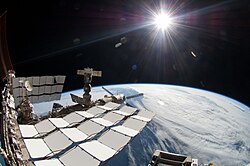
The Sun, as seen from low Earth orbit overlooking the International Space Station. This sunlight is not filtered by the lower atmosphere, which blocks much of the solar spectrum.

Key Facts

  • 到達時間: 太陽表面から地球まで光が届くのに約8.3分かかる。
  • エネルギー構成: 地表に届く光の約52〜55%が赤外線、42〜43%が可視光線、3〜5%が紫外線である。
  • 生命への影響: 光合成のエネルギー源となるほか、人間にとってビタミンD3の合成に不可欠である。
  • 大気の影響: 大気圏外では紫外線が約8%含まれるが、大気によるフィルタリングで地表では減少する。
  • 変動性: 地球と太陽の距離の変化により、1月は平均より約3.3%日射量が増え、7月は約3.3%減少する。

太陽光の組成とエネルギー特性

太陽から放出される電磁波の大部分(約98.7%)は、波長200nmから4000nmの範囲に集中しています。この広大なスペクトルは、大きく分けて以下の3つの領域に分類されます。

  • 紫外線(UV): 波長400nm未満。皮膚への影響や変異原としての性質を持つ一方、健康維持に重要な役割を担います。
  • 可視光線: 波長400nmから700nm。人間が視覚的に認識できる光の領域です。
  • 赤外線(IR): 波長700nmから1,000,000nm(1mm)。主に熱として感知され、さらにA・B・Cの3つのタイプに細分化されます。
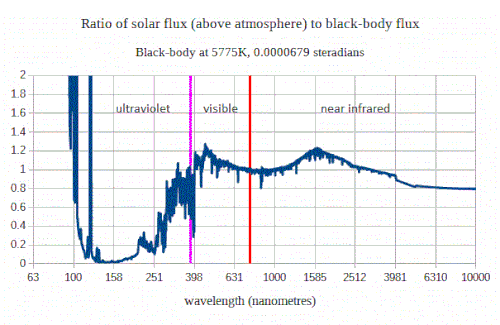
Solar spectrum compared to black-body at 5775 K

太陽のエネルギー出力がどの波長で最大になるかについては、解析方法によって見え方が異なります。波長ベースでグラフ化すると可視光領域(約501nm)にピークが現れますが、周波数ベースで計算すると近赤外線領域(約882nm)にピークが移動します。そのため、特定の波長だけが突出して強いと定義することには科学的な意味がなく、全体的な分布として捉えるのが適切です。
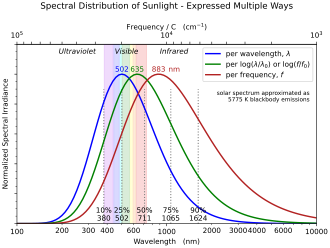
Spectral distribution of sunlight. The different curves reflect 3 different equally valid ways of characterizing the same sunlight. These curves have peaks at different wavelengths, which demonstrates that the notion of a location where the "peak" amount of sunlight is emitted is not meaningful, and is not a characteristic of the light itself (but is merely an artifact of how the spectrum is represented). Percentiles offer a way of thinking about the distribution of energy which is independent of the representation. 50 percent of solar irradiance is associated with wavelengths less than about 711 nm (based on approximating sunlight by the emissions of a 5775 K blackbody).

大気圏によるフィルタリング

太陽光が大気圏に突入すると、雲や空気中の粒子によって散乱・吸収されます。雲に遮られた光は「拡散光」となり、遮られていない直接的な光は「日照(サンシャイン)」として届きます。大気圏外での日射強度は約1,367 W/m²ですが、地表に届く直接光は約1,050 W/m²まで減少します。ただし、大気による散乱光を含めた合計では約1,120 W/m²に達します。
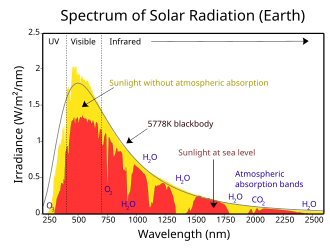
Solar spectral irradiance (watts per square metre per nanometre) above atmosphere (yellow) and at surface (red). Extreme UV and X-rays are produced (left of wavelength range) but comprise very small amounts of the Sun's total output power (area under the curve).
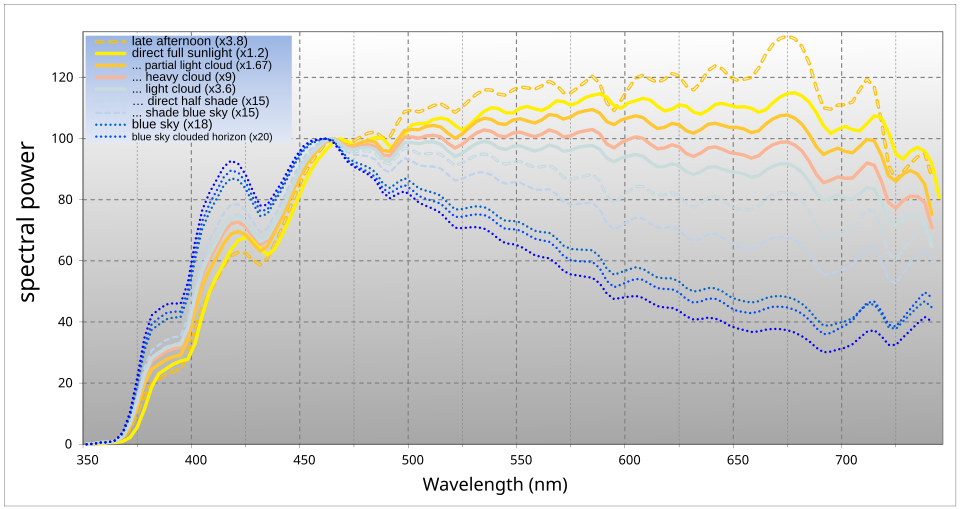
Spectrum of the visible wavelengths at approximately sea level; illumination by direct sunlight compared with direct sunlight scattered by cloud cover and with indirect sunlight by varying degrees of cloud cover. The yellow line shows the power spectrum of direct sunlight under optimal conditions. To aid comparison, the other illumination conditions are scaled by the factor shown in the key so they match at about 470 nm (blue light).

太陽系における日射量の比較

太陽からの距離が変われば、届くエネルギー量は劇的に変化します。地球では安定したエネルギーを受け取っていますが、水星のような内惑星では極めて強力な放射線にさらされ、海王星や冥王星のような外惑星では、地球の月明かりに近いほど微弱な光しか届きません。
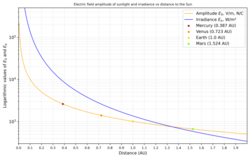
A plot showing amplitude of electric field of sunlight and irradiance based on distance to the Sun. Electric field amplitude at 1 astronomical unit (149.6 million kilometres) is about 1013 V/m.
太陽系主要天体における日射強度
天体名 平均距離 (AU) 最大日射量 (W/m²) 最小日射量 (W/m²)
水星 0.3075 〜 0.4667 14,446 6,272
金星 0.7184 〜 0.7282 2,647 2,576
地球 0.9833 〜 1.017 1,413 1,321
火星 1.382 〜 1.666 715 492
木星 4.950 〜 5.458 55.8 45.9
土星 9.048 〜 10.12 16.7 13.4
天王星 18.38 〜 20.08 4.04 3.39
海王星 29.77 〜 30.44 1.54 1.47
冥王星 29.66 〜 48.87 1.55 0.57
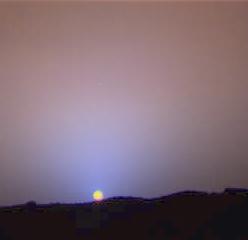
Sunlight on Mars is dimmer than on Earth. This photo of a Martian sunset was imaged by Mars Pathfinder.

地球上の生命と文化への影響

太陽光は生物学的に不可欠な役割を果たしています。特に植物や自栄養生物が行う光合成は、太陽エネルギーを化学エネルギーに変換し、炭水化物を合成することで、地球上の食物連鎖を支えています。
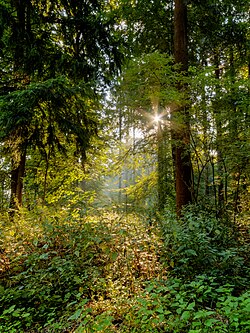
Sunlight penetrating through a forest canopy in Germany.

人間にとっても、太陽光は心身に影響を与えます。紫外線は皮膚に日焼けを引き起こすなどのリスクがある一方で、体内でビタミンD3を合成するために必要です。また、太陽光は古くから芸術や文化の主題となってきました。光と影のコントラストや、季節ごとの光の変化は、多くの画家たちにインスピレーションを与えています。
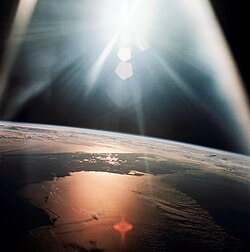
Sunrise over the Gulf of Mexico and Florida. Taken on 20 October 1968 from Apollo 7.
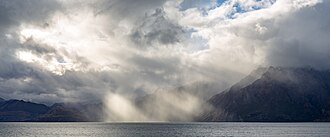
Sunlight shining through clouds, giving rise to crepuscular rays.
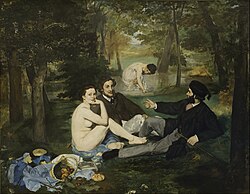
Édouard Manet: Le déjeuner sur l'herbe (1862–63).
Téli verőfény ("Winter Sunshine") by László Mednyánszky, early 20th century.
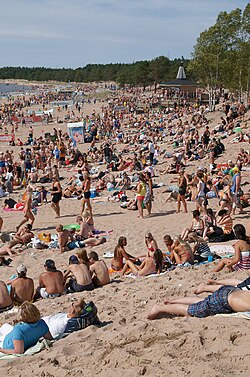
Sun bathers in Finland
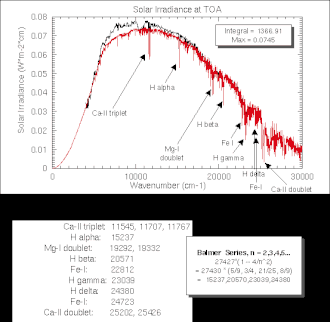
Solar irradiance spectrum at top of atmosphere, on a linear scale and plotted against wavenumber.

Frequently Asked Questions

太陽の光が地球に届くまでにどれくらいの時間がかかりますか?

太陽の表面から地球まで届くのに約8.3分かかります。ただし、光子が太陽の中心部から表面まで移動するには、荷電粒子に衝突して方向を変えながら進むため、1万年から17万年もの時間を要すると考えられています。

「太陽定数」は本当に一定なのではありませんか?

いいえ、実際には一定ではありません。1978年以降の宇宙観測により、太陽定数は11年周期の太陽黒点サイクルなど、さまざまな時間スケールで変動していることが分かっています。

紫外線にはどのようなメリットとデメリットがありますか?

メリットとしては、人体におけるビタミンD3の合成を促進することが挙げられます。一方でデメリットとしては、皮膚へのダメージ(日焼け)や、遺伝子に影響を与える変異原として作用することがあります。

太陽光のエネルギーの中で最も多いのはどの波長ですか?

地表に届くエネルギーの割合で見ると、赤外線が約52〜55%と最も多く、次いで可視光線が約42〜43%を占めています。紫外線は全体の3〜5%程度です。

太陽光の強さは季節によって変わりますか?

はい、変わります。地球が太陽を回る公転軌道が楕円であるため、太陽との距離が変化します。平均的に、1月は7月よりも日射量が約6.6%(平均からそれぞれ±3.3%)高くなります。

References

  1. "Sunlight". Glossary of Meteorology. American Meteorological Society. Retrieved 2025-03-23.
  2. "Climate and Earth's Energy Budget". earthobservatory.nasa.gov. 14 January 2009. Retrieved 2022-01-27.
  3. "Basics of Solar Energy". Archived from the original on 2016-11-28. Retrieved 2016-12-06.
  4. Bell Burnell, S. Jocelyn (2004). An Introduction to the Sun and Stars (illustrated ed.). Cambridge University Press. p. 56.  . Extract of page 56
  5. "The 8-minute travel time to Earth by sunlight hides a thousand-year journey that actually began in the core". SunEarthDay.NASA.gov. . Archived from the original on 2012-01-22. Retrieved 2012-02-12.
  6. C. KANDILLI & K. ULGEN. "Solar Illumination and Estimating Daylight Availability of Global Solar Irradiance". Energy Sources.
  7. "Introduction to Solar Radiation". Newport Corporation. Archived from the original on October 29, 2013.
  8. Calculated from data in "Reference Solar Spectral Irradiance: Air Mass 1.5". National Renewable Energy Laboratory. Archived from the original on September 28, 2013. Retrieved 2009-11-12.
    The first of each set of two figures is for total solar radiation reaching a panel aimed at the Sun (which is 42° above the horizon), whereas the second figure of each pair is the "direct plus circumsolar" radiation (circumsolar meaning coming from the part of the sky within a couple degrees of the Sun). The totals, from 280 to 4000 nm, are 1000.4 and 900.1 W/m2 respectively. It would be good to have more direct figures from a good source, rather than summing thousands of numbers in a database.
  9. Calculated from the ASTM spectrum cited above.
  10. Qiang, Fu (2003). "Radiation (Solar)" (PDF). In Holton, James R. (ed.). Encyclopedia of atmospheric sciences. Vol. 5. Amsterdam: Academic Press. pp. 1859–1863.  .  249246073. Archived (PDF) from the original on 2012-11-01.

📸 フォトギャラリー

The Sun, as seen from low Earth orbit overlooking the International Space Station. This sunlight is not filtered by the lower atmosphere, which blocks much of the solar spectrum.
Sunrise over the Gulf of Mexico and Florida. Taken on 20 October 1968 from Apollo 7.
A plot showing amplitude of electric field of sunlight and irradiance based on distance to the Sun. Electric field amplitude at 1 astronomical unit (149.6 million kilometres) is about 1013 V/m.
Solar spectrum compared to black-body at 5775 K
Solar spectral irradiance (watts per square metre per nanometre) above atmosphere (yellow) and at surface (red). Extreme UV and X-rays are produced (left of wavelength range) but comprise very small amounts of the Sun's total output power (area under the curve).
Spectral distribution of sunlight. The different curves reflect 3 different equally valid ways of characterizing the same sunlight. These curves have peaks at different wavelengths, which demonstrates that the notion of a location where the "peak" amount of sunlight is emitted is not meaningful, and is not a characteristic of the light itself (but is merely an artifact of how the spectrum is represented). Percentiles offer a way of thinking about the distribution of energy which is independent of the representation. 50 percent of solar irradiance is associated with wavelengths less than about 711 nm (based on approximating sunlight by the emissions of a 5775 K blackbody).
Sunlight on Mars is dimmer than on Earth. This photo of a Martian sunset was imaged by Mars Pathfinder.
Solar irradiance spectrum at top of atmosphere, on a linear scale and plotted against wavenumber.
Sunlight shining through clouds, giving rise to crepuscular rays.
Spectrum of the visible wavelengths at approximately sea level; illumination by direct sunlight compared with direct sunlight scattered by cloud cover and with indirect sunlight by varying degrees of cloud cover. The yellow line shows the power spectrum of direct sunlight under optimal conditions. To aid comparison, the other illumination conditions are scaled by the factor shown in the key so they match at about 470 nm (blue light).
Sunlight penetrating through a forest canopy in Germany.
Édouard Manet: Le déjeuner sur l'herbe (1862–63).
Téli verőfény ("Winter Sunshine") by László Mednyánszky, early 20th century.
Sun bathers in Finland