Levels of ozone at various altitudes (DU/km) and blocking of different bands of ultraviolet radiation: In essence, all UVC is blocked by diatomic oxygen (100–200 nm) or by ozone (triatomic oxygen) (200–280 nm) in the atmosphere. The ozone layer then blocks most UVB. Meanwhile, UVA is hardly affected by ozone, and most of it reaches the ground. UVA makes up almost all UV light that penetrates the Earth's atmosphere.
← ホームへ戻る
紫外線UVAUVBUVC電磁波

紫外線(UV)の性質と影響光の科学から実用的な応用まで

🗓 2026年8月12日

私たちの生活に密接に関わっている紫外線(UV)は、可視光線よりも波長が短く、X線よりも長い電磁波の一種です。太陽光の約10%を占めるこの光は、目に見えないながらも、化学反応を誘発したり、物質を光らせたりする強力なエネルギーを持っています。私たちの健康に影響を与える一方で、医療や工業分野で不可欠な役割を果たしている紫外線の正体に迫ります。

Key Facts

  • 波長100〜400ナノメートルの電磁波であり、可視光よりエネルギーが高い。
  • UVA、UVB、UVCの3つの主要な区分があり、それぞれ性質が異なる。
  • 大気中のオゾン層が有害な短波長紫外線を遮断し、地上生物を保護している。
  • DNAを損傷させる性質があるため、殺菌や滅菌に利用される。
  • ビタミンDの生成を助けるなど、生物にとって有益な側面も持つ。

紫外線の基礎知識と分類

紫外線は、その波長の長さによって特性が大きく異なります。一般的に、波長が短いほど光子1つあたりのエネルギーが高くなり、物質に与える影響も強くなります。特に短波長の紫外線は「電離放射線」として機能し、原子から電子を弾き飛ばすほどのエネルギーを持つため、生物のDNAを直接的に破壊することが可能です。

国際標準(ISO 21348)に基づき、紫外線は主に以下のカテゴリーに分類されます。

紫外線の分類と特性まとめ
名称 波長 (nm) 主な特徴・影響
UVA 315–400 透過力が強く、地表に多く到達する。皮膚の深部まで届く。
UVB 280–315 日焼けの主因。ビタミンD生成を促すが、過剰なら皮膚癌のリスクとなる。
UVC 100–280 最もエネルギーが高く有害。通常はオゾン層で完全に吸収される。
極端紫外線 (EUV) 10–121 X線に近い性質を持ち、高度な半導体リソグラフィに使用される。

大気圏では、酸素分子やオゾン層がフィルターの役割を果たしています。特にUVCなどの極めて短い波長は、地表に届く前にほぼすべて吸収されます。これにより、私たちは致死的な放射線から守られています。
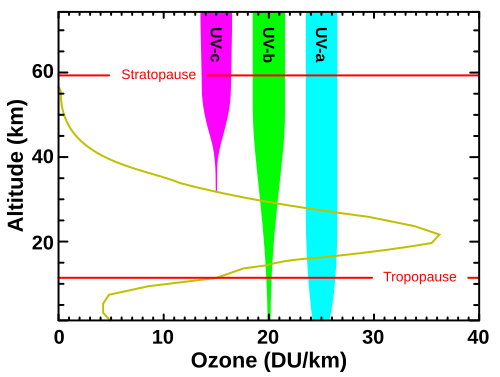
Levels of ozone at various altitudes (DU/km) and blocking of different bands of ultraviolet radiation: In essence, all UVC is blocked by diatomic oxygen (100–200 nm) or by ozone (triatomic oxygen) (200–280 nm) in the atmosphere. The ozone layer then blocks most UVB. Meanwhile, UVA is hardly affected by ozone, and most of it reaches the ground. UVA makes up almost all UV light that penetrates the Earth's atmosphere.

生物への影響:メリットとリスク

紫外線は、生物にとって「毒」にも「薬」にもなります。例えば、人間を含む多くの脊椎動物にとって、UVBは体内でビタミンDを合成するために不可欠な要素です。しかし、過剰な曝露は深刻なダメージをもたらします。

皮膚への影響として最も顕著なのが、紅斑(サンバーン)や日焼けです。これは紫外線の強度と皮膚の感受性が組み合わさって起こる現象で、特に波長が短いほど皮膚へのダメージは急激に増大します。
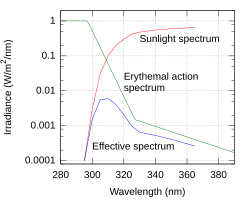
Sunburn effect (as measured by the UV index) is the product of the sunlight spectrum (radiation intensity) and the erythemal action spectrum (skin sensitivity) across the range of UV wavelengths. Sunburn production per milliwatt of radiation intensity is increased by nearly a factor of 100 between the near UVB wavelengths of 315–295 nm.

さらに深刻なのは、細胞レベルでの損傷です。紫外線光子はDNA分子に作用し、隣接するチミン塩基同士を不自然に結合させる「チミンダイマー」という構造を作り出します。これによりDNAの形状が歪み、正常な機能が損なわれることで、皮膚癌などの疾患につながるリスクが高まります。
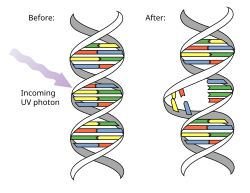
Ultraviolet photons harm the DNA molecules of living organisms in different ways. In one common damage event, adjacent thymine bases bond with each other, instead of across the "ladder". This "thymine dimer" makes a bulge, and the distorted DNA molecule does not function properly.

また、目への影響も無視できません。特にアーク溶接などで発生する短波長の紫外線は、角膜炎(電気性眼炎)や白内障の原因となります。雪山などで起こる「雪盲」も、反射したUVBによる角膜へのダメージの一種です。

物質への作用と工業的利用

紫外線は有機分子の化学結合を切断したり、電子を励起させたりする能力があるため、多方面で活用されています。代表的なのが蛍光現象です。特定の波長の紫外線を物質に当てると、それを吸収して異なる色の可視光として放出します。
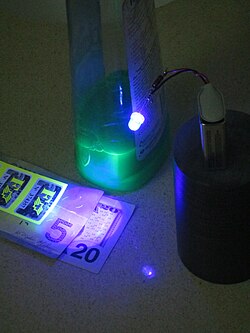
A 380 nanometer UV LED makes some common household items fluoresce.

この性質は、偽造防止技術や科学分析に利用されています。例えば、クレジットカードの隠しマークや、法医学における体液の検出、鉱物の同定などに役立っています。
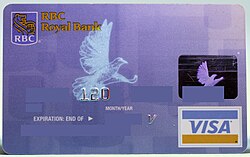
A bird appears on many Visa credit cards when they are held under a UV light source.
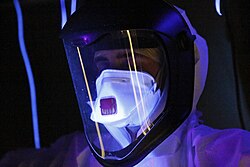
A person wearing full protective gear, glowing in ultraviolet light
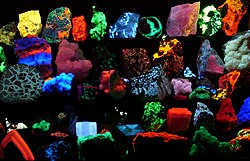
A collection of mineral samples fluorescing brilliantly at various wavelengths as seen while being irradiated by UV

一方で、紫外線は物質を劣化させる要因にもなります。プラスチック(ポリプロピレンなど)や染料は、UVによる化学結合の破壊によって脆くなったり、色が褪せたりします。これを防ぐために、日焼け止めのようなUV吸収剤が製品に配合されます。
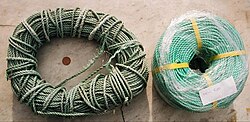

UV damaged polypropylene rope (left) and new rope (right)
IR spectrum showing carbonyl absorption due to UV degradation of polyethylene
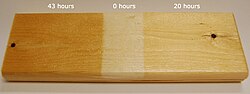
Effects of UV on finished surfaces in 0, 20 and 43 hours

日焼け止めの効果を可視化した画像を見ると、UVを吸収した部分は暗く写り、物理的に光を遮断していることが分かります。
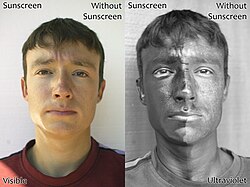
Demonstration of the effect of sunscreen. The left image is a regular photograph of his face; the right image is of reflected UV light. The man's face has sunscreen on his right side only. It appears darker because the sunscreen absorbs the UV light.

人工的な紫外線光源とその応用

自然界の太陽光以外にも、さまざまな方法で紫外線を作り出すことができます。水銀ランプは、特にUVC帯(253.7nmなど)で強いピークを持ち、強力な殺菌能力を持つため、研究室や食品工場の滅菌装置に広く採用されています。
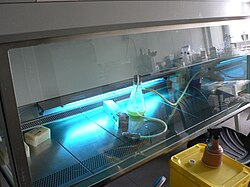
A low-pressure mercury vapor discharge tube floods the inside of a hood with shortwave UV light when not in use, sterilizing microbiological contaminants from irradiated surfaces.

近年では、エネルギー効率の高いUV LEDの開発が進んでいます。特に365nmや395nmのUVA LEDは、樹脂の硬化(UVキュア)や、昆虫を誘引する捕虫器などに利用されています。
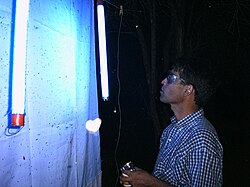
Entomologist using a UV lamp for collecting beetles in Chaco, Paraguay

また、特殊な用途として、UVカメラを用いた撮影もあります。可視光では見えない皮膚のシミや、特定の波長のみを透過させるフィルターを用いた天体観測(木星のオーロラ観測など)に活用されています。
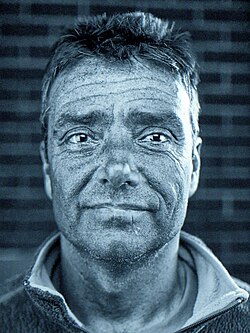
A portrait taken using only UV light between the wavelengths of 335 and 365 nanometers
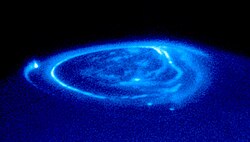
Aurora at Jupiter's north pole as seen in ultraviolet light by the Hubble Space Telescope

強力な紫外線源を扱う際は、適切な保護具の着用が不可欠です。警告サインが掲示されている場所では、特に注意が必要です。
Signs are often used to warn of the hazard of strong UV sources.

さらに、特殊なガラス(ウッドガラスなど)を用いることで、特定の波長だけを透過させ、秘密通信や特殊な照明として利用する技術も存在します。

ภาพประกอบบทความ

Frequently Asked Questions

窓ガラスは紫外線を完全に遮断しますか?

いいえ、完全に遮断するわけではありません。一般的なソーダ石灰ガラスは、波長300nm以下の短波長はほぼ遮断しますが、UVA(350nm以上)の多くは透過させます。そのため、室内でも窓際ではUVAの影響を受けることがあります。

UVCは人間にとって常に危険ですか?

UVCは非常に高いエネルギーを持つため、直接皮膚や目に当たると危険です。しかし、適切に制御された環境(密閉された殺菌装置など)で使用される場合は、微生物のDNAを破壊して滅菌する非常に有効な手段となります。

日焼け止めはどのようにして紫外線を防いでいるのですか?

日焼け止めには、紫外線を吸収して熱などの別のエネルギーに変換する「化学的フィルター」や、紫外線を鏡のように反射・散乱させる「物理的フィルター」が含まれており、これらが皮膚への到達を阻止します。

紫外線でなぜ物質が光る(蛍光)のですか?

物質中の電子が紫外線のエネルギーを吸収して高いエネルギー状態(励起状態)になり、その後、元の状態に戻る際に、吸収したエネルギーの一部を可視光として放出するためです。

UV LEDと水銀ランプの違いは何ですか?

水銀ランプは広範囲のUVを効率よく出せますが、寿命や環境負荷(水銀)の課題があります。一方、UV LEDは特定の波長をピンポイントで出せ、小型で長寿命、環境負荷が低いというメリットがあります。

References

  1. Maqbool, Muhammad (2023). An Introduction to Non-Ionizing Radiation. Bentham Science Publishers.  .
  2. Ida, Nathan (2008). Engineering Electromagnetics, 2nd Ed. Springer Science and Business Media. p. 1122.  .
  3. "Reference Solar Spectral Irradiance: Air Mass 1.5". Archived from the original on 27 January 2011. Retrieved 12 November 2009.
  4. Haigh, Joanna D. (2007). "The Sun and the Earth's Climate: Absorption of solar spectral radiation by the atmosphere". Living Reviews in Solar Physics. 4 (2): 2. :2007LRSP....4....2H. :10.12942/lrsp-2007-2.
  5. Wacker, Matthias; Holick, Michael F. (1 January 2013). "Sunlight and Vitamin D". Dermato-endocrinology. 5 (1): 51–108. :10.4161/derm.24494.  1938-1972.  3897598.  24494042.
  6. David Hambling (29 May 2002). "Let the light shine in". The Guardian. Archived from the original on 23 November 2014. Retrieved 2 January 2015.
  7. Cronin, Thomas W.; Bok, Michael J. (15 September 2016). "Photoreception and vision in the ultraviolet". Journal of Experimental Biology. 219 (18): 2790–2801. :2016JExpB.219.2790C. :10.1242/jeb.128769. :11603/13303.  1477-9145.  27655820.  22365933.
  8. M A Mainster (2006). "Violet and blue light blocking intraocular lenses: photoprotection versus photoreception". British Journal of Ophthalmology. 90 (6): 784–792. :10.1136/bjo.2005.086553.  1860240.  16714268.
  9. Lynch, David K.; Livingston, William Charles (2001). Color and Light in Nature (2nd ed.). Cambridge: . p. 231.  . Archived from the original on 31 December 2013. Retrieved 12 October 2013. Limits of the eye's overall range of sensitivity extends from about 310 to 1050 nanometers
  10. Dash, Madhab Chandra; Dash, Satya Prakash (2009). Fundamentals of Ecology 3E. Tata McGraw-Hill Education. p. 213.  . Archived from the original on 31 December 2013. Retrieved 18 October 2013. Normally the human eye responds to light rays from 390 to 760 nm. This can be extended to a range of 310 to 1,050 nm under artificial conditions.

📸 フォトギャラリー

Levels of ozone at various altitudes (DU/km) and blocking of different bands of ultraviolet radiation: In essence, all UVC is blocked by diatomic oxygen (100–200 nm) or by ozone (triatomic oxygen) (200–280 nm) in the atmosphere. The ozone layer then blocks most UVB. Meanwhile, UVA is hardly affected by ozone, and most of it reaches the ground. UVA makes up almost all UV light that penetrates the Earth's atmosphere.
A 380 nanometer UV LED makes some common household items fluoresce.
Sunburn effect (as measured by the UV index) is the product of the sunlight spectrum (radiation intensity) and the erythemal action spectrum (skin sensitivity) across the range of UV wavelengths. Sunburn production per milliwatt of radiation intensity is increased by nearly a factor of 100 between the near UVB wavelengths of 315–295 nm.
Ultraviolet photons harm the DNA molecules of living organisms in different ways. In one common damage event, adjacent thymine bases bond with each other, instead of across the "ladder". This "thymine dimer" makes a bulge, and the distorted DNA molecule does not function properly.
Demonstration of the effect of sunscreen. The left image is a regular photograph of his face; the right image is of reflected UV light. The man's face has sunscreen on his right side only. It appears darker because the sunscreen absorbs the UV light.
Signs are often used to warn of the hazard of strong UV sources.
UV damaged polypropylene rope (left) and new rope (right)
IR spectrum showing carbonyl absorption due to UV degradation of polyethylene
A portrait taken using only UV light between the wavelengths of 335 and 365 nanometers
Aurora at Jupiter's north pole as seen in ultraviolet light by the Hubble Space Telescope
A bird appears on many Visa credit cards when they are held under a UV light source.
A person wearing full protective gear, glowing in ultraviolet light
A collection of mineral samples fluorescing brilliantly at various wavelengths as seen while being irradiated by UV
Effects of UV on finished surfaces in 0, 20 and 43 hours
A low-pressure mercury vapor discharge tube floods the inside of a hood with shortwave UV light when not in use, sterilizing microbiological contaminants from irradiated surfaces.
Entomologist using a UV lamp for collecting beetles in Chaco, Paraguay
ภาพประกอบบทความ