タグ

熱力学

50 件の記事

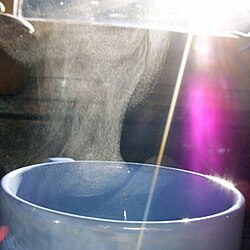
Aerosol of microscopic water droplets suspended in the air above a cup of hot tea after the water vapor has sufficiently cooled and condensed. Water vapor is an invisible gas, but the clouds of condensed droplets refract and scatter the sunlight and are thus visible.

蒸発のメカニズムと日常生活への影響気化現象の科学

蒸発気化蒸気圧気化熱
A small piece of rapidly melting argon ice shows the transition from solid to liquid.

相(フェーズ)の科学物質の状態と平衡のメカニズム

物質の状態相図相転移
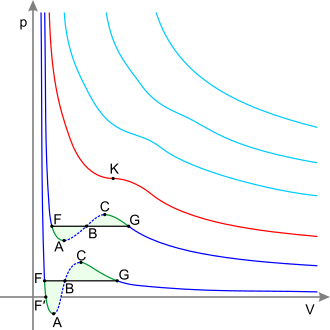
Isotherms of real gas Dark blue curves – isotherms below the critical temperature. Green sections – metastable states. The section to the left of point F – normal liquid. Point F – boiling point. Line FG – equilibrium of liquid and gaseous phases. Section FA – superheated liquid. Section F′A – stretched liquid (p<0). Section AC – analytic continuation of isotherm, physically impossible. Section CG – supercooled vapor. Point G – dew point. The plot to the right of point G – normal gas. Areas FAB and GCB are equal. Red curve – Critical isotherm. Point K – critical point. Light blue curves – supercritical isotherms

実在気体の熱力学理想気体からの逸脱と状態方程式のモデル

実在気体状態方程式ファンデルワールス方程式レッドリッヒ・クォング
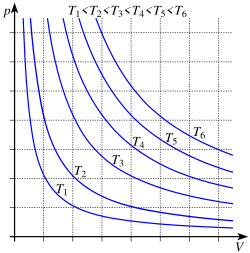
Isotherms of an ideal gas for different temperatures. The curved lines are rectangular hyperbolae of the form y = a/x. They represent the relationship between pressure (on the vertical axis) and volume (on the horizontal axis) for an ideal gas at different temperatures: lines that are farther away from the origin (that is, lines that are nearer to the top right-hand corner of the diagram) correspond to higher temperatures.

熱力学と理想気体法の基礎状態方程式から分子運動論まで

熱力学理想気体状態方程式ボイルの法則
📖

熱力学における体積の概念と物理的特性

熱力学体積比体積理想気体
The thermodynamicists of the original eight founding schools of thermodynamics. The schools with the most-lasting influence on the modern versions of thermodynamics are the Berlin school, particularly Rudolf Clausius's 1865 textbook The Mechanical Theory of Heat, the Vienna school, with the statistical mechanics of Ludwig Boltzmann, and the Gibbsian school at Yale University of Willard Gibbs' 1876 and his book On the Equilibrium of Heterogeneous Substances which launched chemical thermodynamics.[8]

熱力学の基礎から応用までエネルギーとエントロピーの科学

熱力学エントロピー熱力学第一法則熱力学第二法則
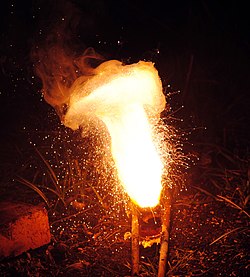
A thermite reaction using iron(III) oxide. The sparks flying outwards are globules of molten iron trailing smoke in their wake.

化学反応の基礎知識メカニズムから産業応用まで

化学反応化学方程式酸化還元反応触媒
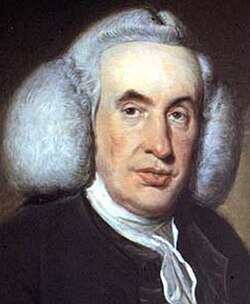
William Cullen

潜熱の歴史と科学温度変化を伴わない熱エネルギーの解明

潜熱顕熱ジョゼフ・ブラックウィリアム・カレン
Aerosol of microscopic water droplets suspended in the air above a cup of hot tea after the water vapor has sufficiently cooled and condensed. Water vapor is an invisible gas, but the clouds of condensed droplets refract and scatter the sunlight and are thus visible.

蒸発のメカニズムと日常生活への影響気化現象の科学的視点

蒸発気化熱水循環蒸気圧

During steady, continuous operation, an energy balance applied to an open system equates shaft work performed by the system to heat added plus net enthalpy added

エンタルピーの基礎から応用まで熱力学におけるエネルギーの定義と役割

エンタルピー熱力学内部エネルギー状態関数
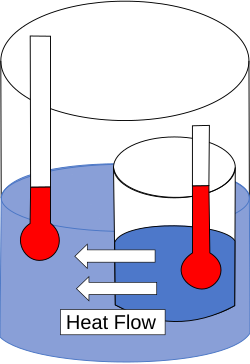
Heat flowing from hot water to cold water

熱力学の基礎と第二法則エネルギーの流れとエントロピーの科学

熱力学熱力学第二法則エントロピーカルノーサイクル
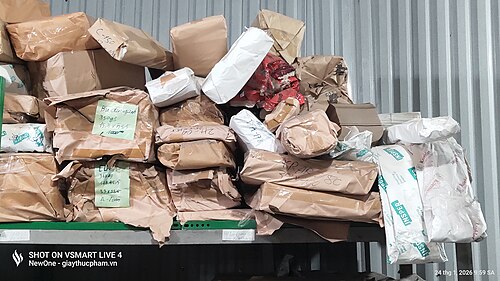
Fragmentation of standardized paper sheets into heterogeneous offcuts through industrial cutting, illustrating increased entropy in a production system.

エントロピーの科学熱力学から情報理論までを紐解く

エントロピー熱力学ルドルフ・クラウジウス統計力学