物理学や化学の基礎的な学習では、気体は「理想気体」として扱われることが一般的です。しかし、現実の世界に存在する気体(実在気体)は、分子自体の体積を持ち、分子間に相互作用が働くため、理想気体の法則からは必ず逸脱します。特に高圧環境や低温状態、あるいは凝縮点に近い条件下では、この逸脱が顕著になり、正確な予測には専用のモデルが必要となります。
実在気体の挙動を決定づける要因には、分子間の引力や反発力(ファンデルワールス力)、温度によって変化する定積比熱、さらには分子の解離や化学反応などが含まれます。これらの影響を定量的に評価するために用いられるのが「圧縮因子(Z)」であり、理想状態からのズレを数値化して表現します。
Key Facts
- 実在気体は分子間相互作用と分子自身の体積を持つため、理想気体法則に従わない。
- 高圧、低温、または臨界点付近では、理想気体近似ではなく実在気体モデルが不可欠である。
- 圧縮因子 (Z) を用いることで、理想気体からの逸脱度を測定できる。
- 状態方程式には、単純な2パラメータモデルから、実験値に基づく多パラメータモデルまで多様な種類が存在する。
実在気体を記述する主要な状態方程式
実在気体の挙動を数学的に表現するために、多くの科学者が状態方程式を提案してきました。以下に代表的なモデルを整理します。
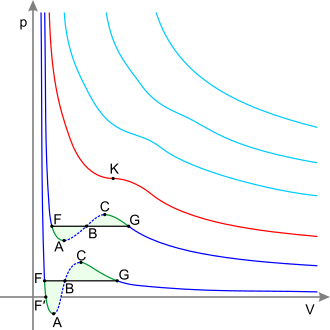
ファンデルワールスモデル
最も古典的かつ基礎的なモデルであり、分子の有限な大きさと分子間引力を導入しました。臨界温度(Tc)や臨界圧力(pc)を用いてパラメータを決定でき、気液平衡の概念を導入した点に大きな意義があります。
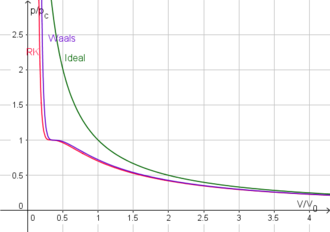
レッドリッヒ・クォング (Redlich-Kwong) モデル
ファンデルワールス方程式を改良した2パラメータモデルです。温度依存性を導入したことで、多くのケースでファンデルワールスモデルよりも高い精度を実現しています。
その他の高度なモデル
- Peng-Robinsonモデル:実在気体だけでなく、一部の液体挙動のモデリングにも有効な汎用性の高い方程式です。
- Virial(ビリアル)方程式:統計力学的な摂動論に基づいた級数展開形式であり、理論的な裏付けが強いモデルです。
- Beattie-Bridgemanモデル:5つの実験定数を用いることで、臨界密度の約80%までの範囲で極めて高い精度を誇ります。
- Wohlモデル:臨界値を用いて定式化されており、個別のガス定数が不明な場合に有用ですが、高密度領域では圧力が急落する特性があります。
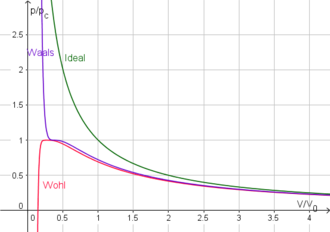
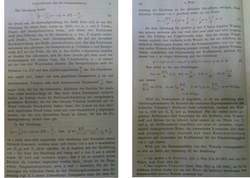
これらのモデルの選択は、解析したい温度・圧力領域や、要求される精度によって異なります。歴史的な研究資料では、これらの方程式の妥当性が詳細に検証されてきました。
実在気体モデルの比較まとめ
| モデル名 | 特徴 | 主な用途・利点 |
|---|---|---|
| ファンデルワールス | 基本的な2パラメータモデル | 概念的な理解、基礎的な実在気体解析 |
| レッドリッヒ・クォング | 温度依存性を追加 | ファンデルワールスより高精度な予測 |
| Peng-Robinson | 液体領域への適用性 | 石油化学などの産業プロセス設計 |
| Beattie-Bridgeman | 5つの実験定数を使用 | 特定の密度範囲における高精度計算 |
| Virial | 統計力学的な級数展開 | 理論的な解析、低圧域の精密記述 |
熱力学的仕事への影響
実在気体が膨張する際に外部に行う仕事は、理想気体の場合とは異なります。この差分は、理想気体の圧力と実在気体の実際の圧力の差を体積で積分することで算出されます。このため、高圧ガスの圧縮機やタービンの設計では、実在気体としての補正が不可欠となります。
Frequently Asked Questions
なぜ理想気体の法則では不十分なのですか?
理想気体は「分子の大きさがゼロ」で「分子間に相互作用がない」と仮定していますが、実際には分子が体積を持ち、互いに引き合ったり反発したりするため、特に高圧・低温下では計算結果に大きな誤差が生じるからです。
臨界点とは何ですか?
気体と液体の区別がつかなくなる特定の温度と圧力の点のことです。この点(臨界点)を超えると、物質は超臨界流体となり、気体と液体の両方の性質を併せ持つようになります。
圧縮因子 Z とは何を意味していますか?
実在気体の状態を理想気体の状態(PV=nRT)で割った比率です。Z=1であれば理想気体として振る舞い、1から離れるほど理想状態からの逸脱が大きいことを示します。
どの状態方程式を使うべきですか?
目的によります。教育的な基礎理解にはファンデルワールス、一般的な工学的計算にはレッドリッヒ・クォングやPeng-Robinson、極めて高い精度が必要な特定のガス解析にはBeattie-Bridgemanなどが適しています。
実在気体モデルは液体にも適用できますか?
多くのモデルは気体向けですが、Peng-Robinsonモデルのように、適切に設計されていれば一部の液体挙動を記述できるモデルも存在します。
References
- D. Berthelot in Travaux et Mémoires du Bureau international des Poids et Mesures – Tome XIII (Paris: Gauthier-Villars, 1907)
- C. Dieterici, Ann. Phys. Chem. Wiedemanns Ann. 69, 685 (1899)
- Pippard, Alfred B. (1981). Elements of classical thermodynamics: for advanced students of physics (Repr ed.). Cambridge: Univ. Pr. p. 74. .
- Peng, D. Y. & Robinson, D. B. (1976). "A New Two-Constant Equation of State". Industrial and Engineering Chemistry: Fundamentals. 15: 59–64. :10.1021/i160057a011. 98225845.
- A. Wohl (1914). "Investigation of the condition equation". Zeitschrift für Physikalische Chemie. 87: 1–39. :10.1515/zpch-1914-8702. 92940790.
- Yunus A. Cengel and Michael A. Boles, Thermodynamics: An Engineering Approach 7th Edition, McGraw-Hill, 2010,
- Gordan J. Van Wylen and Richard E. Sonntage, Fundamental of Classical Thermodynamics, 3rd ed, New York, John Wiley & Sons, 1986 P46 table 3.3
📸 フォトギャラリー