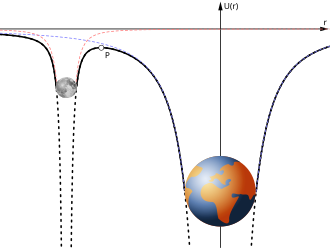
宇宙空間において、ある天体が別の天体を衛星として保持するためには、単に重力を持っているだけでは不十分です。周囲にあるより巨大な天体の強力な重力に抗い、自らの支配下に置くことができる領域が必要となります。この「重力的な支配圏」を定義した概念がヒル圏(Hill sphere)です。
例えば、地球が月を衛星として繋ぎ止めていられるのは、月が地球のヒル圏内に位置しているからです。もし月がこの領域の外へ出れば、太陽の強力な重力に引き寄せられ、地球を離れて太陽を直接周回する独立した惑星のような存在になってしまうでしょう。同様に、太陽系全体の境界も、銀河中心などの巨大質量天体との相互作用によって決まる太陽のヒル圏によって定義されていると考えられます。
Key Facts
- 定義: 巨大な天体の影響下にある小さな天体が、自らの重力で衛星を保持できる近似的な限界領域。
- 決定要因: 二つの天体の質量比と、それらの間の距離(軌道長半径)によって決まる。
- 境界の性質: ラグランジュ点L1およびL2を結ぶ線分が、ヒル圏のサイズを決定する制限要因となる。
- 安定性: 逆行軌道(主星の公転方向と逆向きの軌道)は、順行軌道よりも広い範囲で安定しやすい。
- 極端な例: 質量が極めて小さい物体(例:宇宙往還機)のヒル圏は非常に狭く、物理的なサイズよりも小さくなることがある。
ヒル圏の数学的定義と計算
ヒル圏の半径(ヒル半径 $R_H$)は、制限三体問題という物理モデルに基づいています。これは、質量 $m_1$ の主星と、それより遥かに軽い質量 $m_2$ の副星、そして無視できるほど軽いテスト粒子(衛星など)の3つの物体が相互作用する系を想定したものです。
基本的な近似式では、ヒル半径は以下の関係で表されます。ここで $a$ は二天体間の距離(軌道長半径)を指します。
$$R_H \approx a \sqrt[3]{\frac{m_2}{3(m_1 + m_2)}}$$
実際の天体は完全な円軌道ではなく、楕円軌道を描いています。そのため、離心率 $e$ を考慮すると、ヒル半径は軌道上の位置(真近点角 $\theta$)によって変動します。特に、主星に最も近づく近点でヒル半径は最小となり、最も遠ざかる遠点で最大となります。
![A contour plot of the effective gravitational potential of a two-body system, here, the Sun and Earth, indicating the five Lagrange points.[clarification needed][citation needed]](/images/9e/11/9e11a8177bce00bef28ac754119e3c7bc7b1be7742e86605f5d916c832c339f0.webp)
地球・月系における具体例
地球と月の系にこの理論を当てはめると、月のヒル半径は近点付近で約57,910km、遠点付近で約64,638kmとなります。月と地球の平均距離は約384,400kmであるため、月の重力支配圏は地球・月間距離の約6分の1程度にまで広がっていることがわかります。
![A schematic, not-to-scale representation of Hill spheres (as 2D radii) and Roche limits of each body of the Sun-Earth-Moon system. The actual Hill radius for the Moon is on the order of 60,000 km (i.e., extending less than one-sixth the distance of the 378,000 km between the Moon and the Earth).[9]](/images/ff/29/ff2968df0b29d8234e46bc5353aae1dcb5bf3ac2936b19a36aa3f8de380652a0.webp)
軌道の安定性と物理的制約
ヒル圏内にあれば理論上は衛星を保持できますが、実際にはさらに厳しい安定性の条件が存在します。一般的に、長期的に安定した軌道を維持できるのは、ヒル半径の半分から3分の1程度の範囲内であると言われています。
多惑星系における不安定性
複数の惑星が存在する系では、隣接する惑星同士の「相互ヒル半径」が重要になります。惑星間の距離がこの相互ヒル半径の10倍未満である場合、第三の惑星による摂動(重力の乱れ)が発生し、角運動量が奪われるため、系全体が不安定になる傾向があります。
質量と密度の限界
ヒル圏は天体の質量に依存するため、質量が極端に小さい場合、ヒル圏の半径が天体自身の物理的な半径よりも小さくなることがあります。例えば、低地球軌道にある104トンの宇宙往還機の場合、そのヒル半径はわずか120cm程度です。つまり、往還機の周囲を回る衛星を保持するには、その物体が鉛よりも高い密度を持っていて、1.2メートル以内に収まっている必要があります。
太陽系におけるヒル圏の比較
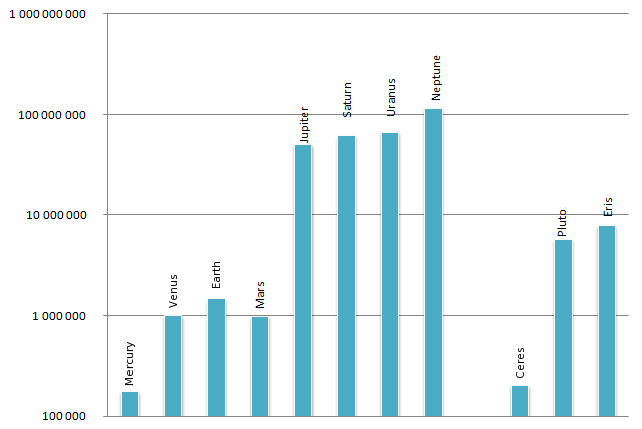
太陽系内で最大のヒル半径を持つのは海王星です。海王星は木星よりも質量は小さいものの、太陽からの距離が非常に遠いため、その重力支配圏は1億1,600万km(約0.775 au)にまで及びます。対照的に、太陽に近い水星のヒル半径はわずか17万5,300kmにとどまります。
以下の表に、太陽系の主要天体におけるヒル圏の特性をまとめます。
| 天体名 | ヒル半径 (百万km) | ヒル半径 (au) | 天体半径比 (分) | 最遠衛星の比率 (衛星距離/ヒル半径) |
|---|---|---|---|---|
| 水星 | 0.1753 | 0.0012 | 10.7 | N/A |
| 金星 | 1.0042 | 0.0067 | 31.8 | N/A |
| 地球 | 1.4714 | 0.0098 | 33.7 | 0.262 |
| 火星 | 0.9827 | 0.0066 | 14.9 | 0.0242 |
| 木星 | 50.5736 | 0.3381 | 223.2 | 0.491 |
| 土星 | 61.6340 | 0.4120 | 147.8 | 0.433 |
| 天王星 | 66.7831 | 0.4464 | 80.0 | 0.306 |
| 海王星 | 115.0307 | 0.7689 | 87.9 | 0.437 |
| 冥王星 | 5.9921 | 0.0401 | 3.5 | 0.0107 |
Frequently Asked Questions
ヒル圏とロシュ限界は何が違うのですか?
ヒル圏は「外部の巨大天体に奪われずに衛星を保持できる最大範囲」を示すのに対し、ロシュ限界は「衛星が主星の潮汐力によって破壊されずに存在できる最小距離」を示します。つまり、ヒル圏は外側の境界、ロシュ限界は内側の境界を定義する概念です。
なぜ逆行軌道の方が安定しやすいのですか?
天体力学的な相互作用において、主星の公転方向と逆向きに回る衛星は、主星からの摂動による影響を相殺しやすいため、順行軌道よりも広い領域で安定して存在できることが知られています。
人工衛星の軌道設計にヒル圏は関係ありますか?
はい、深く関係しています。特にラグランジュ点(L1, L2など)を利用した軌道(ハロー軌道やリサージュ軌道)の設計において、ヒル圏の概念は不可欠です。また、月探査機が地球の重力圏を脱して月の重力圏に入るタイミングの計算にも利用されます。
ヒル圏の外に出るとどうなりますか?
物体がヒル圏の外に出ると、その天体の重力よりも、さらに外側にあるより巨大な天体(例:地球の衛星であれば太陽)の重力的な影響が支配的になります。その結果、元の天体の周りを回ることはできなくなり、より大きな天体の軌道へと取り込まれます。
References
- At average distance, as seen from the Sun. The as seen from Earth varies depending on Earth's proximity to the object.
📸 フォトギャラリー