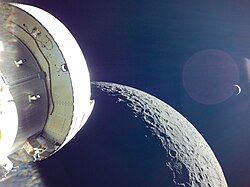
地球の衛星である月を周回する軌道(月周回軌道またはセレノセントリック軌道)は、宇宙探査において極めて重要な役割を果たします。月周回軌道は完全な円形ではなく、多くの場合楕円形を描きます。月から最も遠い地点をアポルン(またはアポシンシオン、アポセレネ)、最も近い地点をペリルン(またはペリシンシオン、ペリセレネ)と呼び、これらの名称は月の女神に由来しています。
宇宙機が地球から月へ向かい、その重力圏に捉えられて周回を開始することを「月周回軌道投入(LOI)」と呼びます。この操作によって、月面観測や着陸に向けた準備が整えられます。
Key Facts
- 低月周回軌道(LLO)は高度100km以下を指し、周期は約2時間である。
- 月内部の質量集中(マスコン)が重力異常を引き起こし、低軌道を不安定にする。
- 特定の傾斜角(27°、50°、76°、86°)では、長期的に安定して周回できる「凍結軌道」が存在する。
- 地球の重力影響を避けるため、高高度では三体問題に基づいた複雑な軌道モデルが必要となる。
- ラグランジュ点を利用したハロー軌道やNRHO(近直線ハロー軌道)が次世代の月探査で活用されている。
低月周回軌道と重力の不均一性
高度100km以下の低月周回軌道(LLO)は、月面詳細観測に最適ですが、維持が非常に困難です。その最大の原因は、月地下に存在するマスコン(Mass Concentrations)と呼ばれる高密度な質量集中領域です。これらは過去に巨大な天体が衝突して形成されたと考えられており、局所的に重力を最大0.5%増加させます。
この重力異常は、宇宙機の軌道を数日で大きく歪ませるため、多くの低軌道は不安定で、最終的に月面に衝突するリスクがあります。1969年のアポロ11号では、この摂動(軌道の乱れ)を予測して軌道を調整しましたが、実際の影響は想定よりも小さかったことが記録されています。
安定した「凍結軌道」の発見
2001年の研究により、特定の軌道傾斜角(27°、50°、76°、86°)を選択すれば、マスコンの影響を最小限に抑えて半永久的に周回できる「凍結軌道」が存在することが判明しました。この発見には、アポロ15号と16号が放出した小型衛星(PFS-1およびPFS-2)のデータが寄与しています。実際に、傾斜角28°付近だったPFS-1は1年半にわたり周回し続けましたが、不安定な11°だったPFS-2はわずか35日で墜落しました。
高高度軌道とラグランジュ点の活用
高度500kmから20,000kmの範囲では、今度は地球の重力が強い摂動要因となります。月のヒル圏(月の重力が支配的な領域)は半径60,000kmまで広がっていますが、実際には690km以上の距離になると地球の干渉により軌道が不安定になります。そのため、高高度の航行には地球・月・宇宙機の三体モデルを用いた計算が不可欠です。
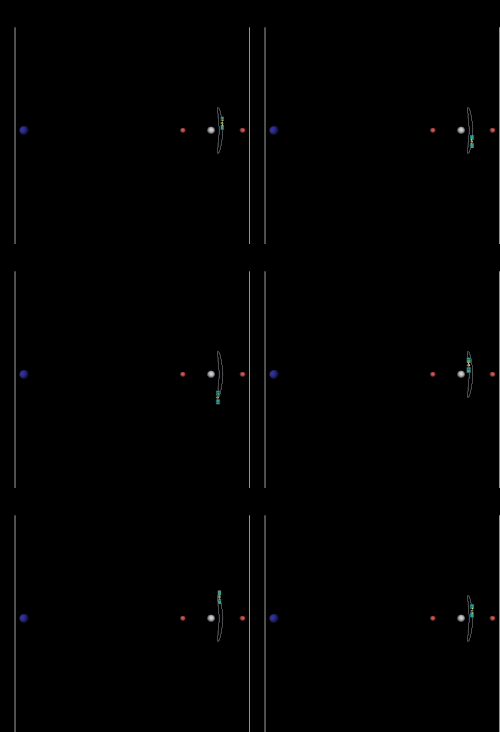
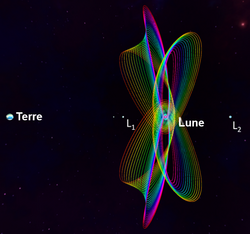
この問題を解決し、安定した位置を確保するために利用されるのがラグランジュ点です。特に地球・月系のL2点付近に形成される「ハロー軌道」は、月の裏側と通信を行う中継衛星に最適です。2019年に打ち上げられた中国の「鵲橋(Queqiao)」は、月面から約65,000kmのL2点付近に配置されました。
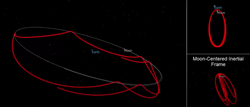
さらに、2022年のCAPSTONEミッション以降、NRHO(近直線ハロー軌道)という特殊な軌道が導入されています。これは将来の月周回有人拠点「ルナ・ゲートウェイ」での運用が計画されている、極めて効率的な軌道です。
月への到達ルートと転移軌道
地球から月周回軌道へ到達する方法は、主に以下の3つのアプローチに分けられます。
| 転移方式 | 所要時間 | 特徴 |
|---|---|---|
| 直接転移 (Direct Transfer) | 3〜4日 | 最短ルートで迅速に到達する。 |
| 低推力転移 (Low Thrust Transfer) | 数ヶ月 | 少ない燃料で緩やかに加速して到達する。 |
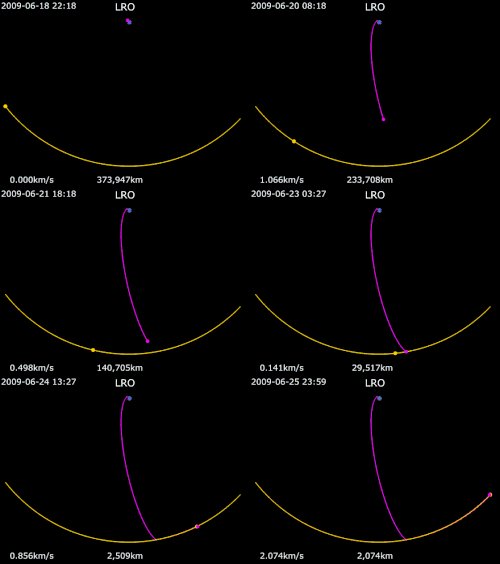
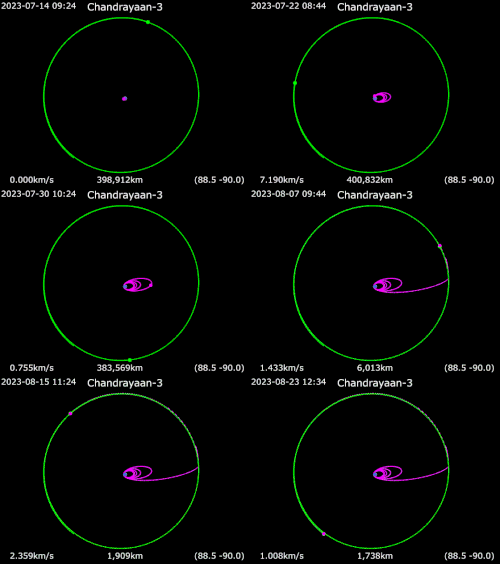
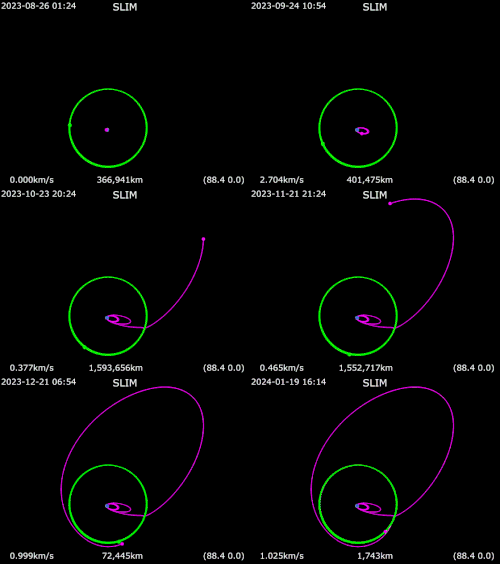
| 低エネルギー転移 (Low-Energy Transfer) | 2.5〜4ヶ月 | 重力のバランスを利用して効率的に移動する。 |
月周回探査の歴史的歩み
人類の月周回への挑戦は、1959年のソ連によるルナ1号から始まりました。ルナ1号は月を通過したのみでしたが、ルナ3号は「自由帰還軌道」を用いて月の裏側を撮影することに成功しました。そして1966年、ルナ10号が史上初めて地球以外の天体である月を周回する軌道に乗りました。
米国では1966年にルナ・オービター1号が月周回を開始しました。当初は楕円軌道で飛行し、その後高度約310kmの円軌道に移行して、アポロ計画の着陸候補地選定のための詳細な地図作成を行いました。
![First image of Earth from around another astronomical object (the Moon), and first picture of both Earth and the Moon from space, by Lunar Orbiter 1 (not to be confused with the later Earthrise image). [10][11]](/images/df/ac/dfacffe4c653367e40a5be21eb01c84eb7affa23e1777bac02f7499719b3970b.jpg)
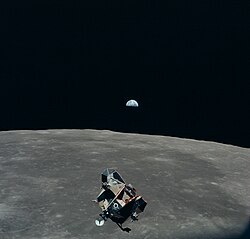
有人探査のアポロ計画では、司令・サービスモジュール(CSM)が月周回軌道で待機し、月着陸船(LM)が降下するという運用が行われました。LMは降下軌道投入(DOI)によってペリルンを約15kmまで下げ、月面の山々に衝突しないよう慎重にアプローチしました。アポロ14号以降は、燃料節約のためCSMの燃料を用いてDOIを行う運用に変更されました。
太陽同期月周回軌道の構想
将来的な構想として、太陽に対する軌道面の向きを一定に保つ「太陽同期月周回軌道」が提案されています。地球の太陽同期軌道とは異なり、月の重力場は極めて不均一であるため、自然にこの軌道を維持することは不可能です。実現には、地球と太陽からの摂動を打ち消すための能動的な軌道制御が不可欠となります。
Frequently Asked Questions
なぜ低月周回軌道は不安定なのですか?
月内部に「マスコン」と呼ばれる密度の高い質量集中領域が存在するためです。これにより重力が局所的に強まり、宇宙機が引っ張られることで軌道が歪み、最終的に月面に衝突しやすくなります。
「凍結軌道」とは何ですか?
特定の軌道傾斜角(27°、50°、76°、86°)に設定することで、マスコンによる摂動の影響を相殺し、燃料をほとんど消費せずに長期間安定して周回できる特殊な軌道のことです。
NRHO(近直線ハロー軌道)のメリットは何ですか?
ラグランジュ点を利用したこの軌道は、地球との通信を維持しやすく、かつ月面へのアクセス効率が良いため、ルナ・ゲートウェイのような長期的な拠点運用に適しています。
月へ行くのに最も早い方法はどれですか?
「直接転移」と呼ばれる方式で、約3〜4日で到達可能です。一方で、燃料効率を重視する場合は数ヶ月かけて移動する低エネルギー転移などが採用されます。
アポロ計画ではどのように着陸準備をしたのですか?
まず月周回軌道に入り、その後「降下軌道投入(DOI)」という減速操作を行って、月面に近い高度(約15km)までペリルンを下げることで、安全に着陸するためのアプローチを開始しました。
References
- Woods, W.D. (2008). "Entering lunar orbit: the LOI manoeuvre". How Apollo Flew to the Moon. Space Exploration. Springer Praxis Books. pp. 189–210. :10.1007/978-0-387-74066-9_8. .
-
Bell, Trudy E. (2006-11-06). "Bizarre Lunar Orbits". Science@NASA. . Archived from the original on 2006-11-10. Retrieved 2012-12-09.
Lunar mascons make most low lunar orbits unstable ... As a satellite passes 50 or 60 miles overhead, the mascons pull it forward, back, left, right, or down, the exact direction and magnitude of the tugging depends on the satellite's trajectory. Absent any periodic boosts from onboard rockets to correct the orbit, most satellites released into low lunar orbits (under about 60 miles or 100 km) will eventually crash into the Moon. ... [There are] a number of 'frozen orbits' where a spacecraft can stay in a low lunar orbit indefinitely. They occur at four inclinations: 27°, 50°, 76°, and 86° — the last one being nearly over the lunar poles. The orbit of the relatively long-lived subsatellite had an inclination of 28°, which turned out to be close to the inclination of one of the frozen orbits—but poor PFS-2 was cursed with an inclination of only 11°.
- Konopliv, A. S.; Asmar, S. W.; Carranza, E.; Sjogren, W. L.; Yuan, D. N. (2001-03-01). "Recent Gravity Models as a Result of the Lunar Prospector Mission". Icarus. 150 (1): 1–18. :2001Icar..150....1K. :10.1006/icar.2000.6573. 0019-1035.
- "Apollo 11 Mission Report" (PDF). . pp. 4–3 to 4–4. Archived from the original (PDF) on 4 May 2025.
- Ely, Todd (July 2005). "Stable Constellations of Frozen Elliptical Inclined Lunar Orbits". The Journal of the Astronautical Sciences. 53 (3): 301–316. :2005JAnSc..53..301E. :10.1007/BF03546355.
- Follows, Mike (4 October 2017). "Ever Decreasing Circles". . Retrieved 23 July 2023.
The moon's Hill sphere has a radius of 60,000 kilometres, about one-sixth of the distance between it and Earth.
For mean distance and mass data for the bodies (for verification of the foregoing citation), see Williams, David R. (20 December 2021). "Moon Fact Sheet". . Greenbelt, MD: NASA Goddard Space Flight Center. Retrieved 23 July 2023. - "A New Paradigm for Lunar Orbits". Phys.org. 2006-12-01. Retrieved 2023-11-05.
- "NSSDCA - Queqiao". nasa.gov. Retrieved May 10, 2025.
- The Aerospace Corporation (2023-07-20). "It's International Moon Day! Let's talk about Cislunar Space". Medium. Retrieved 2023-11-07.
- Stein, Ben P. (August 23, 2011). "45 Years Ago: How the 1st Photo of Earth From the Moon Happened". Space.com. Retrieved October 7, 2020.
📸 フォトギャラリー