タグ

原子核

6 件の記事

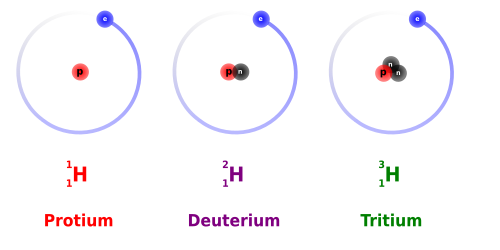
The three most stable isotopes of hydrogen: protium (A = 1), deuterium (A = 2), and tritium (A = 3)

水素の同位体プロチウム・重水素・トリチウムの特性と科学的役割

水素同位体プロチウム重水素
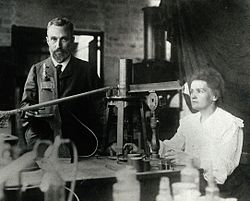
Pierre and Marie Curie in their Paris laboratory, before 1907

核物理学と放射性崩壊のメカニズム原子核の安定性と変容

核物理学放射性崩壊半減期アルファ崩壊
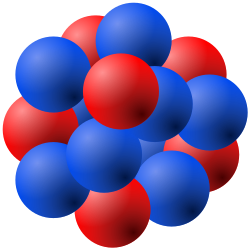
A model of an atomic nucleus showing it as a compact bundle of protons (red) and neutrons (blue), the two types of nucleons. In this diagram, protons and neutrons look like little balls stuck together, but an actual nucleus (as understood by modern nuclear physics) cannot be explained like this, but only by using quantum mechanics. In a nucleus that occupies a certain energy level (for example, the ground state), each nucleon can be said to occupy a range of locations.

原子核の構造と物理学物質の中心にある極小の世界

原子核核物理学陽子中性子
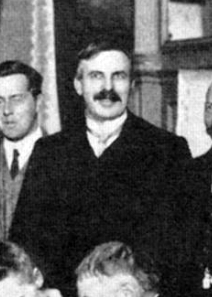
Ernest Rutherford at the first Solvay Conference, 1911

陽子(プロトン)の正体原子核を構成する基本粒子とその物理学的特性

陽子プロトンクォーク原子核
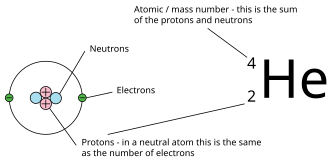
This is a diagram that explains AZE notation. On the left is a model of an atom, with a nucleus in the middle consisting of two circular protons marked with a "+" symbol tightly placed next to two blue neutrons. A ring surrounds the nucleus, containing two circular electrons that are smaller than the neutrons and the electrons. A description for protons says in a neutral atom they are the same as the number of electrons. On the right is the AZE notation of Helium, with the chemical symbol He with a superscript and subscript to the left of the symbol. The superscript, 4, is the atomic / mass number, the sum of the protons and neutrons. The subscript, 2, is the number of protons.

原子番号の基礎知識元素を定義する正体とその歴史

原子番号陽子数周期表ヘンリー・モーゼリー
The original building of the Cavendish Laboratory was the home of some of the great discoveries in physics. It was founded in 1874 by the Duke of Devonshire (whose family name was Cavendish), and its first professor was James Clerk Maxwell. The Laboratory has since moved to West Cambridge.[24]

ジェームズ・チャドウィック中性子の発見と核物理学への貢献

ジェームズ・チャドウィック中性子ノーベル物理学賞アーネスト・ラザフォード