物質の最小単位である原子の中心には、陽子と中性子からなる原子核が存在します。この極小の世界では、強力な核力によって粒子が結びついていますが、すべての原子核が安定しているわけではありません。不安定な核がエネルギーを放出し、より安定した状態へと変化する現象を「放射性崩壊」と呼びます。このプロセスは、宇宙の成り立ちから現代の医療技術まで、広範な科学的基盤となっています。
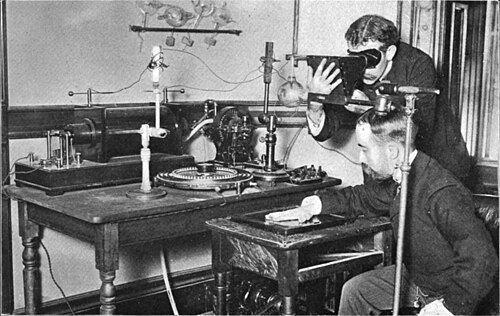
初期の放射能研究は、ピエール・キュリーとマリー・キュリーら先駆者によって切り拓かれました。彼らの献身的な研究により、特定の元素が自発的に放射線を放出することが明らかになりました。

Key Facts
- 放射線の種類: 透過力の低い順にアルファ線、ベータ線、ガンマ線に分類される。
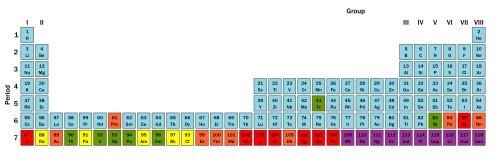
- 核の安定性: 原子番号82の鉛までが安定な同位体を持ち、83のビスマス以降はすべて放射性である。
- 半減期: 放射性物質の量が半分に減少するまでの時間は、核種によって数秒から数百億年まで極めて幅広く存在する。
- 崩壊の要因: 強い相互作用(アルファ崩壊)、弱い相互作用(ベータ崩壊)、電磁相互作用(ガンマ崩壊)が関与している。
放射線の種類と透過特性
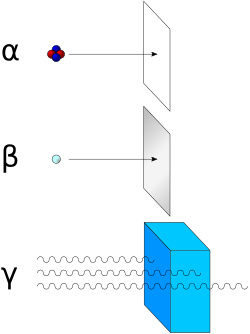
放射性崩壊によって放出される粒子や電磁波は、その性質によって大きく3つのカテゴリーに分けられます。アーネスト・ラザフォードは、電場や磁場を用いた実験により、これらの放射線が物質を透過する能力に明確な差があることを突き止めました。
アルファ崩壊は主に原子番号52(テルル)以上の重い元素で見られ、ヘリウム原子核が放出されます。一方、ベータ崩壊はほぼすべての元素で観察される現象です。また、アルファ崩壊やベータ崩壊の副産物として、励起状態の核から高エネルギーの光であるガンマ線が放出されます。
これらの放射線は、遮蔽材によって止めることができる距離が異なります。アルファ線は紙一枚で遮断でき、ベータ線はアルミニウム板で阻止されますが、ガンマ線を減衰させるには厚い鉛などの高密度な物質が必要です。
原子核の安定性と分類
原子核の安定性は、陽子数(Z)と中性子数(N)の比率、および結合エネルギーによって決まります。安定な核種が分布する領域は「安定の谷」と呼ばれ、ここから外れた核種は崩壊を通じて安定な状態を目指します。
核種は以下のように分類されます:
- 同位体: 陽子数が同じで中性子数が異なる核種。
- 同重核種: 質量数(A = Z + N)が同じ核種。
- 同中性子数核種: 中性子数が同じ核種。
放射性崩壊の多様なモード
不安定な核種は、エネルギー状態に応じて複数の崩壊経路を選択することがあります。例えば、銅-64はベータプラス崩壊と電子捕獲という2つの異なる経路で崩壊します。
崩壊の形態は多岐にわたり、陽子や中性子の放出、さらには核が2つ以上の小さな核に分裂する自発核分裂なども含まれます。これらの遷移プロセスは、中性子数と原子番号の変化として図式化できます。
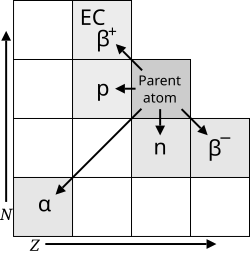
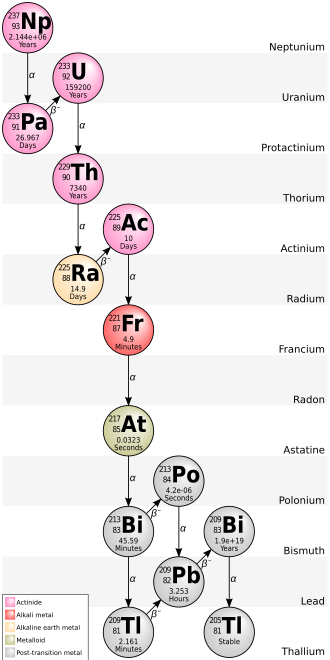
また、一つの核種が崩壊してできた「娘核」がさらに不安定な場合、安定な核に到達するまで連続的に崩壊が起こります。これを崩壊系列と呼びます。
崩壊速度と時間的特性
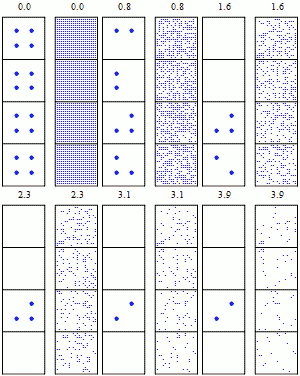
放射性崩壊は確率的な現象であり、個々の原子がいつ崩壊するかを予測することはできません。しかし、大量の原子が集まった集団としては、指数関数的な減少パターンを示します。
この減少速度を特徴づけるのが半減期($t_{1/2}$)です。これは、元の原子数の半分が崩壊するまでに要する時間を指します。また、平均寿命($ au$)という指標もあり、これは自然対数の底 $e$ に基づいた時間定数です。
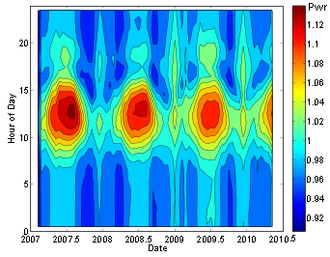
崩壊速度は一般に一定と考えられていますが、特殊な条件下では変化することがあります。例えば、レニウム-187は中性状態では半減期が416億年ですが、完全にイオン化された状態では「束縛状態ベータ崩壊」により、わずか32.9年まで短縮されることが研究で示されています。
また、ガンマ線検出器の応答において、日次や季節的な変動が観察される事例も報告されています。
放射性崩壊のまとめ
放射性崩壊の主要なメカニズムと特性を以下の表にまとめます。
| 崩壊モード | 放出される粒子/波 | 原子番号(Z)の変化 | 質量数(A)の変化 | 主な相互作用 |
|---|---|---|---|---|
| アルファ崩壊 ($\alpha$) | ヘリウム核 | -2 | -4 | 強い相互作用 |
| ベータ崩壊 ($\beta^-$) | 電子・反ニュートリノ | +1 | 不変 | 弱い相互作用 |
| 陽電子放出 ($\beta^+$) | 陽電子・ニュートリノ | -1 | 不変 | 弱い相互作用 |
| 電子捕獲 ($\epsilon$) | ニュートリノ | -1 | 不変 | 弱い相互作用 |
| ガンマ崩壊 ($\gamma$) | 高エネルギー光子 | 不変 | 不変 | 電磁相互作用 |
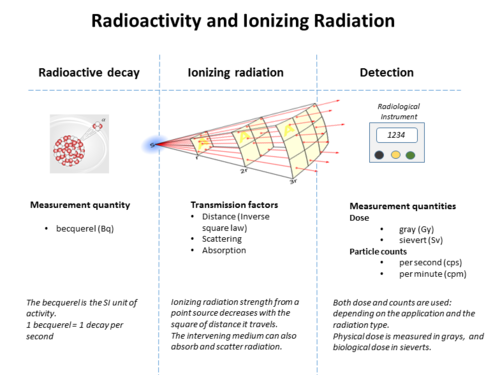
放射能と検出される電離放射線の関係は、エネルギー量と粒子の種類によって決定されます。
Frequently Asked Questions
半減期が長い物質は安全なのですか?
半減期が長いということは、単位時間あたりに放出される放射線の量(放射能)が少ないことを意味します。しかし、安全かどうかは物質の化学的性質や、放出される放射線の種類、および曝露量に依存するため、一概に「安全」とは言えません。
なぜ原子核は崩壊するのですか?
原子核内の陽子同士の電気的な反発力と、陽子・中性子を結びつける核力のバランスが不安定なためです。よりエネルギー的に安定な状態(結合エネルギーが高い状態)に移行しようとする自然なプロセスです。
ベータ崩壊と陽電子放出の違いは何ですか?
ベータマイナス崩壊では中性子が陽子に変わり電子を放出しますが、陽電子放出(ベータプラス崩壊)では陽子が中性子に変わり陽電子を放出します。どちらも核の安定性を高めるための経路ですが、中性子数と陽子数の比率によってどちらが起こるかが決まります。
放射線遮蔽に鉛が使われるのはなぜですか?
ガンマ線のような透過力の強い放射線を止めるには、電子密度が高く、原子番号が大きい(質量が重い)物質が有効だからです。鉛は密度が高く、効率的にガンマ線を吸収・散乱させることができます。
バトマン方程式とは何ですか?
連続的に崩壊が起こる崩壊系列において、各段階の核種の個数が時間とともにどのように変化するかを計算するための一般解となる方程式です。
References
- "Radioactivity: Weak Forces". Radioactivity. EDP Sciences. Archived from the original on 12 August 2021. Retrieved 4 March 2020.
- Stabin, Michael G. (2007). "3". In Stabin, Michael G. (ed.). Radiation Protection and Dosimetry: An Introduction to Health Physics. . :10.1007/978-0-387-49983-3. .
- Best, Lara; Rodrigues, George; Velker, Vikram (2013). "1.3". Radiation Oncology Primer and Review. . .
- Loveland, W.; Morrissey, D.; (2006). Modern Nuclear Chemistry. Wiley-Interscience. p. 57. :2005mnc..book.....L. .
- Radvanyi, Pierre; Villain, Jacques (November 2017). "The discovery of radioactivity". Comptes Rendus. Physique. 18 (9–10): 544–550. :2017CRPhy..18..544R. :10.1016/j.crhy.2017.10.008.
- Mould, Richard F. (1995). A century of X-rays and radioactivity in medicine : with emphasis on photographic records of the early years (Reprint. with minor corr ed.). Bristol: Inst. of Physics Publ. p. 12. .
- Henri Becquerel (1896). "Sur les radiations émises par phosphorescence". Comptes Rendus. 122: 420–421.
- Comptes Rendus 122: 420 (1896), translated by Carmen Giunta. Retrieved 12 April 2021.
- Henri Becquerel (1896). "Sur les radiations invisibles émises par les corps phosphorescents". Comptes Rendus. 122: 501–503.
- Comptes Rendus 122: 501–503 (1896), translated by Carmen Giunta. Retrieved 12 April 2021.
📸 フォトギャラリー