Rain water flux from a canopy. Among the forces that govern drop formation: surface tension by cohesion, Van der Waals force, Plateau–Rayleigh instability.
← ホームへ戻る

表面張力の科学液体の表面で起こる物理現象のメカニズム

🗓 2026年8月11日

水滴が丸くまとまったり、小さな虫が水面に浮かんだりする現象の背後には、表面張力という物理的な力が働いています。これは液体特有の性質であり、液体の表面をできるだけ小さくしようとする力のことです。私たちの日常生活から高度な工業プロセスまで、あらゆる場面でこの現象が重要な役割を果たしています。

Key Facts

  • 表面張力は、液体の表面積を広げるために必要な力、または単位面積あたりのエネルギーとして定義される。
  • SI単位系では N/m(ニュートン毎メートル)または J/m²(ジュール毎平方メートル)で表される。
  • 液体内部の分子は全方向から引き合っているが、表面の分子は内側からのみ引かれるため、表面を縮めようとする力が生じる。
  • 温度が上昇すると、一般的に液体の表面張力は低下する。
  • 界面活性剤を加えることで、表面張力を意図的に下げることが可能である。

表面張力の根本的な仕組み

液体の中にある分子は、周囲を他の分子に囲まれており、あらゆる方向から均等に引き合う力(凝集力)を受けています。しかし、液体の最表面に位置する分子は、上方に隣接する分子が存在しないため、内側に向かう正味の力を受けます。この不均衡な力が、表面を最小限に抑えようとする張力として現れます。
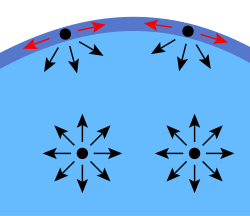
Diagram of the cohesive forces on molecules of a liquid

この現象はエネルギーの観点からも説明できます。表面積を増やすには外部から仕事(エネルギー)を加える必要があり、このエネルギーは表面に蓄えられます。そのため、外部からの拘束がない自由な状態の液滴は、同じ体積で最も表面積が小さくなる球形になろうとします。

Molecules on the surface of a tiny droplet (left) have, on average, fewer neighbors than those on a flat surface (right). Hence they are bound more weakly to the droplet than are flat-surface molecules.

表面張力の強さは、液体を引っ張る力と、それによって増加する表面積の比率で測定されます。物理学的には、表面張力 $\gamma$ は、加えられた仕事 $W$ を増加した面積 $\Delta A$ で割った値として定義されます。
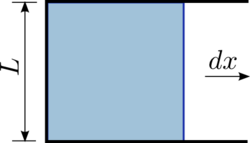
This diagram illustrates the force necessary to increase the surface area. This force is proportional to the surface tension.

日常生活に見られる表面張力の例

表面張力は、私たちの身の回りで多くの具体的な現象として観察できます。例えば、葉の上に水滴が球状に溜まる現象や、蛇口から落ちる水滴の形状などは、表面張力が液体の形状を維持しようとする結果です。
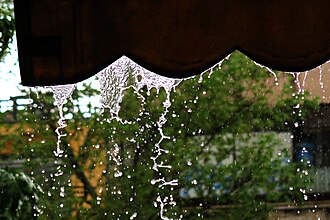
Rain water flux from a canopy. Among the forces that govern drop formation: surface tension by cohesion, Van der Waals force, Plateau–Rayleigh instability.

また、アメンボなどの昆虫が水面に沈まずに歩けるのは、水面の表面張力が彼らの体重を支える十分な抗力を生み出しているためです。同様に、針を慎重に水面に置くと、表面張力によって浮くことがあります。
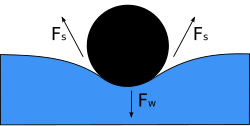
Cross-section of a needle floating on the surface of water. Fw is the weight and Fs are surface tension resultant forces.

さらに、表面張力は液体の浸透を防ぐ役割も果たします。例えば、特定の布地(ダマスク織など)の上に水滴を置いた際、表面張力が十分に高ければ、液体が繊維の隙間に染み込むのを一時的に防ぐことができます。
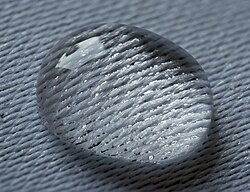
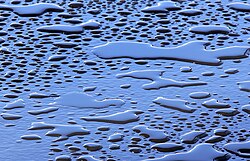
Water droplet lying on a damask. Surface tension is high enough to prevent seeping through the textile

界面の曲率と圧力の関係

液体の表面が湾曲している場合、その内部と外部の間には圧力差が生じます。これはヤング・ラプラス方程式によって記述され、曲率が大きくなる(半径が小さくなる)ほど、内部の圧力は高くなります。
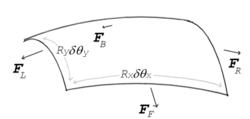
Surface tension forces acting on a tiny (differential) patch of surface. δθx and δθy indicate the amount of bend over the dimensions of the patch. Balancing the tension forces with pressure leads to the Young–Laplace equation

この原理により、非常に小さな液滴ほど内部圧力が高くなる傾向があります。また、表面張力によって表面積を最小化しようとする性質は、数学的な「最小曲面」の概念とも深く結びついています。
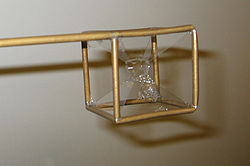
Minimal surface

接触角と濡れ性のメカニズム

液体が固体表面に触れたとき、液体・固体・気体の3つの界面の間で力のバランスが生じます。このバランスによって決まる角度を接触角と呼びます。接触角が小さいほど液体は表面に広がりやすく(濡れ性が高い)、大きいほど弾いて丸くなります。
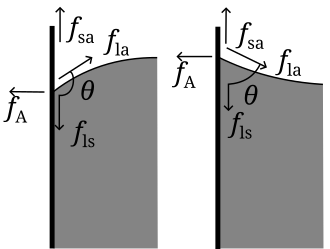
Forces at contact point shown for contact angle greater than 90° (left) and less than 90° (right)

例えば、水とガラスのように親和性が高い組み合わせでは接触角が小さくなりますが、水とテフロンやパラフィンワックスのような撥水性の高い素材では、接触角が大きくなります。極端な例として、接触角が180°に近づくと、液体は表面にほとんど付着せず、完全な球に近い形状を維持します。

Illustration of how lower contact angle leads to reduction of puddle depth

この接触角の性質は、細い管の中で液体が上昇または下降する毛細管現象の原動力となります。接触角が90°未満の液体は管を上昇し、90°を超える液体(水銀など)は管の中で下降します。
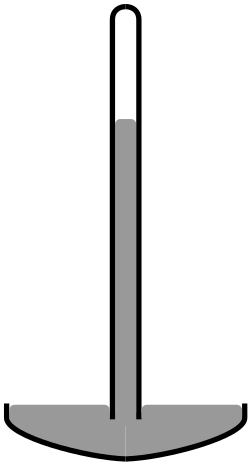
Diagram of a mercury barometer
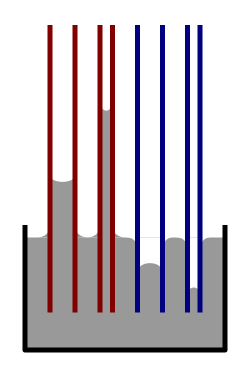
Illustration of capillary rise and fall. Red=contact angle less than 90°; blue=contact angle greater than 90°

また、平坦な面に広がった液体の厚み(水たまりの厚さ)も、表面張力と重力のバランス、および接触角によって決定されます。接触角が180°に近いほど、水たまりは厚みを持ちやすくなります。

Profile curve of the edge of a puddle where the contact angle is 180°. The curve is given by the formula:[11] x − x 0 = 1 2 H cosh − 1 ⁡ ( H h ) − H 1 − h 2 H 2 {\displaystyle x-x_{0}={\frac {1}{2}}H\cosh ^{-1}\left({\frac {H}{h}}\right)-H{\sqrt {1-{\frac {h^{2}}{H^{2}}}}}} where H = 2 γ / g ρ {\textstyle H=2{\sqrt {{\gamma }/{g\rho }}}}
Small puddles of water on a smooth clean surface have perceptible thickness.

表面張力に影響を与える要因

表面張力は一定ではなく、温度や溶質の濃度によって変化します。

温度の影響

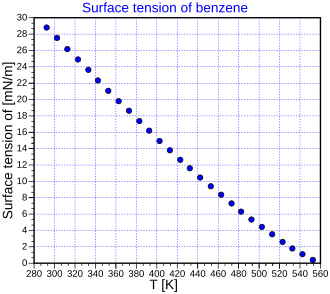
一般的に、温度が上がると分子の熱運動が激しくなり、分子間の凝集力が弱まるため、表面張力は低下します。水やベンゼンなどの多くの液体でこの傾向が見られます。
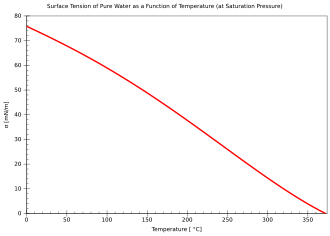
Temperature dependence of the surface tension between the liquid and vapor phases of pure water
Temperature dependency of the surface tension of benzene

溶質と界面活性剤の影響

液体に何を溶かすかによって、表面張力は増減します。無機塩類を溶かすと表面張力が上昇することが多い一方、アルコールなどの界面活性剤(サーファクタント)を加えると、表面張力は劇的に低下します。界面活性剤は液体の表面に集まり、水分子同士の結びつきを弱めるため、汚れを落としやすくする洗浄剤などに利用されています。

液流の分裂と微粒化

液体が細い流れとなって放出されるとき、表面張力の影響で不安定性が生じ、最終的に小さな液滴へと分裂します。これはプラトー・レイリー不安定性と呼ばれる現象で、表面積を最小化しようとする力が、細長い液柱を球状の滴に分断させるためです。
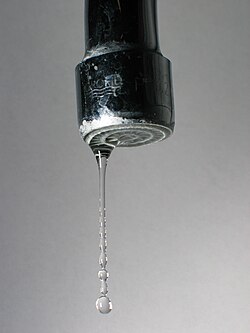
Breakup of an elongated stream of water into droplets due to surface tension.

また、物理的な界面は実際にはわずかな厚みを持つ移行領域ですが、数学的な解析においては、ギブスが定義したように「精密な数学的表面」として扱うことが一般的です。
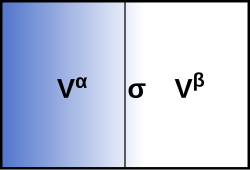
Gibbs' placement of a precise mathematical surface in a fuzzy physical interface.

主要液体の表面張力データ

以下に、代表的な液体の表面張力の値をまとめます。

代表的な液体の表面張力(20〜25°C付近)
液体名 温度 (°C) 表面張力 $\gamma$ (mN/m または dyn/cm)
25 71.97
水銀 20 486.5
エタノール 20 22.27
ベンゼン 20 28.88
グリセロール 20 63.00
液体ヘリウム II -273 0.37

Frequently Asked Questions

なぜ水滴は丸くなるのですか?

表面張力によって、液体は表面積を最小限にしようとするためです。幾何学的に、一定の体積を持つ形状の中で最も表面積が小さいのは球体であるため、水滴は自然と丸い形になります。

界面活性剤を使うと表面張力はどうなりますか?

界面活性剤を加えると、液体の表面張力は低下します。これにより、液体が固体表面に広がりやすくなり(濡れ性の向上)、汚れへの浸透力が高まるため、洗剤などの洗浄効果が得られます。

温度が上がると表面張力は変わりますか?

はい、一般的に温度が上昇すると表面張力は低下します。これは熱エネルギーによって分子間の相互作用(凝集力)が弱まるためです。

毛細管現象とは何ですか?

表面張力と、液体と管壁との間の付着力のバランスによって、液体が細い管の中を自然に上昇または下降する現象です。水のように接触角が小さい液体は上昇し、水銀のように接触角が大きい液体は下降します。

表面張力の単位は何ですか?

SI単位系では N/m(ニュートン毎メートル)が用いられます。また、エネルギーの観点から J/m²(ジュール毎平方メートル)と表記されることもあります。古い文献では cgs単位系の dyn/cm(ダイン毎センチメートル)がよく使われていました。

References

  1. In a , the upper liquid surface is an interface between the liquid and a vacuum containing some molecules of evaporated liquid.

📸 フォトギャラリー

Rain water flux from a canopy. Among the forces that govern drop formation: surface tension by cohesion, Van der Waals force, Plateau–Rayleigh instability.
Diagram of the cohesive forces on molecules of a liquid
Water droplet lying on a damask. Surface tension is high enough to prevent seeping through the textile
This diagram illustrates the force necessary to increase the surface area. This force is proportional to the surface tension.
Surface tension forces acting on a tiny (differential) patch of surface. δθx and δθy indicate the amount of bend over the dimensions of the patch. Balancing the tension forces with pressure leads to the Young–Laplace equation
Cross-section of a needle floating on the surface of water. Fw is the weight and Fs are surface tension resultant forces.
Minimal surface
Forces at contact point shown for contact angle greater than 90° (left) and less than 90° (right)
Diagram of a mercury barometer
Illustration of capillary rise and fall. Red=contact angle less than 90°; blue=contact angle greater than 90°
Profile curve of the edge of a puddle where the contact angle is 180°. The curve is given by the formula:[11] x − x 0 = 1 2 H cosh − 1 ⁡ ( H h ) − H 1 − h 2 H 2 {\displaystyle x-x_{0}={\frac {1}{2}}H\cosh ^{-1}\left({\frac {H}{h}}\right)-H{\sqrt {1-{\frac {h^{2}}{H^{2}}}}}} where H = 2 γ / g ρ {\textstyle H=2{\sqrt {{\gamma }/{g\rho }}}}
Small puddles of water on a smooth clean surface have perceptible thickness.
Illustration of how lower contact angle leads to reduction of puddle depth
Breakup of an elongated stream of water into droplets due to surface tension.
Gibbs' placement of a precise mathematical surface in a fuzzy physical interface.
Temperature dependence of the surface tension between the liquid and vapor phases of pure water
Temperature dependency of the surface tension of benzene
Molecules on the surface of a tiny droplet (left) have, on average, fewer neighbors than those on a flat surface (right). Hence they are bound more weakly to the droplet than are flat-surface molecules.