水が狭い隙間を伝って、重力に逆らって自然に上昇していく様子を見たことはないでしょうか。この不思議な現象は毛細管現象(もうさいかんげんしょう)と呼ばれます。私たちの日常生活から生物の生存戦略、さらには高度な工業製品に至るまで、この物理現象は至る所で重要な役割を果たしています。
毛細管現象とは、外部から力を加えることなく、液体が非常に狭い空間を移動するプロセスを指します。この現象の根源にあるのは、液体分子同士が引き合う「凝集力」と、液体分子が容器の壁面などの固体表面に引き寄せられる「付着力」という2つの分子間力の相互作用です。
例えば、水のような極性を持つ液体がガラスのような親水性の表面に触れると、付着力が凝集力を上回り、液体は壁面に沿って広がろうとします。このとき、液体の表面張力によって液面が引き上げられ、結果として狭い管の中を液体が上昇することになります。
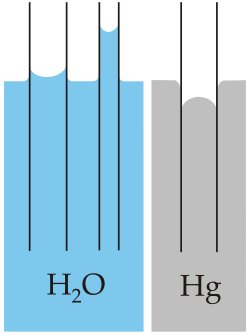
Key Facts
- 基本原理:液体内部の凝集力と、固体壁面への付着力のバランスによって発生する。
- 管の太さの影響:管の直径が細ければ細いほど、液体はより高く上昇する。
- 液体の種類:水のように壁面に濡れる液体は上昇するが、水銀のように反発する液体は逆に下降する。
- 生物への応用:植物の水分輸送や、一部の動物の水分摂取に不可欠な仕組みである。
- 多孔質材料:スポンジやレンガなどの微細な穴を持つ物質は、毛細管現象によって液体を吸収する。
毛細管現象の物理的メカニズム
メニスカスと表面張力
液体が狭い管に入ると、液面は平らではなく湾曲します。この湾曲した液面をメニスカスと呼びます。水の場合、ガラス壁面への強い付着力によって液面が凹状になり、表面張力がこの曲面を平らにしようと引き上げるため、液体が上昇します。
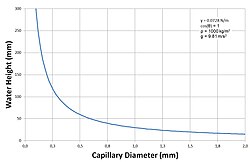
上昇高度を決定する「ジュリンの法則」
液体がどれくらいの高さまで上昇するかは、数学的に定義されています。これを「ジュリンの法則」と呼び、液体の表面張力、接触角、密度、および管の半径によって決まります。重要なのは、上昇高度(h)が管の半径(r)に反比例することです。つまり、管が細くなればなるほど、液体は驚くほど高く上昇します。
自然界と日常生活における具体例
生物の生存戦略
植物は、根から吸収した水を高い枝先まで届けるために毛細管現象を利用しています。蒸散による圧力低下や浸透圧と組み合わさることで、巨大な樹木でも水分を輸送することが可能です。
また、動物の中にもこの力を利用する種がいます。例えば、トゲトゲの皮膚を持つトカゲ(Moloch horridus)は、皮膚の微細な溝を伝って環境中の水分を口まで運ぶという驚異的な仕組みを備えています。
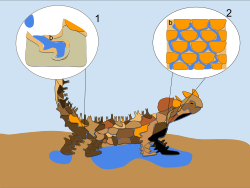
身近な道具と現象
私たちの周りには、意図的にこの現象を利用したものが多くあります。ペーパータオルやスポンジが液体を素早く吸い上げるのは、素材内部に無数の微細な隙間(毛細管)が存在するためです。また、万年筆のペン先へインクが供給される仕組みや、化学分析で用いられる薄層クロマトグラフィー(TLC)でも、この原理が活用されています。
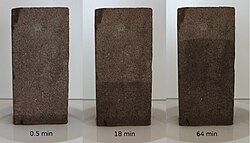
建築物への影響:上昇浸透
毛細管現象は時に問題を引き起こします。コンクリートやレンガなどの多孔質材料は、地面の水分を吸い上げやすく、これが壁面を伝って上昇する「上昇浸透(Rising Damp)」という現象を招き、建物の劣化やカビの原因となります。
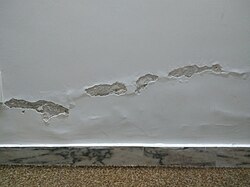
多孔質材料における液体の吸収
乾燥した多孔質材料に液体が触れると、最初は急速に吸収されますが、時間の経過とともにその速度は低下します。この吸収量は、材料の透過性や温度、湿度などの要因に左右されます。
| 材料 | 吸水性指標 (mm·min1/2) |
|---|---|
| 石膏プラスター | 3.50 |
| 粘土レンガ | 1.16 |
| モルタル | 0.70 |
| 気泡コンクリート | 0.50 |
| コンクリートレンガ | 0.20 |
このように、材料によって毛細管の構造が異なるため、水分の吸い上げやすさには大きな差が出ます。
科学的探究の歴史と展開
毛細管現象の観察は古く、レオナルド・ダ・ヴィンチの記録にも見られます。その後、ロバート・ボイルらが実験を通じて、この現象が真空状態の影響を受けない独自のメカニズムであることを突き止めました。
19世紀に入ると、トーマス・ヤングとピエール=シモン・ラプラスによって定量的な理論(ヤング・ラプラス方程式)が確立され、物理学としての基盤が整いました。さらに、アルベルト・アインシュタインもキャリアの初期に毛細管現象に関する論文を執筆しており、多くの偉大な科学者がこのシンプルながら奥深い現象に挑んできました。
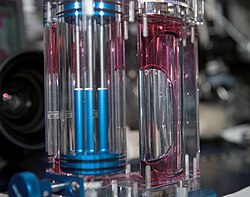
現代では、国際宇宙ステーション(ISS)のような微小重力環境下で、重力の影響を排除した毛細管流の研究が行われており、宇宙空間での液体制御技術への応用が期待されています。
Frequently Asked Questions
なぜ管が細いほど液体は高く上がるのですか?
管が細くなると、液体全体の重量(重力)に対して、壁面から引き上げる力(付着力と表面張力)の比率が高まるためです。これにより、より高い位置まで液体を押し上げることが可能になります。
水以外の液体でも毛細管現象は起きますか?
はい、起きます。ただし、液体と壁面の相性によって結果が変わります。水のように壁面に濡れる液体は上昇しますが、水銀のように壁面を弾く液体の場合、液面は凸状になり、逆に液面が押し下げられる現象が起こります。
植物が数百メートルの高さまで水を上げられるのは毛細管現象だけが理由ですか?
いいえ、毛細管現象だけでは不十分です。葉からの蒸散による強力な吸引力(負圧)や、根での浸透圧、そして水分子同士が連なって引っ張り合う凝集力が組み合わさることで、高所まで水を運んでいます。
毛細管現象を止める方法はありますか?
壁面の性質を変えることが有効です。例えば、撥水剤などのコーティングを施して付着力を弱めることで、液体が浸透するのを防ぐことができます。これは建築物の防水処理(防湿層の設置)などで応用されています。
宇宙空間(無重力)でも毛細管現象は起こりますか?
はい、起こります。毛細管現象は重力ではなく分子間力によって引き起こされるため、無重力環境でも機能します。むしろ重力の妨げがないため、液体輸送の制御において非常に重要な役割を果たします。
References
- See:
- Manuscripts of Léonardo de Vinci (Paris), vol. N, folios 11, 67, and 74.
- Guillaume Libri, Histoire des sciences mathématiques en Italie, depuis la Renaissance des lettres jusqu'a la fin du dix-septième siecle [History of the mathematical sciences in Italy, from the Renaissance until the end of the seventeenth century] (Paris, France: Jules Renouard et cie., 1840), vol. 3, page 54 Archived 2016-12-24 at the . From page 54: "Enfin, deux observations capitales, celle de l'action capillaire (7) et celle de la diffraction (8), dont jusqu'à présent on avait méconnu le véritable auteur, sont dues également à ce brillant génie." (Finally, two major observations, that of capillary action (7) and that of diffraction (8), the true author of which until now had not been recognized, are also due to this brilliant genius.)
- C. Wolf (1857) "Vom Einfluss der Temperatur auf die Erscheinungen in Haarröhrchen" (On the influence of temperature on phenomena in capillary tubes) Annalen der Physik und Chemie, 101 (177) : 550–576; see footnote on page 551 Archived 2014-06-29 at the by editor Johann C. Poggendorff. From page 551: " ... nach Libri (Hist. des sciences math. en Italie, T. III, p. 54) in den zu Paris aufbewahrten Handschriften des grossen Künstlers Leonardo da Vinci (gestorben 1519) schon Beobachtungen dieser Art vorfinden; ... " ( ... according to Libri (History of the mathematical sciences in Italy, vol. 3, p. 54) observations of this kind [i.e., of capillary action] are already to be found in the manuscripts of the great artist Leonardo da Vinci (died 1519), which are preserved in Paris; ... )
- More detailed histories of research on capillary action can be found in:
- David Brewster, ed., Edinburgh Encyclopaedia (Philadelphia, Pennsylvania: Joseph and Edward Parker, 1832), volume 10, pp. 805–823 Archived 2016-12-24 at the .
- Maxwell, James Clerk; Strutt, John William (1911). "Capillary Action" . In (ed.). . Vol. 5 (11th ed.). Cambridge University Press. pp. 256–275.
- John Uri Lloyd (1902) "References to capillarity to the end of the year 1900," Archived 2014-12-14 at the Bulletin of the Lloyd Library and Museum of Botany, Pharmacy and Materia Medica, 1 (4) : 99–204.
- In his book of 1759, Giovani Batista Clemente Nelli (1725–1793) stated (p. 87) that he had "un libro di problem vari geometrici ec. e di speculazioni, ed esperienze fisiche ec." (a book of various geometric problems and of speculation and physical experiments, etc.) by Aggiunti. On pages 91–92, he quotes from this book: Aggiunti attributed capillary action to "moto occulto" (hidden/secret motion). He proposed that mosquitoes, butterflies, and bees feed via capillary action, and that sap ascends in plants via capillary action. See: Giovambatista Clemente Nelli, Saggio di Storia Letteraria Fiorentina del Secolo XVII ... [Essay on Florence's literary history in the 17th century, ... ] (Lucca, (Italy): Vincenzo Giuntini, 1759), pp. 91–92. Archived 2014-07-27 at the
- Robert Boyle, New Experiments Physico-Mechanical touching the Spring of the Air, ... (Oxford, England: H. Hall, 1660), pp. 265–270. Available on-line at: Echo (Max Planck Institute for the History of Science; Berlin, Germany) Archived 2014-03-05 at the .
- See, for example:
- Robert Hooke (1661) An attempt for the explication of the Phenomena observable in an experiment published by the Right Hon. Robert Boyle, in the 35th experiment of his Epistolical Discourse touching the Air, in confirmation of a former conjecture made by R. Hooke. [pamphlet].
- Hooke's An attempt for the explication ... was reprinted (with some changes) in: Robert Hooke, Micrographia ... (London, England: James Allestry, 1667), pp. 12–22, "Observ. IV. Of small Glass Canes." Archived 2016-12-24 at the
- Geminiano Montanari, Pensieri fisico-matematici sopra alcune esperienze fatte in Bologna ... Archived 2016-12-29 at the [Physical-mathematical ideas about some experiments done in Bologna ... ] (Bologna, (Italy): 1667).
- George Sinclair, Ars Nova et Magna Gravitatis et Levitatis Archived 2017-11-03 at the [New and great powers of weight and levity] (Rotterdam, Netherlands: Arnold Leers, Jr., 1669).
- Johannes Christoph Sturm, Collegium Experimentale sive Curiosum [Catalog of experiments, or Curiosity] (Nüremberg (Norimbergæ), (Germany): Wolfgang Moritz Endter & the heirs of Johann Andreas Endter, 1676). See: "Tentamen VIII. Canaliculorum angustiorum recens-notata Phænomena, ... " Archived 2014-06-29 at the (Essay 8. Recently noted phenomena of narrow capillaries, ... ), pp. 44–48.
- See:
- Honorato Fabri, Dialogi physici ... ((Lyon (Lugdunum), France: 1665), pages 157 ff Archived 2016-12-24 at the "Dialogus Quartus. In quo, de libratis suspensisque liquoribus & Mercurio disputatur. (Dialogue four. In which the balance and suspension of liquids and mercury is discussed).
- Honorato Fabri, Dialogi physici ... ((Lyon (Lugdunum), France: Antoine Molin, 1669), pages 267 ff Archived 2017-04-07 at the "Alithophilus, Dialogus quartus, in quo nonnulla discutiuntur à D. Montanario opposita circa elevationem Humoris in canaliculis, etc." (Alithophilus, Fourth dialogue, in which Dr. Montanari's opposition regarding the elevation of liquids in capillaries is utterly refuted).
- Jacob Bernoulli, Dissertatio de Gravitate Ætheris Archived 2017-04-07 at the (Amsterdam, Netherlands: Hendrik Wetsten, 1683).
- Isaac Vossius, De Nili et Aliorum Fluminum Origine [On the sources of the Nile and other rivers] (Hague (Hagæ Comitis), Netherlands: Adrian Vlacq, 1666), pages 3–7 Archived 2017-04-07 at the (chapter 2).
- Borelli, Giovanni Alfonso De motionibus naturalibus a gravitate pendentibus (Lyon, France: 1670), page 385, Cap. 8 Prop. CLXXXV (Chapter 8, Proposition 185.). Available on-line at: Echo (Max Planck Institute for the History of Science; Berlin, Germany) Archived 2016-12-23 at the .
- Carré (1705) "Experiences sur les tuyaux Capillaires" Archived 2017-04-07 at the (Experiments on capillary tubes), Mémoires de l'Académie Royale des Sciences, pp. 241–254.
📸 フォトギャラリー