私たちの日常生活に深く根ざしている氷は、単なる「凍った水」以上の複雑な科学的側面を持っています。水(H2O)が固体へと相転移することで生まれるこの物質は、特有の結晶構造や物理的特性を持ち、地球の気候調節や人類の文化・産業に多大な影響を与えてきました。
氷の正体は、水分子が特定の規則に従って配列した結晶体です。特に一般的な氷(氷Ih)は、二次元の六方格子上に水分子が配置され、それが三次元的に積み重なることで構成されています。
![The three-dimensional crystal structure of H2O ice Ih (c) is composed of bases of H2O ice molecules (b) located on lattice points within the two-dimensional hexagonal space lattice (a).[4][5]](/images/5d/1f/5d1f27cb31f794872f7bf2bda947d8fe74b1293788c98259562f897bcd2281b2.png)
Key Facts
- 密度: 約0.9167–0.9168 g/cm3であり、液体である水よりも密度が低いために水に浮きます。
- 結晶構造: 一般的な氷は六方晶系に属し、これが雪の結晶などの美しい幾何学模様を生み出します。
- 多様な相: 温度と圧力の条件によって、多くの異なる結晶相(氷Iから氷XIXなど)が存在します。
- 環境への影響: 地球上の氷の減少は海面上昇に直結し、アルベド(反射率)の変化を通じて温暖化を加速させます。
氷の物理的・化学的特性
氷は化学式H2Oで表される単純な物質ですが、その物理的特性は非常に多様です。屈折率は1.309であり、光の透過や反射に影響を与えます。また、機械的な強度においては、圧縮強度(24〜60 kg-force/cm2)が引張強度(5〜18 kg-force/cm2)を大きく上回るという特徴があります。
熱的な性質に注目すると、氷の熱伝導率は温度に依存して変化し、比熱容量も温度によって変動します。これらの特性が、氷を天然の冷却材として利用することを可能にしています。
| 特性項目 | 数値・詳細 |
|---|---|
| 密度 (ρ) | 0.9167–0.9168 g/cm3 |
| 屈折率 (n) | 1.309 |
| ヤング率 (E) | 3,400 ~ 37,500 kg-force/cm2 |
| 誘電率 (εr) | 約 95 |
相転移と圧力の影響
水は温度だけでなく、圧力によってもその状態が変化します。標準的な気圧下では0℃で凍結しますが、極端な高圧下では異なる構造を持つ「氷の相」が現れます。これにより、惑星内部のような超高圧環境では、地球上の氷とは全く異なる性質の氷が存在すると考えられています。
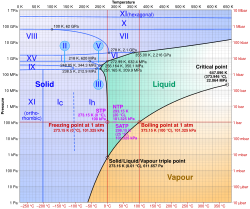
![An alternative formulation of the phase diagram for certain ices and other phases of water[15]](/images/ca/ee/caeed554c7d76353680b869b2379e0cb14a01548a38ab34444098a0eee15e363.jpg)
自然界における氷の形態
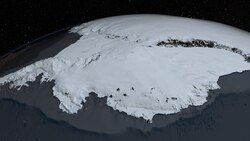
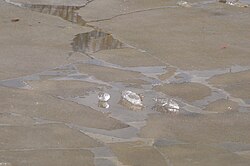
氷は環境に応じてさまざまな形態で現れます。海洋では、微細な氷の結晶が集まったグリースアイスや、波の作用で丸まった「氷の卵」などが形成されます。また、南極や北極に見られる巨大な氷床や氷山は、地球の淡水資源の大部分を蓄えています。
![Frozen landscape in the Northwest Territories of Canada. A large ice circle can be clearly seen floating on water.[40][41]](/images/47/58/475862376556d26998db9abbe59e8d5d1aba0dd5660fa5db6f433a6caf23f105.jpg)
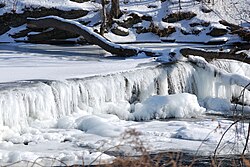
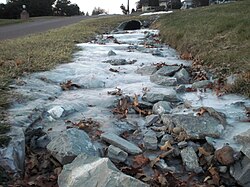
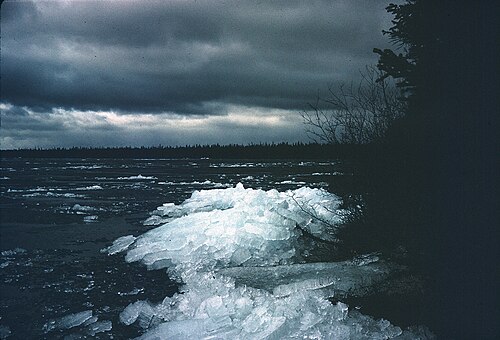
陸上や河川においても、氷は多様な姿を見せます。凍結した滝や、川の流れによって形成される氷の塊などがその例です。
降水としての氷
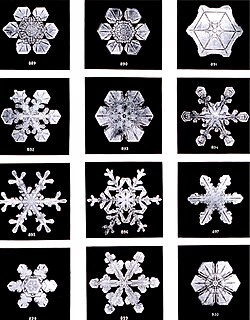
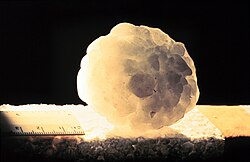
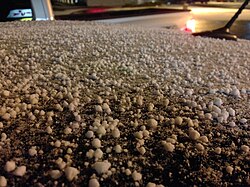
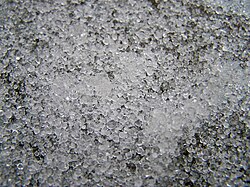
空から降る氷の形態には、結晶が美しく組み合わさった雪や、強い上昇気流によって層状に成長した雹(ひょう)があります。また、過冷却された雨粒が地表に触れた瞬間に凍る着氷や、小さな氷の粒である霰(あられ)なども存在します。
表面に形成される氷
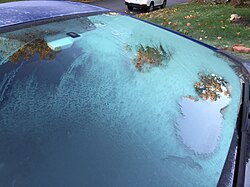
地表や植物の表面では、水蒸気が直接氷になる昇華現象によって「霜」が形成されます。窓ガラスに現れる氷の模様(霜の花)や、樹木を白く染める霧氷などは、気象条件によって異なる形状になります。
![Rime ice on the leading edge of an aircraft wing. When the build-up is too large, the black deicing boot inflates to shake it off.[130][131]](/images/86/f3/86f35e8215686ffb1953a8dec0e6513f08179b7c643b246d9bd9f6447561fef5.jpg)
また、湖などの静止した水面では、透明度の高い氷や、垂直に成長したキャンドルアイスなどの特殊な形態が見られることがあります。
人間活動と氷の利用
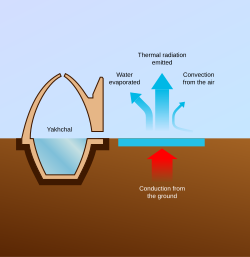
人類は古くから氷の特性を利用してきました。かつては天然の氷を切り出して保存する「氷切り」が行われ、冷蔵庫が普及する前は氷室などの貯蔵施設が不可欠でした。古代イランのヤフチャールのような放射冷却を利用した構造物は、その知恵の結晶と言えます。
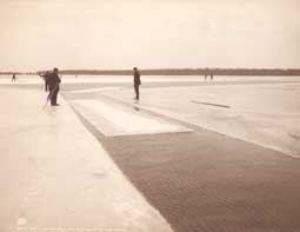
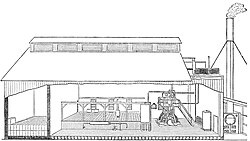
現代では、人工的な製氷技術が発展し、冷却用途だけでなく、建築材料や芸術作品としても利用されています。氷ホテルや氷の彫刻は、氷の透明度と成形性を活かしたものです。
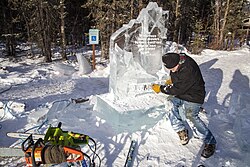
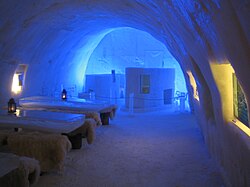
交通とレクリエーション
氷の低い摩擦係数は、スケートやカーリングといったスポーツを可能にしました。一方で、道路上の「ブラックアイス」は視認しにくく、交通安全上の大きなリスクとなります。また、北極圏などの航路では、砕氷船を用いて氷を砕きながら進む必要があります。
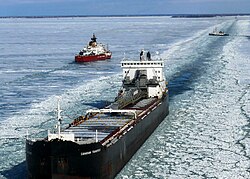
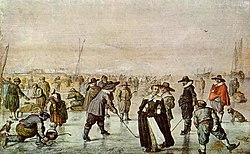
極地での物流においては、氷を構造材として利用した「氷の桟橋」が建設されることもあります。
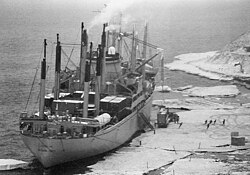
気候変動による氷の喪失と影響
地球温暖化に伴い、世界各地で氷の減少が加速しています。1994年から2017年の間に、地球は約28兆トンの氷を失ったと推定されており、これにより海面が上昇しています。特にグリーンランドや南極の氷床の融解は、将来的な海面上昇の主要な要因となります。
![Earth lost 28 trillion tonnes of ice between 1994 and 2017, with melting grounded ice (ice sheets and glaciers) raising the global sea level by 34.6 ±3.1 mm.[150] The rate of ice loss has risen by 57% since the 1990s − from 0.8 to 1.2 trillion tonnes per year.[150]](/images/99/fa/99fa810deeb310548975a2149f64d8a322ce335cab40e61e9b5fab4f0511adfb.png)
![On average, climate change has lowered the thickness of land ice with every year, and reduced the extent of sea ice cover.[150]](/images/b3/30/b3303ebd749ede2ee46c360585ee6a0b2e2c051da66e615399a89df96a825973.png)
氷の喪失は単に海面を上げるだけでなく、太陽光の反射率(アルベド)を低下させ、さらに地表が熱を吸収しやすくなるという正のフィードバックを引き起こします。これにより、北極圏の温暖化が地球平均よりも速く進む「北極増幅」という現象が生じています。
![Potential regional warming caused by the loss of all land ice outside of East Antarctica, and by the disappearance of Arctic sea ice every year starting from June.[155] While plausible, consistent sea ice loss would likely require relatively high warming,[156] and the loss of all ice in Greenland would require multiple millennia.[157][158]](/images/ac/c4/acc4a524e0e2318ad074ad626596226eb0b107b48213c2b1ef40f8a3eb34e46a.jpg)
![Possible equilibrium states of the Greenland ice sheet in response to different equilibrium carbon dioxide concentrations in parts per million. Second and third states would result in 1.8 m (6 ft) and 2.4 m (8 ft) of sea level rise, while the fourth state is equivalent to 6.9 m (23 ft).[161]](/images/b0/fd/b0fd96eb9a7f320eaef2aa17b7da4b6094b9e44fac662125279be6fa4e24224d.jpg)
氷の融解プロセスは、浮氷の消失から地上の氷河の後退まで多岐にわたります。
Frequently Asked Questions
なぜ氷は水に浮くのですか?
水が凍って氷になると、水分子が水素結合によって規則的な六角形の格子構造を作るため、液体状態のときよりも分子間の隙間が広がります。その結果、体積が増加し密度が低くなるため、氷は水よりも軽くなり、水面に浮くことになります。
氷が「滑る」のはなぜですか?
氷の表面には、非常に薄い液体の層(準液体層)が存在しているためと考えられています。この薄い水膜が潤滑剤のような役割を果たすため、摩擦が極めて低くなり、スケート靴などで滑走することが可能になります。
「ブラックアイス」とは何ですか?
路面上の水が薄く凍結し、下の路面の色が透けて見えるため、一見すると濡れているだけの道路に見える氷のことです。非常に滑りやすく、視認しにくいため、冬道の運転において非常に危険な状態を指します。
気候変動で氷がなくなるとどうなりますか?
まず、陸上の氷床や氷河が溶けることで海面が上昇し、沿岸地域の浸水リスクが高まります。また、白い氷が失われて暗い色の海面や地面が露出すると、太陽光の吸収量が増え、地球全体の温暖化がさらに加速するという悪循環に陥ります。
氷にはいろいろな種類があるというのは本当ですか?
はい。私たちが目にする氷は「氷Ih」と呼ばれる相ですが、極めて高い圧力や特殊な温度条件下では、分子配列が異なる「氷II」から「氷XIX」まで、多くの異なる結晶相が存在することが科学的に証明されています。
References
- Harvey, Allan H. (2017). "Properties of Ice and Supercooled Water". In Haynes, William M.; Lide, David R.; Bruno, Thomas J. (eds.). CRC Handbook of Chemistry and Physics (97th ed.). Boca Raton, FL: CRC Press. .
- Voitkovskii, K. F., Translation of: "The mechanical properties of ice" ("Mekhanicheskie svoistva l'da"), Academy of Sciences (USSR), AD0662716
- Evans, S. (1965). "Dielectric Properties of Ice and Snow–a Review". Journal of Glaciology. 5 (42): 773–792. :10.3189/S0022143000018840. 227325642.
- Physics of Ice, V. F. Petrenko, R. W. Whitworth, Oxford University Press, 1999,
- Bernal, J. D.; Fowler, R. H. (1933). "A Theory of Water and Ionic Solution, with Particular Reference to Hydrogen and Hydroxyl Ions". The Journal of Chemical Physics. 1 (8): 515. :1933JChPh...1..515B. :10.1063/1.1749327.
- Bjerrum, N (11 April 1952). "Structure and Properties of Ice". Science. 115 (2989): 385–390. :1952Sci...115..385B. :10.1126/science.115.2989.385. 17741864.
- Lide, D. R., ed. (2005). CRC Handbook of Chemistry and Physics (86th ed.). Boca Raton, Florida: CRC Press. .
- Richardson, Eliza (20 June 2021). "Ice, Water, and Vapor". LibreTexts Geosciences. Archived from the original on 26 April 2024. Retrieved 26 April 2024.
- Akyurt, M.; Zaki, G.; Habeebullah, B. (15 May 2002). "Freezing phenomena in ice–water systems". Energy Conversion and Management. 43 (14): 1773–1789. :2002ECM....43.1773A. :10.1016/S0196-8904(01)00129-7.
- Tyson, Neil deGrasse. "Water, Water". haydenplanetarium.org. Archived from the original on 26 July 2011.
📸 フォトギャラリー