物理学や天文学において、物体の位置や運動を記述するためには「どこから見たか」という基準が必要です。この基準となる抽象的な仕組みが参照系(Reference Frame)です。しかし、日常会話で使われる「視点」という言葉とは異なり、科学的な文脈では、数学的な道具である「座標系」と、物理的な状態を示す「観測フレーム」を厳密に区別して考える必要があります。
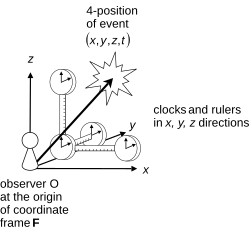
例えば、ある地点にいる観測者が、周囲の出来事を記述するためにx, y, zという軸と時間tを設定したとき、それは一つの時空イベントを特定するための枠組みとなります。
Key Facts
- 参照系は、物理的な空間における原点、方向、スケールを規定した抽象的な座標システムである。
- 座標系は数学的な記述言語であり、一つの観測フレームに対して複数の座標系(デカルト座標、極座標など)を選択できる。
- 慣性系とは、物理法則が最も単純な形で記述される系であり、ニュートン力学では慣性の法則が成り立つ系を指す。
- 非慣性系では、遠心力やコリオリ力などの「見かけの力(慣性力)」を導入しなければ現象を説明できない。
- 相対性理論では、観測者の運動状態によって時間の進み方が異なるため、座標時間という概念が重要になる。
観測フレームと座標系の本質的な違い
多くの人が混同しがちなのが、「観測フレーム(Observational Frame)」と「座標系(Coordinate System)」の概念です。これらは独立した概念として捉える必要があります。
物理的な概念としての観測フレーム
観測フレームとは、観測者の運動状態に関連する物理的な概念です。例えば、「静止しているか」「等速直線運動をしているか」「回転しているか」といった状態がこれに当たります。これは物理的な実体としての「視点」であり、観測者がどのような運動をしているかによって、観測される物理現象(特に力)が変わります。
数学的な道具としての座標系
一方で座標系は、観測結果を記述するための数学的な言語に過ぎません。ある観測フレームにいる人は、自分の都合に合わせてデカルト座標(直交座標)を使ってもいいし、円運動を記述するために極座標を使っても構いません。座標系を変更しても、観測者の運動状態(フレーム)が変わるわけではないため、物理的な本質は変化しません。
慣性系と非慣性系:運動状態による分類
物理学では、参照系をその運動状態に基づいて大きく2つのタイプに分類します。
慣性系(Inertial Frame)
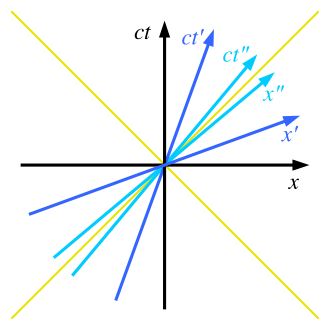
慣性系とは、外力が働かない物体が静止し続けるか、あるいは等速直線運動を続ける系です。ニュートン力学の第一法則がそのまま適用できるため、物理法則が最もシンプルな形で記述されます。特殊相対性理論においては、これらの系はローレンツ変換によって結びついています。
非慣性系(Non-inertial Frame)
加速運動や回転運動をしている系は非慣性系と呼ばれます。この系で物体を観察すると、実際には存在しないはずの力(見かけの力)が働いているように見えます。例えば、回転する地球上の観測者は、コリオリ力や遠心力を考慮しなければ物体の運動を正しく説明できません。
相対論的な視点では、速度が増すにつれて時空の捉え方が変化し、異なる参照系間での時間の同期や距離の測定に差異が生じます。
相対性理論における参照系の拡張
アインシュタインの相対性理論では、参照系の概念がさらに深化しました。ガリレイ相対性理論ではすべての座標時間が等価であると考えられていましたが、相対論では観測者の速度に応じて座標時間が変化します。
また、一般相対性理論では、重力場そのものが時空の歪みとして扱われるため、より汎用的な座標系が用いられます。ここでは、自由落下している系が局所的な慣性系として機能するという等価原理が重要な役割を果たします。
参照系のまとめ
| 項目 | 座標系 (Coordinate System) | 観測フレーム (Observational Frame) |
|---|---|---|
| 性質 | 数学的な構成物(言語) | 物理的な運動状態 |
| 目的 | 位置や時間を数値化して記述する | 観測者の視点と運動状態を定義する |
| 例 | デカルト座標、極座標、一般化座標 | 慣性系、回転系、加速系 |
| 変更の影響 | 記述形式が変わるが物理現象は不変 | 観測される力(慣性力など)が変化する |
Frequently Asked Questions
座標系を変えると物理法則は変わりますか?
いいえ、変わりません。座標系は単なる「記述方法」であるため、デカルト座標から極座標に変更しても、物理的な現象や法則そのものが変化することはありません。
慣性系と非慣性系の決定的な違いは何ですか?
最大の違いは「見かけの力(慣性力)」の有無です。慣性系ではニュートンの運動法則がそのまま成り立ちますが、非慣性系では遠心力やコリオリ力などの補正項を導入しなければ運動を説明できません。
「ラボ系(実験室系)」とは何ですか?
物理実験において、測定装置(検出器や時計など)が静止している参照系のことです。多くの場合、便宜上慣性系として扱われますが、地球上の実験室は厳密には回転しているため非慣性系となります。
相対性理論で参照系が重要なのはなぜですか?
観測者の運動状態(速度)によって、時間の進み方や物体の長さが変化するためです。異なる参照系間の関係を正しく記述するために、ローレンツ変換などの数学的枠組みが必要になります。
References
- Here is a quotation applicable to moving observational frames and various associated Euclidean three-space coordinate systems [R, R′, etc.]:
We first introduce the notion of reference frame, itself related to the idea of observer: the reference frame is, in some sense, the "Euclidean space carried by the observer". Let us give a more mathematical definition:… the reference frame is... the set of all points in the Euclidean space with the rigid body motion of the observer. The frame, denoted , is said to move with the observer.… The spatial positions of particles are labelled relative to a frame by establishing a coordinate system R with origin O. The corresponding set of axes, sharing the rigid body motion of the frame , can be considered to give a physical realization of . In a frame , coordinates are changed from R to R′ by carrying out, at each instant of time, the same coordinate transformation on the components of intrinsic objects (vectors and tensors) introduced to represent physical quantities in this frame.
and this on the utility of separating the notions of and [R, R′, etc.]:As noted by Brillouin, a distinction between mathematical sets of coordinates and physical frames of reference must be made. The ignorance of such distinction is the source of much confusion… the dependent functions such as velocity for example, are measured with respect to a physical reference frame, but one is free to choose any mathematical coordinate system in which the equations are specified.
and this, also on the distinction between and [R, R′, etc.]:The idea of a reference frame is really quite different from that of a coordinate system. Frames differ just when they define different spaces (sets of rest points) or times (sets of simultaneous events). So the ideas of a space, a time, of rest and simultaneity, go inextricably together with that of frame. However, a mere shift of origin, or a purely spatial rotation of space coordinates results in a new coordinate system. So frames correspond at best to classes of coordinate systems.
and from J. D. Norton:In traditional developments of special and general relativity it has been customary not to distinguish between two quite distinct ideas. The first is the notion of a coordinate system, understood simply as the smooth, invertible assignment of four numbers to events in spacetime neighborhoods. The second, the frame of reference, refers to an idealized system used to assign such numbers […] To avoid unnecessary restrictions, we can divorce this arrangement from metrical notions. […] Of special importance for our purposes is that each frame of reference has a definite state of motion at each event of spacetime. […] Within the context of special relativity and as long as we restrict ourselves to frames of reference in inertial motion, then little of importance depends on the difference between an inertial frame of reference and the inertial coordinate system it induces. This comfortable circumstance ceases immediately once we begin to consider frames of reference in nonuniform motion even within special relativity.…More recently, to negotiate the obvious ambiguities of Einstein’s treatment, the notion of frame of reference has reappeared as a structure distinct from a coordinate system.
 and various associated Euclidean three-space coordinate systems [R, R′, etc.]:
📸 フォトギャラリー