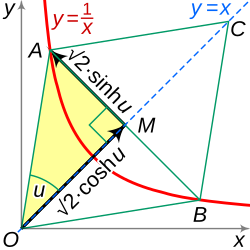
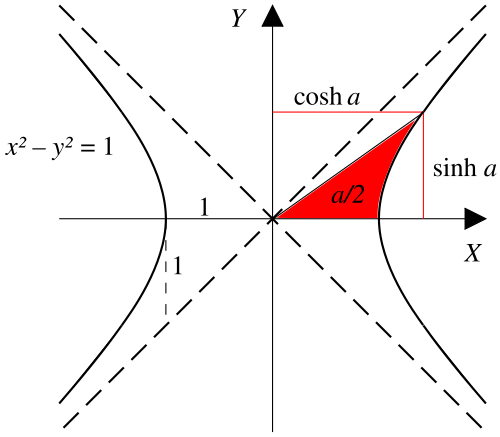
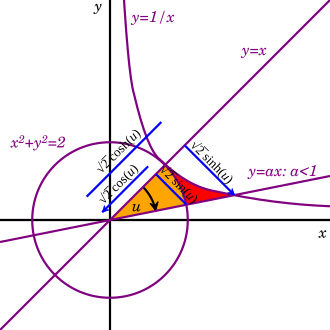
数学の世界において、双曲線関数は私たちがよく知る三角関数(円関数)の「双曲線版」とも言える関数です。円関数が単位円上の点を用いて定義されるのに対し、双曲線関数は単位双曲線を用いて定義されます。このため、円関数と非常に似た性質を持ちながらも、異なる幾何学的特性と応用範囲を持っています。
例えば、円関数における点 $(\cos t, \sin t)$ が半径1の円を描くように、双曲線関数における点 $(\cosh t, \sinh t)$ は単位双曲線の右半分を形成します。また、微分においても、$\sin$ の微分が $\cos$ になるのと同様に、$\sinh$ の微分は $\cosh$ になり、$\cosh$ の微分は $\sinh$ になるという密接な関係があります。
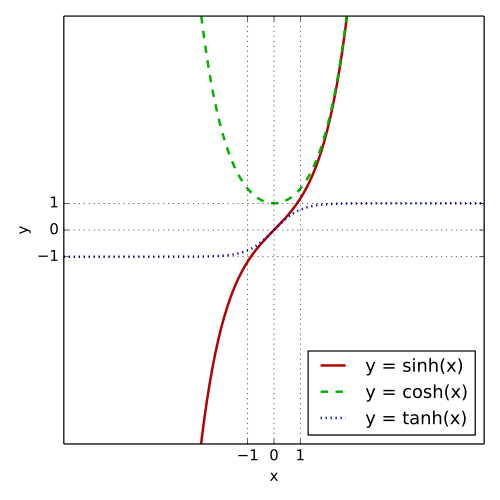
Key Facts
- 幾何学的基礎:円ではなく双曲線に基づいて定義される関数である。
- 指数関数との関係:すべての基本双曲線関数は、ネイピア数 $e$ を底とする指数関数を用いて表現できる。
- 物理学への応用:特殊相対性理論のローレンツ変換や、懸垂線(カテナリー)の記述、熱伝導や流体力学に関わるラプラス方程式の解に不可欠である。
- 三角関数との類似性:加法定理や微分公式など、円関数と酷似した数学的構造を持つ。
双曲線関数の定義と種類
双曲線関数は、指数関数 $e^x$ と $e^{-x}$ の組み合わせによって定義されます。最も基本的な関数である双曲線正弦(sinh)と双曲線余弦(cosh)から、他の関数が派生します。
基本関数と派生関数
双曲線正弦 $\sinh x$ は指数関数の奇関数部分であり、双曲線余弦 $\cosh x$ は偶関数部分として定義されます。これらを基に、正接($\tanh$)、余正接($\coth$)、正割($\text{sech}$)、余正割($\text{csch}$)が導かれます。
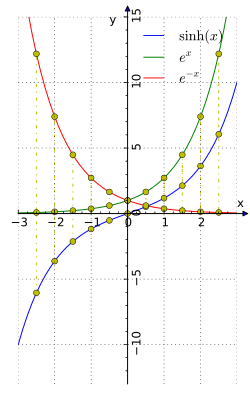
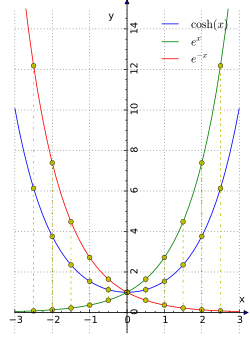
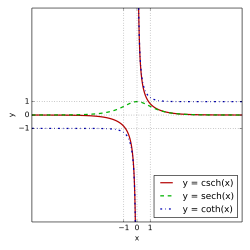
また、これらの逆関数として、$\text{arsinh}$ や $\text{arcosh}$ といった逆双曲線関数が存在し、これらは対数関数 $\ln$ を用いて書き換えることが可能です。
複素数を用いた定義
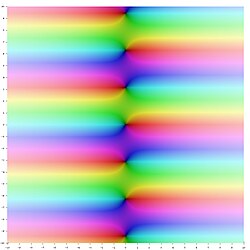
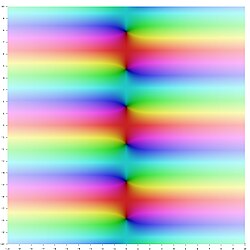
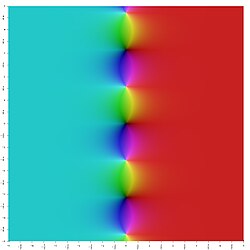
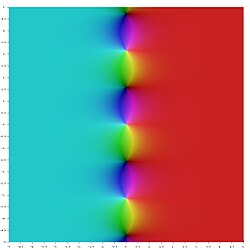
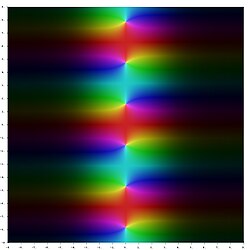
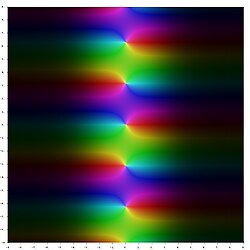
双曲線関数は、複素数 $i$ を用いて通常の三角関数と結びつけることができます。例えば、$\cosh x = \cos(ix)$ や $\sinh x = -i\sin(ix)$ といった関係が成り立ち、これにより円関数と双曲線関数が数学的に統合されます。
数学的特性と重要な公式
双曲線関数は、円関数に似た多くの恒等式を持ちますが、符号が異なる点に注意が必要です。最も代表的なのが、ピタゴラスの定理に似た $\cosh^2 x - \sinh^2 x = 1$ という関係式です。
主要な公式まとめ
| 項目 | 公式 / 関係式 |
|---|---|
| 基本恒等式 | $\cosh^2 x - \sinh^2 x = 1$ |
| 微分 ($\sinh$) | $ rac{d}{dx}\sinh x = \cosh x$ |
| 微分 ($\cosh$) | $ rac{d}{dx}\cosh x = \sinh x$ |
| 加法定理 ($\sinh$) | $\sinh(x+y) = \sinh x \cosh y + \cosh x \sinh y$ |
| テイラー展開 ($\sinh$) | $x + \frac{x^3}{3!} + \frac{x^5}{5!} + \dots$ |
さらに、2階微分を行うと元の関数に戻る($ rac{d^2}{dx^2}\sinh x = \sinh x$)という特性があり、これが多くの線形微分方程式の解として現れる理由となっています。
実世界での応用例
双曲線関数は単なる理論上の道具ではなく、物理現象の記述に広く利用されています。特に、重力によって垂れ下がった鎖やケーブルの形状である懸垂線(カテナリー)は、$\cosh$ 関数によって完璧に表現されます。
また、現代物理学の柱である特殊相対性理論では、速度の合成や座標変換(ローレンツ・ブースト)を、双曲線空間における回転として捉えることで計算を簡略化しています。さらに、電磁気学や熱伝導、流体力学で用いられるラプラス方程式の解にも、これらの関数が登場します。
Frequently Asked Questions
双曲線関数と三角関数の最大の違いは何ですか?
最大の違いは、定義の基礎となる図形が「円」か「双曲線」かという点です。これにより、例えばピタゴラスの定理に相当する式において、三角関数は $\sin^2 x + \cos^2 x = 1$ となりますが、双曲線関数では $\cosh^2 x - \sinh^2 x = 1$ と符号がマイナスになります。
なぜ物理学で双曲線関数が使われるのですか?
指数関数的な増大や減衰を含む現象、あるいは双曲面のような幾何学的構造を持つ空間(ミンコフスキー空間など)を扱う際に、双曲線関数が自然な表現形式となるためです。特に相対性理論の速度変換などは双曲線回転として記述されます。
$\sinh$ や $\cosh$ はどのように計算しますか?
基本的には指数関数 $e^x$ を用いて計算します。$\sinh x = (e^x - e^{-x})/2$、$\cosh x = (e^x + e^{-x})/2$ という定義式に値を代入することで算出可能です。
逆双曲線関数とは何ですか?
ある値からその値を導き出した引数(角度に相当するもの)を求める関数です。例えば $\text{arsinh}(x)$ は、$\sinh$ の値が $x$ になるような値を返します。これらは対数関数 $\ln$ を用いて表現できるため、計算機での処理が容易です。
References
- "Hyperbolic Functions". mathworld.wolfram.com. Retrieved 2020-08-29.
- (1999) Collins Concise Dictionary, 4th edition, HarperCollins, Glasgow, , p. 1386
- Collins Concise Dictionary, p. 328
- "Hyperbolic Functions". www.mathsisfun.com. Retrieved 2020-08-29.
- Collins Concise Dictionary, p. 1520
- Collins Concise Dictionary, p. 329
- tanh
- Collins Concise Dictionary, p. 1340
- (2003), Special Relativity, London: Springer, p. 71,
- ; , eds. (1972), , New York: ,
📸 フォトギャラリー