太古の遺物や生物の化石が「いつの時代のものか」を明らかにする技術として、放射性炭素年代測定(カーボンデート)は不可欠な役割を果たしています。この手法は、有機物に含まれる炭素の同位体の性質を利用して、生物が死後どれだけの時間が経過したかを推定するものです。
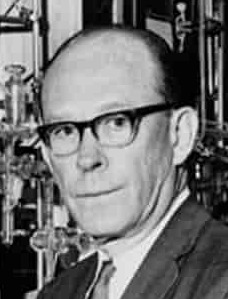
1940年代後半にシカゴ大学のウィラード・リビーによって開発されたこの画期的な手法は、科学的な年代決定に革命をもたらし、リビー博士には1960年にノーベル化学賞が授与されました。
Key Facts
- 測定対象: 植物や動物などの有機物を含む試料。
- 原理: 宇宙線によって生成される放射性同位体「炭素14(14C)」の崩壊を利用。
- 半減期: 約5,730年(計算上の基準となる「リビー半減期」は5,568年)。
- 測定限界: 一般的に約50,000年前まで(特殊な手法で最大75,000年前まで可能)。
- 校正: 大気中の炭素濃度の変動を補正するため、校正曲線を用いて暦年代に変換する。
炭素14が生成され、蓄積されるプロセス
自然界の炭素には、安定した12Cと13Cのほか、放射性を持つ炭素14(14C)が存在します。14Cは、地球の大気上層で宇宙線が窒素原子(14N)と衝突することで絶えず生成されています。
生成された14Cは酸素と結びついて二酸化炭素となり、光合成を通じて植物に取り込まれます。その後、食物連鎖を通じて動物の体内にも蓄積されます。生物が生きている間は、呼吸や食事によって外部から炭素を取り込み続けるため、体内の14C濃度は大気中の濃度とほぼ平衡状態に保たれています。
![Simplified version of the carbon exchange reservoir, showing proportions of carbon and relative activity of the 14C in each reservoir[5][note 7]](/images/02/a1/02a180c8f1d8593ef51525b6d889fe2fa348f9eb8ab1bbf7f70e1882b256c9ab.webp)
死後の崩壊と時間の計測
生物が死ぬと、新たな炭素の摂取が止まります。すると、体内に蓄積されていた14Cは放射性崩壊を起こし、徐々に窒素(14N)へと戻っていきます。この減少速度は一定であるため、残っている14Cの量を測定することで、死後どれだけの時間が経過したかを逆算できるのです。
年代測定の精度を高める技術と課題
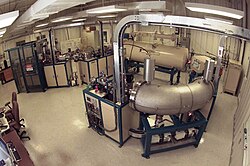
初期の測定法はベータ崩壊を数える方式でしたが、現在は加速器質量分析(AMS)という高度な技術が主流です。これにより、ごく少量の試料からでも極めて高精度に炭素同位体の比率を測定することが可能になりました。

校正曲線の必要性
大気中の14C濃度は、地球の磁場や太陽活動の影響で時代ごとにわずかに変動しています。そのため、単純な計算で得られる「放射性炭素年代」と、実際の「暦年代」にはズレが生じます。この誤差を修正するために、年輪などのデータに基づいた校正曲線(IntCalなど)が用いられます。
![The Northern hemisphere curve from IntCal20. As of 2020, this is the most recent version of the standard calibration curve. The diagonal line shows where the curve would lie if radiocarbon ages and calendar ages were the same.[84]](/images/11/65/11651ecc0121c599697bb95900e067b91da7da6e96d736e9e946a8cdd0432f0a.png)
測定結果に影響を与える要因
正確な測定には、いくつかの外的要因を考慮する必要があります。例えば、化石燃料の燃焼による14Cの希釈(スース効果)や、20世紀半ばの核実験による大気中の14C急増などが挙げられます。また、海洋生物は深海から上昇してくる「古い炭素」の影響を受けるため、陸上生物とは異なる補正が必要です。
![Atmospheric 14C for the northern and southern hemispheres, showing percentage excess above pre-bomb levels. The Partial Test Ban Treaty went into effect on 10 October 1963.[38]](/images/12/12/121284c06e6cc51ecb71944cb96c4b2399e969e5ccdbe61064a95d9982cacdf6.png)
![North Ronaldsay sheep on the beach in North Ronaldsay, Scotland. In the winter, these sheep eat seaweed, which has a higher δ13C content than grass; samples from these sheep have a δ13C value of about −13‰, which is much higher than for sheep that feed on grasses.[45]](/images/e6/e7/e6e7f9c8c165fd5632719dd689e60b4c2aa372b7edc0d9afde6ae898bf6127d9.jpg)
実用的な応用と表記法
この技術は考古学において絶大な威力を発揮しました。代表的な例として、死海文書の真贋判定に活用されたことが挙げられます。これにより、歴史的な文書や遺物の年代が科学的に裏付けられました。


年代の表記について
未校正の年代は通常「BP(Before Present)」という単位で表記されます。ここでの「Present(現在)」は、核実験の影響を受ける前の基準年である西暦1950年を指します。例えば「500 BP」は西暦1450年を意味します。
| 項目 | 詳細・影響 | 備考 |
|---|---|---|
| 安定同位体 | 12C, 13C | 崩壊せず一定量保持される |
| 放射性同位体 | 14C | 半減期 約5,730年で減少 |
| スース効果 | 化石燃料の燃焼 | 試料が実際より古く測定される |
| 核実験影響 | 大気中14Cの増加 | 1960年代にピークに達した |
| リザーバー効果 | 海洋などの環境差 | 生息環境により炭素比率が異なる |
Frequently Asked Questions
なぜ5万年以上前のものは測定できないのですか?
炭素14の半減期が約5,730年と比較的短いため、5万年も経過すると、試料に残っている放射性炭素の量が極めて少なくなります。検出限界を下回るため、通常の測定では正確な年代を特定できなくなります。
「リビー半減期」と「現代の半減期」の違いは何ですか?
開発当初、リビー博士は半減期を5,568年と推定しました。後の研究でより正確な値(約5,730年)が判明しましたが、過去の膨大なデータとの整合性を保つため、慣習的に「リビー半減期」を用いて計算し、その後に校正曲線で補正する手法が取られています。
現代のプラスチック製品などは測定できますか?
プラスチックの原料となる石油などの化石燃料は、数千万年以上前のものであるため、炭素14は完全に崩壊して消失しています。そのため、化石燃料由来の製品は「極めて古い」という結果になります。
汚染(コンタミネーション)が起きるとどうなりますか?
試料に新しい時代の炭素が混入すると、実際よりも若く測定されます。逆に、非常に古い炭素が混入すると、実際よりも古く測定されます。特に古い試料ほど、わずかな現代炭素の混入が年代に大きな誤差を与えるため、厳格な洗浄と前処理が必要です。
References
- Korff's paper actually referred to slow neutrons, a term that since Korff's time has acquired a more specific meaning, referring to a range of neutron energies that does not overlap with thermal neutrons.
- Some of Libby's original samples have since been retested, and the results, published in 2018, were generally in good agreement with Libby's original results.
- The interaction of cosmic rays with nitrogen and oxygen below the earth's surface can also create 14
C, and in some circumstances (e.g. near the surface of snow accumulations, which are permeable to gases) this 14
C migrates into the atmosphere. However, this pathway is estimated to be responsible for less than 0.1% of the total production of 14
C. - The half-life of 14
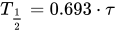
C (which determines the mean-life) was thought to be 5568 ± 30 years in 1952. The mean-life and half-life are related by the following equation: - Two experimentally determined values from the early 1950s were not included in the value Libby used: ~6,090 years, and 5900 ± 250 years.
- The term "conventional radiocarbon age" is also used. The definition of radiocarbon years is as follows: the age is calculated by using the following : a) using the Libby half-life of 5568 years, rather than the currently accepted actual half-life of 5730 years; (b) the use of an NIST standard known as HOxII to define the activity of radiocarbon in 1950; (c) the use of 1950 as the date from which years "before present" are counted; (d) a correction for , based on a standard isotope ratio, and (e) the assumption that the 14
C/12
C ratio has not changed over time. - The data on carbon percentages in each part of the reservoir is drawn from an estimate of reservoir carbon for the mid-1990s; estimates of carbon distribution during pre-industrial times are significantly different.
- For marine life, the age only appears to be 400 years once a correction for is made. This effect is accounted for during calibration by using a different marine calibration curve; without this curve, modern marine life would appear to be 400 years old when radiocarbon dated. Similarly, the statement about land organisms is only true once fractionation is taken into account.
- "PDB" stands for "Pee Dee Belemnite", a fossil from the in South Carolina.
- The PDB value is 11.2372‰.
📸 フォトギャラリー