地球上の生命維持において、目に見えないほど小さな生物たちが決定的な役割を果たしています。水流に身を任せて漂うプランクトンは、単なる「漂流生物」ではなく、酸素の供給や炭素の固定、そして海洋食物網の基盤として、地球環境を制御する巨大なシステムの一部となっています。
Key Facts
- 酸素供給: 地球上の酸素の約50%がプランクトンによって生成されている。
- 炭素固定: 毎年300億〜500億トンの炭素を隔離し、気候変動の抑制に寄与している。
- 食物網の基盤: 微小な植物プランクトンが、魚類からクジラに至るまでの海洋生物のエネルギー源となる。
- 広範な生息域: 海洋の表層から深海、さらには大気中(エアロプランクトン)まで広く分布する。
プランクトンの定義と分類
プランクトンは、自力で水流に抗って泳ぐ能力を持たない生物の総称です。これに対し、能動的に泳ぐ生物はネクトン(遊泳生物)、海底に生息するものはベントス(底生生物)と呼ばれます。また、海面付近に生息するネウストンの中には、プランクトンに分類される種も存在します。
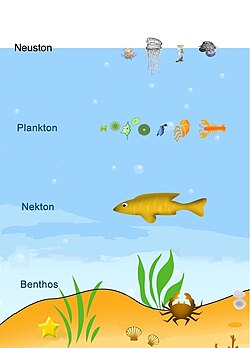
生息環境による分類
プランクトンは主に海洋に多く見られますが、淡水域や、さらには海面からの飛沫によって大気中へと運ばれるエアロプランクトンとしても存在します。これにより、微生物が地球規模で移動することが可能になります。
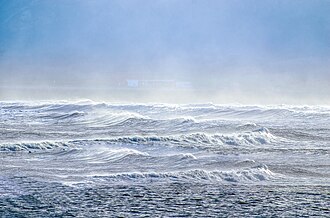
ライフサイクルによる分類
一生をプランクトンとして過ごすホロプランクトン(永久プランクトン)と、幼生期などの一部の期間だけプランクトンとして漂い、成長後に底生生物や遊泳生物になるメロプランクトン(一時的プランクトン)に分けられます。例えば、カニの幼生や魚の卵などがこれに該当します。
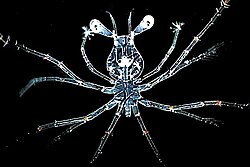
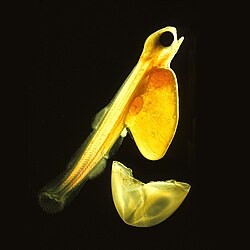
サイズと種による多様な形態
プランクトンは、その大きさに応じて非常に細かく分類されます。ウイルスのような極小のフェムトプランクトンから、クラゲのような巨大なメガプランクトンまで、その範囲は極めて広範です。
| 区分 | サイズ範囲 (ESD) | 代表的な生物 |
|---|---|---|
| メガプランクトン | 20 cm超 | クラゲ、サルパ、イカ類 |
| マクロプランクトン | 2 cm 〜 20 cm | 大型端脚類、サルガッスム(海藻) |
| メソプランクトン | 0.2 mm 〜 20 mm | カイアシ類、小型クラゲ |
| マイクロプランクトン | 20 μm 〜 200 μm | 大型の単細胞生物、小型の甲殻類 |
| ナノプランクトン | 2 μm 〜 20 μm | 小型の珪藻、鞭毛虫 |
| ピコプランクトン | 0.2 μm 〜 2 μm | 細菌、小型真核生物 |
| フェムトプランクトン | 0.2 μm未満 | 海洋ウイルス |
これらの生物は、単細胞の原核生物から複雑な多細胞動物まで多岐にわたります。特に珪藻などの微小藻類は、光合成を行うことで膨大なエネルギーを生産しています。
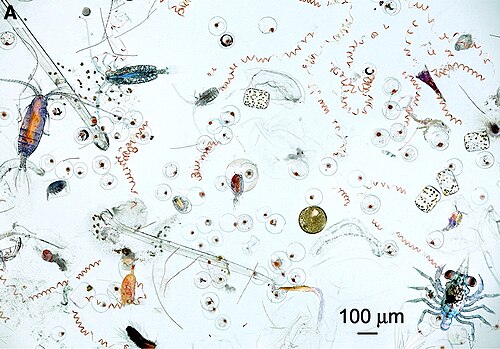
![Plankton species diversity Diverse assemblages of unicellular and multicellular organisms with different sizes, shapes, feeding strategies, ecological functions, life cycle characteristics, and environmental sensitivities.[16] Courtesy of Christian Sardet/CNRS/Tara expeditions](/images/ff/7c/ff7c236f44e37ae6006ea6396117a985e985b8a2b9866b002e3ff73f82995b58.jpg)
栄養摂取モードと生態的役割
プランクトンはそのエネルギー獲得方法によって、大きく3つのグループに分けられます。
1. 植物プランクトン (Phytoplankton)
光合成を行い、太陽エネルギーを化学エネルギーに変換するグループです。海洋食物網の最底辺を支えており、クロロフィル濃度によってその分布や量を確認することができます。
![Ocean chlorophyll concentration is a proxy for, or an indicator of, the distribution and abundance of phytoplankton. The intensity of green indicates how abundant the phytoplankton are, while blue indicates where there are few phytoplankton. – NASA Earth Observatory, October 2019.[6]](/images/14/ca/14ca5911573955df093944d9412fadaf18d450cbe7e7b871465283c5a0dfc008.png)
2. 動物プランクトン (Zooplankton)
植物プランクトンや他の動物プランクトンを捕食するグループです。カイアシ類やクラゲなどが含まれ、下位の栄養段階から上位の捕食者(魚類など)へエネルギーを橋渡しします。
![Jellyfish are gelatinous zooplankton.[77]](/images/af/38/af38c4db4ec82521d009d0893e3a652e6ce71f1da5ed2d984210dfbf0ee8386d.jpg)
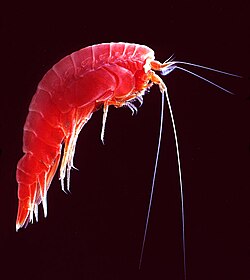
3. ミクソプランクトン (Mixoplankton)
光合成と捕食の両方の能力を持つハイブリッドな生物です。環境に応じてエネルギー獲得手段を切り替えることができるため、生存戦略において非常に柔軟です。
地球規模の循環と環境への影響
プランクトンは、単に海を漂っているだけでなく、地球全体の物質循環に深く関与しています。
海洋コンベアベルトと深海生態系
海水の温度や塩分濃度の差によって生じる巨大な海流「海洋コンベアベルト」は、微生物を深海へと運びます。2025年の研究では、このベルトを通じて極めて深い海域にも多様な微生物コミュニティが存在することが明らかになりました。
![The ocean conveyor belt carries warm surface waters (red) northward near the surface and cold deep waters (blue) southward. Diverse and flourishing microbial ecosystems have been found deep in the belt.[43][44]](/images/3e/0f/3e0f43d62556304d2e027e45e9a949a03d2f70b0f4d4cdf42a0724e593480e3b.jpg)
炭素循環と微生物ループ
プランクトンによる炭素の固定は、大気中の二酸化炭素を減少させる重要なメカニズムです。また、死骸や排泄物が深海へ沈降する過程や、菌類が関与する「マイコロープ」、ウイルスによる細胞破壊(ウイルスシャント)などを通じて、栄養分が再循環されます。
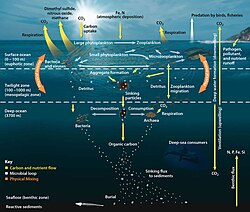
![The central role played by pelagic fungi, both parasitic and saprotrophic in the mycoloop, and saprotrophic fungi as active contributors to the microbial loop. The activity of heterotrophic microbes, including pelagic fungi, has far-reaching global implications for fisheries (i.e., the amount of carbon that will ultimately flow to higher trophic levels) and climate change (i.e., the amount of carbon that will be sequestered in the ocean or respired back to CO2 and the release of other greenhouse gases; e.g., N2O.[99]](/images/62/c3/62c3cd9194903cd1a02b6a74eb2391149755f5028a10f433f9978ef900806fc3.jpg)
極限環境での生存戦略
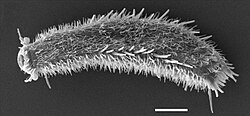
一部のプランクトンは驚異的な生存能力を持っています。例えば、ガストリクス(腹毛動物)の中には、乾燥した環境で数年間生存できる強靭な卵を産む種が存在します。
プランクトンの保護と未来
2024年、国連グローバル・コンパクトの海洋スチュワードシップ・コアリションは、30人以上の専門家と共に「プランクトン宣言(Plankton Manifesto)」を発表しました。これは、生物多様性の喪失や海洋汚染、気候変動に対処するため、海洋生態系の基盤であるプランクトンを保護し、その潜在能力を最大限に活用することを目的とした戦略的な提言です。
![Tomopteris, a holoplanktic bioluminescence polychaete worm[87]](/images/08/e7/08e7053b32c5a95504f705c53e3bd91e7d3c8bd5b9698fe8de9a2bac7f245363.jpg)
Frequently Asked Questions
プランクトンはすべて小さいのですか?
いいえ。ウイルスのような極小のものから、数センチメートル、あるいは20センチメートルを超えるクラゲのような大型の生物まで、サイズは非常に多様です。
プランクトンが絶滅するとどうなりますか?
プランクトンは地球の酸素の約半分を生成し、海洋食物網の基盤となっているため、絶滅すれば海洋生物のほとんどが飢餓状態になり、大気中の二酸化炭素濃度が急上昇して深刻な気候変動が引き起こされると考えられます。
「ミクソプランクトン」とは何ですか?
植物プランクトンのように光合成を行いながら、同時に動物プランクトンのように他の生物を捕食して栄養を得ることができる、混合栄養型の生物のことです。
プランクトンは海にしかいないのですか?
いいえ。海洋だけでなく、湖や川などの淡水域にも生息しています。また、海面からの飛沫によって大気中に舞い上がり、風に乗って世界中を旅する「エアロプランクトン」としても存在します。
References
- Lalli, Carol; Parsons, Timothy R. (1997-04-10). Biological Oceanography: An Introduction. Oxford: Elsevier. .
- Smith, David J. (July 2013). "Aeroplankton and the Need for a Global Monitoring Network". BioScience. 63 (7): 515–516. :10.1525/bio.2013.63.7.3. 86371218.
- "plankter". American Heritage Dictionary. Houghton Mifflin Harcourt Publishing Company. Archived from the original on 9 November 2018. Retrieved 9 November 2018.
- Lawton, Graham (10 February 2024). "Fungi ahoy!". New Scientist. 261 (3477): 37–39. :2024NewSc.261b..37L. :10.1016/S0262-4079(24)00274-4.
- Dolan, John (November 2012). "Microzooplankton: the microscopic (micro) animals (zoo) of the plankton" (PDF). . Archived from the original (PDF) on 4 March 2016. Retrieved 16 January 2014.
- Chlorophyll NASA Earth Observatory. Accessed 30 November 2019.
- Agrawai, Anju; Gopnal, Krishna (2013). Biomonitoring of Water and Waste Water. Springer India. p. 34. . Retrieved 2 April 2018.
- Martin, J.H.; Fitzwater, S.E. (1988). "Iron-deficiency limits phytoplankton growth in the Northeast Pacific Subarctic". Nature. 331 (6154): 341–343. :1988Natur.331..341M. :10.1038/331341a0. 4325562.
- Boyd, P.W.; et al. (2000). "A mesoscale phytoplankton bloom in the polar Southern Ocean stimulated by fertilization". Nature. 407 (6805): 695–702. :2000Natur.407..695B. :10.1038/35037500. 11048709. 4368261.
- Karleskint, George; Turner, Richard; Small, James (2013). "17: The Open Sea". Introduction to Marine Biology (4th ed.). Brooks/Cole. pp. 442–443. .
📸 フォトギャラリー