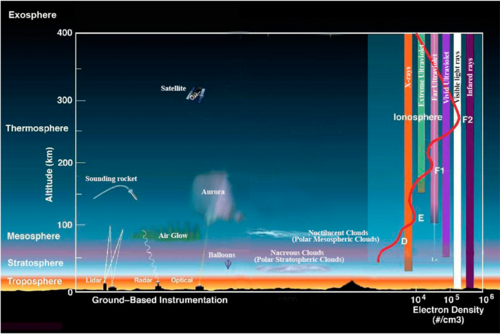
地球の大気圏上層には、太陽からの強力なエネルギーによってガスが電離し、電子とイオンが漂う特殊な領域が存在します。これが電離層(Ionosphere)です。高度約48kmから965kmにわたるこの領域は、熱圏の大部分と中間圏・外圏の一部を含んでおり、地球の磁気圏の内縁を形成しています。
電離層は単なる大気の一部ではなく、現代の通信インフラに不可欠な役割を果たしています。特に遠距離の無線通信やGPS信号の伝達に直接的な影響を与えるため、その物理的特性を理解することは科学的にも実用的にも極めて重要です。
Key Facts
- 正体:太陽放射によって大気分子が電離した、電子と電荷を持つ原子・分子の層。
- 範囲:高度約50kmから1,000km以上にわたる広大な領域。
- 主要機能:特定の周波数の電波を反射・屈折させ、地平線を超えた遠距離通信を可能にする。
- 影響:GPS信号の経路を偏向させ、到達時間を遅延させる要因となる。
- 変動性:太陽活動、昼夜のサイクル、季節によって電子密度が激しく変化する。
電離層の構造と物理的メカニズム
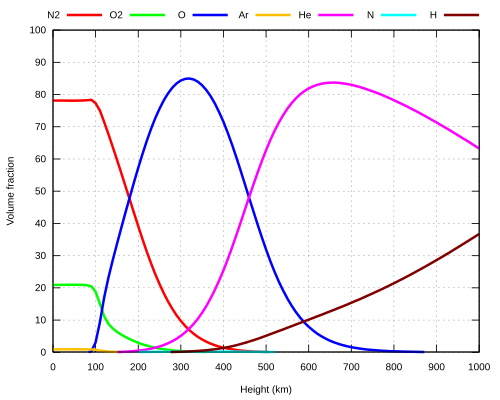
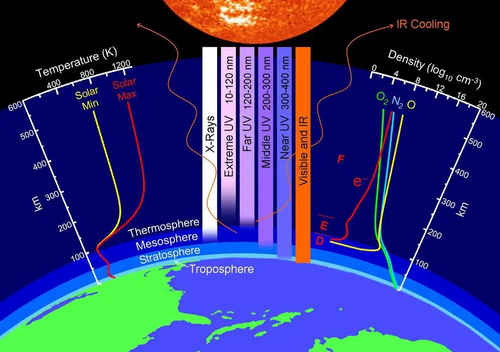
電離層は一様な層ではなく、高度に応じて異なる特性を持つ複数の層に分かれています。これらの層は、太陽からの紫外線(UV)やX線が、窒素(N2)や酸素(O2、O)などの大気成分を電離させることで形成されます。
高度別の層構造
電離層は主に以下の3つの主要層で構成されています。
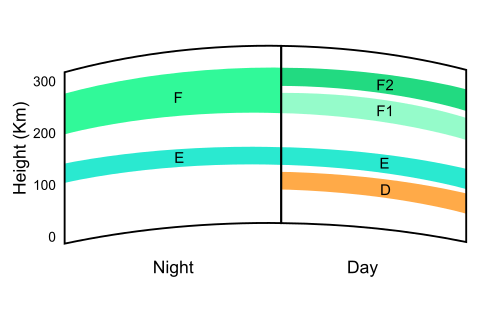
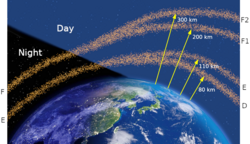
- D層(高度60〜90km): 最も低い層であり、主にライマンアルファ線による一酸化窒素の電離で形成されます。太陽フレアによるハードX線が放出されると、窒素や酸素の電離が促進されます。
- E層(高度105〜160km): 「ケネリー・ヘビサイド層」とも呼ばれます。紫外線による分子状酸素の電離で形成され、正午に電子密度がピークに達します。
- F層(高度160km以上): 最も高い層で、さらにF1層とF2層に分かれます。極端紫外線による原子状酸素の電離が主因です。夜間にはF1層がF2層に統合されます。
また、E層には時折「散発的E層(Es層)」と呼ばれる局所的な高密度領域が現れ、通常では不可能なVHF帯などの長距離通信が突如として可能になる現象が起こります。
電波伝搬への影響と実用的応用
電離層の最大の特性は、電波に対する屈折と反射です。電波が電離層に入射すると、電子密度に応じて進行方向が曲げられます。ある臨界周波数以下の電波は、完全に反射されて地上に戻るため、地球の曲率を超えて遠方の地点へ信号を届ける「スカイウェーブ(電離層反射波)」として利用されます。
周波数ごとの伝搬特性
- 300kHz 〜 3MHz: 主に地表に沿って伝わる地表波として伝搬しますが、夜間は電離層による反射が強まります。
- 2MHz 〜 30MHz(HF帯): 昼夜問わず電離層で反射し、超長距離通信に利用されます。
- 30MHz 〜 10GHz: 基本的に電離層を突き抜けて直進するため、見通し通信(Line-of-sight)となります。
一方で、この特性はGPS(GNSS)などの衛星通信においては「誤差」として現れます。衛星から地上へ届く信号が電離層を通過する際、電子密度によって経路が曲がり、到達時間が遅れるため、精密な測位には電離層補正が必要です。
電離層のダイナミクスと異常現象
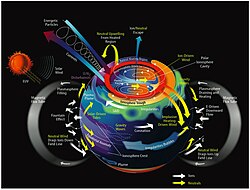
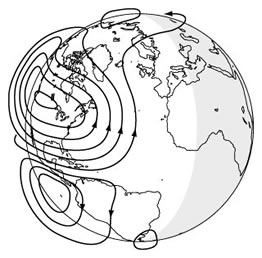
電離層は静止した層ではなく、太陽風や地球磁場との相互作用により常に変動しています。例えば、磁気赤道付近では、太陽駆動の風によって「赤道電撃(Equatorial Electrojet)」と呼ばれる強力な東向きの電流が発生します。
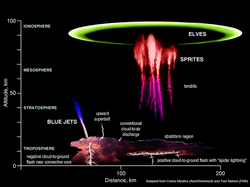
また、激しい雷活動に伴い、電離層の下端で「スプライト」のような上層大気雷が発生することもあります。これらは大気電気学における重要な現象の一つです。
大気圏の全体像における位置づけ
電離層は、温度が高度とともに上昇する熱圏に重なるように存在しています。高度100km付近のターボポーズ(乱流圏界面)を超えると、ガスは拡散によって分離し、さらに高度600km以上の外圏では、原子が地球の重力を振り切って宇宙空間へ脱出することがあります。
電離層の特性まとめ
| 層の名前 | 高度範囲 | 主な電離要因 | 主な特徴 |
|---|---|---|---|
| D層 | 60 〜 90 km | ライマンα線、ハードX線 | 最下層。電波の吸収が起こりやすい。 |
| E層 | 105 〜 160 km | 紫外線(UV)、X線 | ケネリー・ヘビサイド層。散発的E層が発生。 |
| F層 | 160 〜 1,000 km+ | 極端紫外線(EUV) | 最高密度層。長距離通信の主役。夜間は統合。 |
Frequently Asked Questions
電離層がなければ無線通信はどうなりますか?
HF帯(短波)などの電離層反射を利用した長距離通信ができなくなります。地平線の向こう側へ電波を飛ばすには、人工衛星を経由させるか、非常に強力な出力で地表波を飛ばすしかなくなります。
なぜ昼と夜で通信状況が変わるのですか?
電離層を形成するエネルギー源が太陽光であるためです。夜間になると太陽放射がなくなるため、特に低い層(D層やE層)の電子密度が激減し、電波の吸収が減ってより高い層での反射が効率的に行われるようになります。
GPSの精度にどう影響しますか?
電離層内の自由電子が電波の速度をわずかに遅らせるため、衛星から受信機までの距離計算に誤差が生じます。これを補正しないと、位置情報に数メートルから数十メートルのズレが発生します。
地球以外の惑星にも電離層はありますか?
はい。土星の衛星タイタンや、木星の衛星イオ、エウロパ、ガニメデ、さらには冥王星などでも電離層が観測されています。タイタンの電離層は炭素化合物を含んでいるのが特徴です。
References
- (2003) [1917]. "ionosphere". In Peter Roach; James Hartmann; Jane Setter (eds.). English Pronouncing Dictionary. : . .
- "ionosphere". . Merriam-Webster. 1032680871.
- Zell, Holly (2 March 2015). "Earth's Atmospheric Layers". NASA. Retrieved 2020-10-23.
- Gallagher, D. L. (April 26, 2023). "The Earth's Plasmasphere". NASA. Retrieved 2025-07-23.
- Rawer, K. (1993). Wave Propagation in the Ionosphere. : . .
- Lopez, Ericson D.; Ubillus, Bryan A.; Meza, Ariel A. (2024). "Preliminary mapping of ionospheric total electron content (TEC) over Ecuador using global positioning system (GPS) data". :2403.19053 [physics.space-ph].
- Gauss, Carl Friedrich (1839). "Allgemeine Theorie des Erdmagnetismus [General theory of terrestrial magnetism]". In Gauss, Carl Friedrich; Weber, Wilhelm (eds.). Resultate aus den Beobachtungen des Magnetischen Vereins im Jahre 1838 [Findings from the Observations of the Magnetic Society in the Year 1838] (in German). Leipzig, (Germany): Weidmanns' Bookshop. pp. 1–57. Gauss speculated that magnetic forces might be generated not only by electrical currents flowing through the Earth's interior but also by some sort of electrical current(s) flowing through the atmosphere. From p. 50: "§ 36. Ein anderer Theil unserer Theorie, über welchen ein Zweifel Statt finden kann, ist die Voraussetzung, … zu untersuchen, wie die aus denselben hervorgehende magnetische Wirkung auf der Erdoberfläche sich gestalten würde." (Another part of our theory about which doubt may arise is the assumption that the agents of terrestrial magnetic force have their source exclusively in the interior of the Earth. If the immediate causes [of terrestrial magnetism] should be sought entirely or in part outside [the Earth's interior], then we can — in so far as we exclude baseless fantasies and we want to restrict ourselves to the scientifically known [facts] — consider only galvanic currents. Atmospheric air is not a conductor of such currents; empty space also is not: thus our knowledge fails us when we seek a carrier for galvanic currents in the upper regions [of the atmosphere]. Only the enigmatic phenomena of the northern lights — in which by all appearances electricity in motion plays a major role — prohibits us from simply denying the possibility of such currents just on account of that ignorance, and in any case it remains interesting to investigate how the magnetic effect resulting from [those currents] would manifest itself on the Earth's surface.)
- English translation: Gauss, Carl Friedrich; Sabine, Elizabeth Juliana, trans. (1841). "General theory of terrestrial magnetism". In Taylor, Richard (ed.). Scientific Memoirs, Selected from the Transactions of Foreign Academies of Science and Learned Societies, and from Foreign Journals. London, England: Richard and John E. Taylor. pp. 184–251.
{{}}: CS1 maint: multiple names: authors list () See p. 229. - English translation: Glassmeier, K.-H; Tsurutani, B. T. (2014). "Carl Friedrich Gauss – General Theory of Terrestrial Magnetism – a revised translation of the German text". History of Geo- and Space Sciences. 5 (1): 11–62. :2014HGSS....5...11G. :10.5194/hgss-5-11-2014.
- English translation: Gauss, Carl Friedrich; Sabine, Elizabeth Juliana, trans. (1841). "General theory of terrestrial magnetism". In Taylor, Richard (ed.). Scientific Memoirs, Selected from the Transactions of Foreign Academies of Science and Learned Societies, and from Foreign Journals. London, England: Richard and John E. Taylor. pp. 184–251.
- Marconi, Guglielmo (January 2002). "Wireless telegraphic communication". Resonance. 7 (1): 95–101. :10.1007/bf02836176. 0971-8044.
- John S. Belrose, "Fessenden and Marconi: Their Differing Technologies and Transatlantic Experiments During the First Decade of this Century Archived 2009-01-23 at the ". International Conference on 100 Years of Radio, 5–7 September 1995.
- "Marconi and the History of Radio". IEEE Antennas and Propagation Magazine. 46.
📸 フォトギャラリー