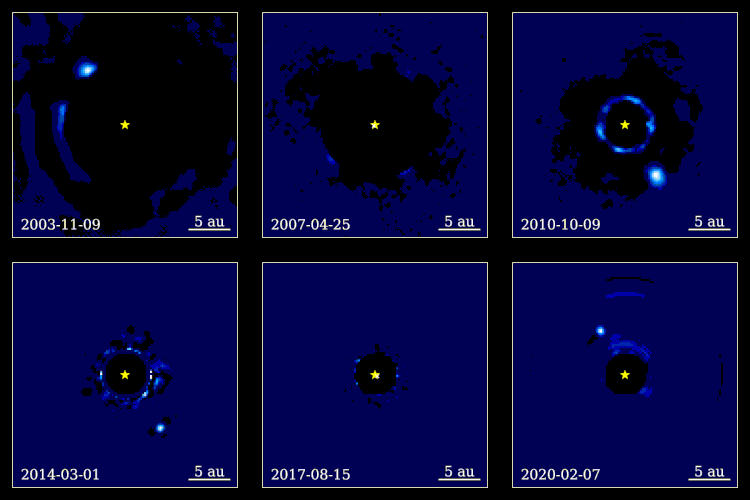
Timelapse of exoplanets orbit motion
← ホームへ戻る
系外惑星ハビタブルゾーン天文学トランジット法ドップラー分光法

系外惑星の最新知見:未知の世界を探索する天文学の最前線

🗓 2026年8月10日

私たちの太陽系以外に存在する惑星、すなわち系外惑星(Extrasolar planet)の探査は、現代天文学において最もエキサイティングな分野の一つです。かつては想像の産物であった「他の星を回る惑星」は、今や観測技術の向上により、数千もの実在する世界としてカタログ化されています。

系外惑星の発見の歴史は、1992年にパルサーの周囲で初めて確認されたことに始まります。その後、1995年には主系列星(太陽のような安定して燃える星)の周囲でも発見され、宇宙に惑星が普遍的に存在することが明らかになりました。2026年7月30日時点のデータでは、4,740の惑星系に6,333個の系外惑星が確認されており、そのうち1,056のシステムでは複数の惑星が共存していることが分かっています。

Exoplanet detections per year as of September 2024[48]

Key Facts

  • 確認数: 6,333個の系外惑星が4,740のシステムで確認済み。
  • 多様な質量: 月の約2倍の質量を持つ「Draugr」から、木星の約30倍に達する「HR 2562 b」まで極めて多様。
  • ハビタブルゾーン: 太陽に似た星の約5分の1が、生命居住可能領域に地球サイズの惑星を持つと推定。
  • 銀河系の可能性: 天の川銀河には、赤色矮星を含めると最大400億個の潜在的に居住可能な地球型惑星が存在する可能性。
  • 観測の偏り: 現在の検出手法は、主星に近い巨大惑星を見つけやすい傾向にある。

惑星をどのように見つけるのか:検出手法のメカニズム

系外惑星はあまりに遠く、主星の強い光に隠れているため、直接見ることは非常に困難です。そのため、多くの場合は間接的な手法が用いられます。

間接的な検出法

最も成果を上げているのがトランジット法(Transit photometry)です。これは、惑星が主星の前を横切る際に、星の明るさがわずかに暗くなる現象を捉える方法です。
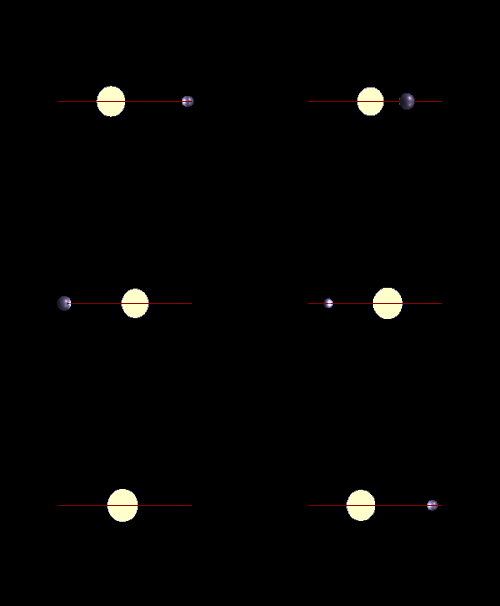
Edge-on animation of a star-planet system, showing the geometry considered for the transit method of exoplanet detection

また、ドップラー分光法(Doppler spectroscopy)も重要です。惑星の重力によって主星がわずかに揺さぶられることで、光の波長が変化する現象を利用して惑星の存在を突き止めます。
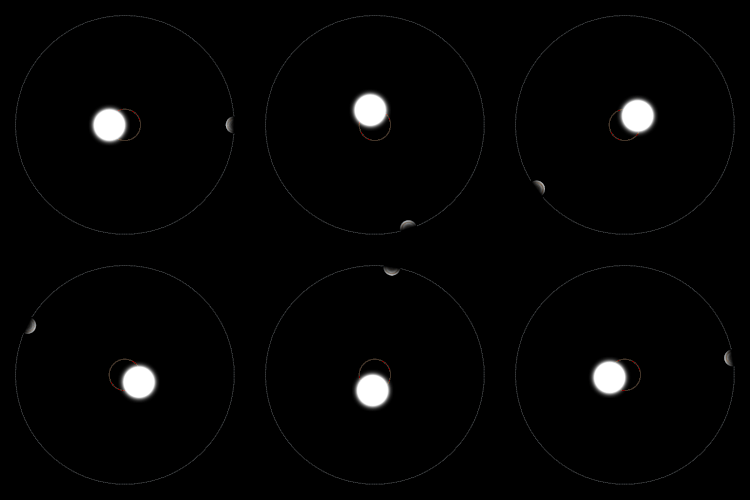
A planet is able to gravitationally pull its host star

直接的な観測とその他の手法

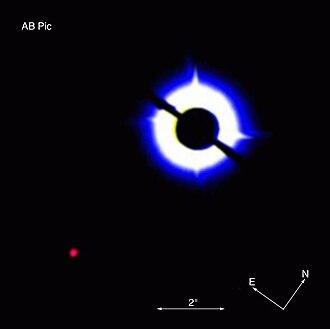
高度な技術を用いた直接撮像(Direct imaging)では、主星の光を遮るコロナグラフなどを用いて、惑星そのものを撮影します。また、重力レンズ効果を利用したマイクロレンズ法や、惑星の公転周期の変動を分析する手法など、多角的なアプローチが取られています。
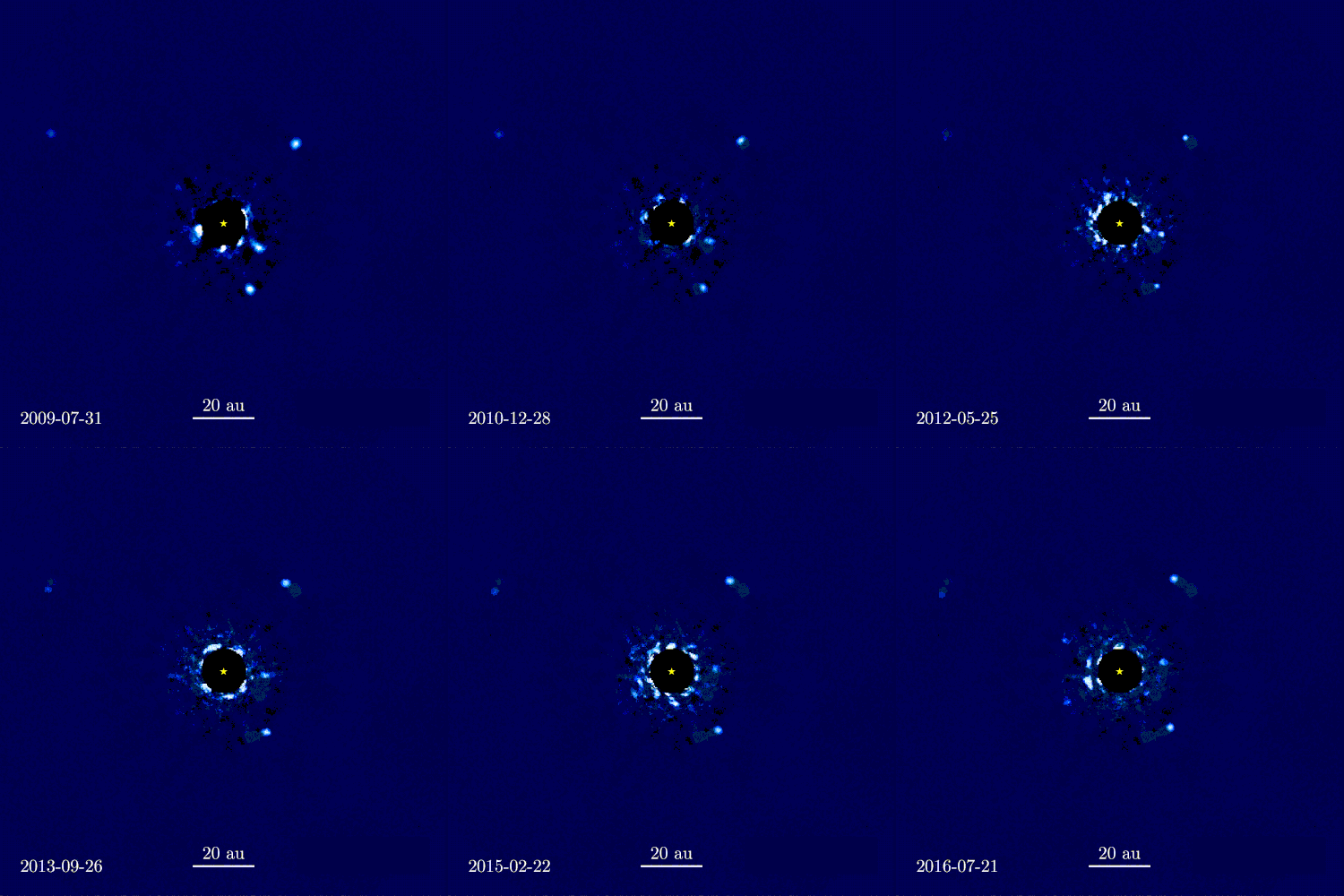
Timelapse of exoplanets orbit motion

Exoplanet HIP 65426b is the first discovered planet around star HIP 65426.[42]

Coronagraphic image of AB Pictoris showing a companion (bottom left), which is either a brown dwarf or a massive planet. The data were obtained on 16 March 2003 with NACO on the VLT, using a 1.4 arcsec occulting mask on top of AB Pictoris.

Two directly imaged exoplanets around star Beta Pictoris, star-subtracted and artificially embellished with an outline of the orbit of one of the planets. The white dot in the center is the other exoplanet in the same system.

多様な惑星の姿と環境

発見された系外惑星は、私たちの想像を絶する多様性を持っています。サイズ面では、水星や火星よりも遥かに小さい世界から、木星を遥かに凌ぐ巨大ガス惑星まで存在します。
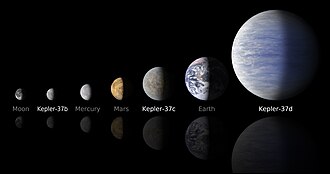
Comparison of the size of exoplanets orbiting Kepler-37 to Mercury, Mars and Earth

また、大気の組成や色も千差万別です。例えば、大気中のケイ酸塩の液滴が青い光を散乱させることで、深い青色に見える惑星(HD 189733bなど)が存在することが分かっています。大気の状態によって、雲に覆われた世界や、逆に澄み切った空を持つ世界があると考えられています。
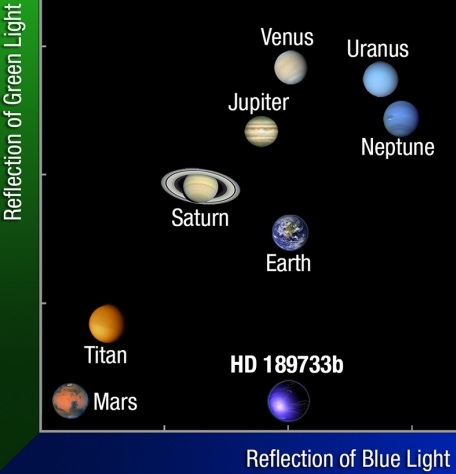
Color-color diagram comparing the colors of Solar System planets to exoplanet HD 189733b. HD 189733b reflects as much green as Mars and almost as much blue as Earth.

Clear versus cloudy atmospheres on two exoplanets.[179]

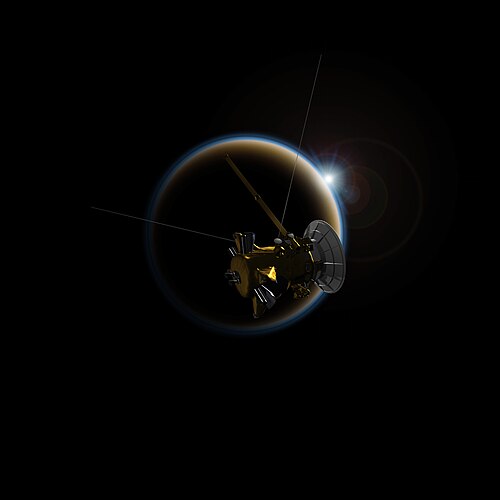
Artist's concept of the Cassini spacecraft in front of a sunset on Saturn's moon Titan

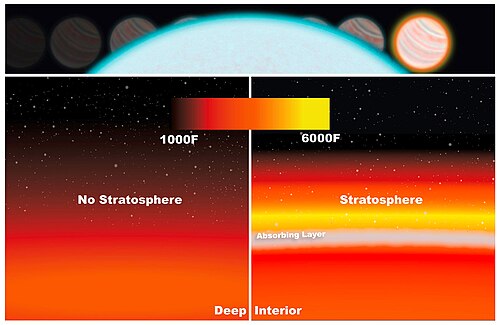
Artist's illustration of temperature inversion in an exoplanet's atmosphere, with and without a stratosphere

さらに、主星が2つある連星系を回る惑星など、太陽系にはない特異な軌道を持つ世界も確認されています。

Artist's impression of exoplanet orbiting two stars.[116]

生命の可能性を求めて:ハビタブルゾーンの探究

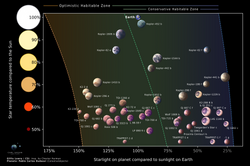
天文学者が最も注目しているのが、ハビタブルゾーン(Habitable zone)です。これは、惑星の表面に液体の水が存在しうる、主星からの距離が適切な領域を指します。

主星の種類(スペクトル型)によって、このゾーンの位置は異なります。例えば、低温の赤色矮星ではゾーンは星に近く、高温の星では遠くなります。2015年に発表された「Kepler-452b」は、太陽に似たG2型星のハビタブルゾーン内に位置する地球に近いサイズの惑星として注目を集めました。
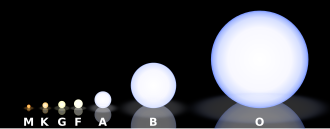
The Morgan–Keenan spectral classification system, showing size-and-color comparisons of M, K, G, F, A, B, and O stars

A diagram depicting habitable zone boundaries across star type. The y-axis is stellar temperature, with the Sun (5772 Kelvin) at the top. The x-axis is the percentage of starlight that reaches the planet, ranging from 25% of Earth's starlight to 150% of Earth's starlight on the inner edge of the habitable zone. The image plots 42 exoplanets, most of which orbit red dwarfs. The coldest planets around red dwarfs are depicted as icy "eyeball" planets due to tidal locking, while most of the other planets around red dwarfs are purple, due to speculations about purple photosynthesizing creatures. Habitable one planets around yellow stars are depicted as green or blue. Earth is plotted near the top, with only Kepler-452 b close to its position.

今後のミッションでは、より小さな岩石惑星を、より広い軌道で発見することが目標となっており、ナンシー・グレース・ローマン宇宙望遠鏡などの次世代機に期待が寄せられています。
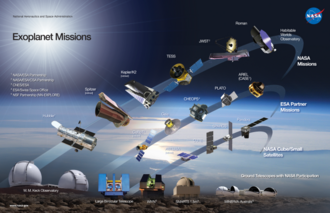
NASA graphic of present and future exoplanet missions as of 2022.

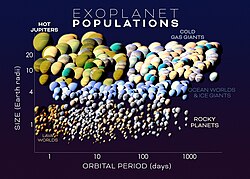
This plot shows currently known exoplanets, with different categories highlighted. Nancy Grace Roman Space Telescope will help fill in the bottom-right of the plot by finding small worlds in large orbits.

系外惑星の概要まとめ

系外惑星の主要データと特性
項目 詳細・数値
確認済み惑星数 6,333個(2026年7月時点)
最小質量惑星 Draugr(月の約2倍)
最大質量惑星 HR 2562 b(木星の約30倍 ※定義により褐色矮星の可能性あり)
主要な検出法 トランジット法、ドップラー分光法、直接撮像など
潜在的な居住可能惑星数 天の川銀河に110億〜400億個(推定)

Frequently Asked Questions

系外惑星とは具体的にどのような天体ですか?

私たちの太陽系の外側にある、他の恒星(主星)の周りを公転している惑星のことです。ガス惑星から岩石惑星まで、多様な種類が存在します。

「ハビタブルゾーン」とは何ですか?

主星からの距離が適切で、惑星の表面に液体の水が存在できる温度領域のことです。生命が存在するための重要な条件の一つと考えられています。

なぜ直接撮影できない惑星が多いのですか?

惑星自体は光を発せず、隣接する主星が圧倒的に明るいため、惑星の光が主星の輝きに飲み込まれてしまうからです。そのため、明るさの変化や重力による揺れを観測する間接的な手法が主流となっています。

地球に似た惑星は見つかっていますか?

はい。Kepler-452bのように、サイズや主星との距離が地球に近い惑星がいくつか発見されています。また、統計的に太陽に似た星の約20%がハビタブルゾーンに地球サイズの惑星を持つと推定されています。

褐色矮星と系外惑星の違いは何ですか?

一般的に、質量が非常に大きく、内部で重水素の核融合が起こる(または起こりうる)境界線にある天体を褐色矮星と呼びます。質量が大きすぎる系外惑星は、定義によって褐色矮星に分類されることがあります。

References

  1. For the purpose of this 1 in 5 statistic, "Sun-like" means . Data for Sun-like stars was not available so this statistic is an extrapolation from data about .
  2. For the purpose of this 1 in 5 statistic, Earth-sized means 1–2 Earth radii.
  3. For the purpose of this 1 in 5 statistic, "habitable zone" means the region with 0.25 to 4 times Earth's stellar flux (corresponding to 0.5–2 AU for the Sun).
  4. About 1/4 of stars are GK Sun-like stars. The number of stars in the galaxy is not accurately known, but assuming 200 billion stars in total, the would have about 50 billion Sun-like (GK) stars, of which about 1 in 5 (22%) or 11 billion would have Earth-sized planets in the habitable zone. Including red dwarfs would increase this to 40 billion.

📸 フォトギャラリー

Timelapse of exoplanets orbit motion
Comparison of the size of exoplanets orbiting Kepler-37 to Mercury, Mars and Earth
Exoplanet HIP 65426b is the first discovered planet around star HIP 65426.[42]
NASA graphic of present and future exoplanet missions as of 2022.
Exoplanet detections per year as of September 2024[48]
Coronagraphic image of AB Pictoris showing a companion (bottom left), which is either a brown dwarf or a massive planet. The data were obtained on 16 March 2003 with NACO on the VLT, using a 1.4 arcsec occulting mask on top of AB Pictoris.
Two directly imaged exoplanets around star Beta Pictoris, star-subtracted and artificially embellished with an outline of the orbit of one of the planets. The white dot in the center is the other exoplanet in the same system.
Edge-on animation of a star-planet system, showing the geometry considered for the transit method of exoplanet detection
A planet is able to gravitationally pull its host star
The Morgan–Keenan spectral classification system, showing size-and-color comparisons of M, K, G, F, A, B, and O stars
Artist's impression of exoplanet orbiting two stars.[116]
Color-color diagram comparing the colors of Solar System planets to exoplanet HD 189733b. HD 189733b reflects as much green as Mars and almost as much blue as Earth.
Clear versus cloudy atmospheres on two exoplanets.[179]
Artist's concept of the Cassini spacecraft in front of a sunset on Saturn's moon Titan
Artist's illustration of temperature inversion in an exoplanet's atmosphere, with and without a stratosphere
A diagram depicting habitable zone boundaries across star type. The y-axis is stellar temperature, with the Sun (5772 Kelvin) at the top. The x-axis is the percentage of starlight that reaches the planet, ranging from 25% of Earth's starlight to 150% of Earth's starlight on the inner edge of the habitable zone. The image plots 42 exoplanets, most of which orbit red dwarfs. The coldest planets around red dwarfs are depicted as icy "eyeball" planets due to tidal locking, while most of the other planets around red dwarfs are purple, due to speculations about purple photosynthesizing creatures. Habitable one planets around yellow stars are depicted as green or blue. Earth is plotted near the top, with only Kepler-452 b close to its position.
This plot shows currently known exoplanets, with different categories highlighted. Nancy Grace Roman Space Telescope will help fill in the bottom-right of the plot by finding small worlds in large orbits.