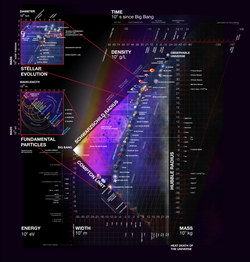
私たちの目に映る星々や惑星、そして私たち自身の体を構成する物質は、宇宙全体のほんの一部に過ぎません。宇宙の大部分を占めながら、光を発せず、反射も吸収もしないため直接観測することができない未知の物質、それがダークマター(暗黒物質)です。この不可視の物質は、強力な重力を通じて銀河の形成や維持に決定的な役割を果たしています。
Key Facts
- 不可視の正体:電磁波(光)と相互作用しないため、望遠鏡で直接見ることはできない。
- 重力の証拠:銀河の回転速度や光の曲がり方など、重力的な影響からその存在が証明されている。
- 宇宙の主成分:通常の物質(バリオン)よりも遥かに多く存在し、宇宙の構造を支える「骨組み」となっている。
- 有力候補:WIMPやアクシオンなどの未知の素粒子、あるいは原始ブラックホールなどが候補に挙がっている。
ダークマターの存在を裏付ける観測的根拠
ダークマターは直接見えませんが、周囲の天体に与える重力的な影響を分析することで、その存在が明らかになりました。
銀河の回転曲線と速度分散
渦巻銀河の回転速度を観測すると、中心から離れた外縁部の星々が、予想よりも遥かに速い速度で回転していることが分かりました。通常の可視物質だけでは、これらの星を繋ぎ止める重力が不足しており、銀河はバラバラに飛散してしまうはずです。この矛盾を解消するためには、目に見えない膨大な質量が銀河全体を包み込んでいる必要があります。
![The rotation curve of spiral galaxy UGC 11455.[67][68] The observed rotation is shown as points with error bars. The expected rotation from normal matter is shown in the line below.](/images/65/cf/65cf968736eb6d3a7443768d8bb9ea3b438e174504e7e443cb499a2cde0773c7.webp)
重力レンズ効果
アインシュタインの一般相対性理論によれば、巨大な質量を持つ物体の周囲では空間が歪み、後方から来る光が曲げられます。これを重力レンズと呼びます。遠方の銀河からの光が不自然に歪んでいる様子を観測することで、光を発しないダークマターがどこに、どれだけ分布しているかを地図化することが可能です。
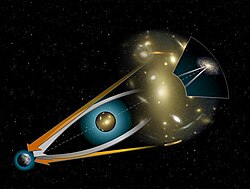
銀河団の衝突と弾丸銀河団
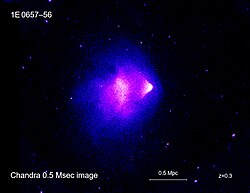
「弾丸銀河団(Bullet Cluster)」のような銀河団同士の衝突観測は、決定的な証拠となりました。衝突時、ガス(通常の物質)は相互作用して減速しますが、ダークマターは互いを通り抜け、重力中心だけが前方に移動したことが観測されました。これにより、ダークマターが通常の物質とは異なる性質を持つことが証明されました。
ダークマターの正体:理論的な候補
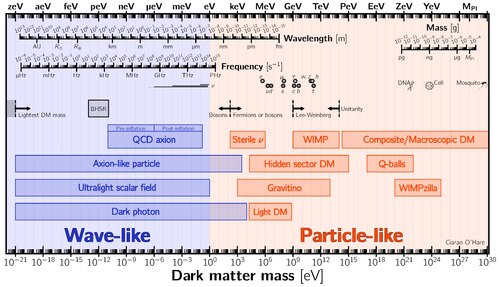
ダークマターが何でできているかについては、大きく分けて「非バリオン物質(通常の原子を構成しない物質)」と「マクロな天体」の2つの方向から研究が進んでいます。
素粒子候補(非バリオン物質)
- WIMP(ウィンプ):弱く相互作用する重量級粒子。超対称性理論などで予言されており、最も有力な候補の一つです。
- アクシオン:非常に軽く、強い相互作用の理論的な問題を解決するために導入された粒子です。
- ステライルニュートリノ:標準模型のニュートリノよりもさらに相互作用が弱い未知のニュートリノです。
マクロな天体候補
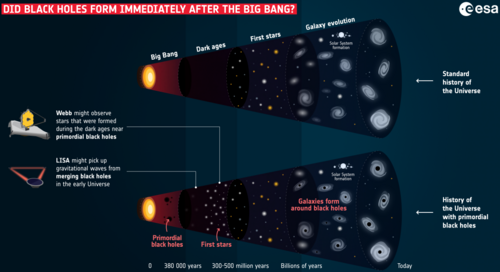
粒子ではなく、コンパクトな天体であるという説もあります。特に、宇宙誕生直後の高密度領域が崩壊して形成されたとされる原始ブラックホール(PBH)が注目されています。これらは星の進化を経てできるブラックホールとは異なり、宇宙初期の物理条件によって誕生したと考えられています。
![Primordial black holes were possibly formed by the collapse of overdense regions in the inflationary or early radiation-dominated universe.[165]](/images/3d/c8/3dc80a9c22ef3d4ab44f276baf8557157b0103a1799dc86dc580dd4853a06356.png)
検出に向けたアプローチと実験
科学者たちは、ダークマターの正体を突き止めるために3つの異なる手法で探索を続けています。
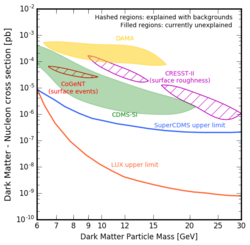
- 直接検出:地下深くの検出器を用い、ダークマター粒子が原子核に衝突した際に発生する微小な信号を捉える試みです(例:LZ実験、XENONnTなど)。
- 間接検出:宇宙空間でダークマター粒子同士が衝突・消滅した際に放出されるガンマ線やニュートリノなどの二次粒子を観測する方法です。
- 加速器による生成:LHC(大型ハドロン衝突型加速器)などの高エネルギー衝突実験により、人工的にダークマター粒子を作り出そうとする試みです。
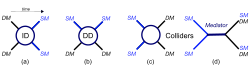
ダークマターの特性まとめ
| 候補名 | 分類 | 主な特徴 | 検出アプローチ |
|---|---|---|---|
| WIMP | 素粒子 | 質量が大きく、弱相互作用のみを行う | 直接検出・加速器 |
| アクシオン | 素粒子 | 極めて軽く、電磁場との相互作用が期待される | ヘリオスコープ・共振空洞 |
| 原始ブラックホール | 天体 | 宇宙初期に形成された高密度天体 | 重力レンズ・波形観測 |
| ステライルニュートリノ | 素粒子 | 標準模型外のニュートリノ | X線観測(間接検出) |
Frequently Asked Questions
ダークマターとダークエネルギーは何が違うのですか?
ダークマターは「重力によって物質を引き寄せ、構造を作る」役割を持ちますが、ダークエネルギーは「宇宙の膨張を加速させ、空間を押し広げる」正反対の性質を持つエネルギーです。
なぜダークマターは「暗黒」と呼ばれているのですか?
光(電磁波)を放出せず、反射も吸収もしないため、いかなる電磁波望遠鏡でも直接観測することができないからです。その正体が不明であるため、「ダーク(暗黒)」という名称が付けられました。
ダークマターが存在しない可能性はありますか?
一部の理論では、物質の量ではなく「重力の法則(修正ニュートン力学など)」自体が、銀河スケールで変化しているという説(修正重力理論)が提案されています。しかし、弾丸銀河団などの観測結果は、物質としてのダークマターの存在を強く支持しています。
ダークマターは私たちの体の中にもありますか?
理論上、ダークマター粒子は宇宙全体に遍在しており、絶えず私たちの体を通り抜けていると考えられています。ただし、通常の物質との相互作用が極めて弱いため、私たちはそれを全く感じることができません。
References
- "Um, wie beobachtet, einen mittleren Dopplereffekt von 1000 km/sek oder mehr zu erhalten, müsste also die mittlere Dichte im Comasystem mindestens 400 mal grösser sein als die auf Grund von Beobachtungen an leuchtender Materie abgeleitete. Falls sich dies bewahrheiten sollte, würde sich also das überraschende Resultat ergeben, dass dunkle Materie in sehr viel grösserer Dichte vorhanden ist als leuchtende Materie."(p125)
- [In order to obtain an average Doppler effect of 1000 km/s or more, as observed, the average density in the Coma system would thus have to be at least 400 times greater than that derived on the basis of observations of luminous matter. If this were to be confirmed, the surprising result would then follow that dark matter is present in very much greater density than luminous matter.]
- However, in the modern cosmic era, this neutrino field has cooled and started to behave more like matter and less like radiation.
- This is a consequence of the and the observation that spiral galaxies are spherically symmetric to a large extent (in 2D).
- The three neutrino types already observed are indeed abundant, and dark, and matter, but their individual masses are almost certainly too tiny to account for more than a small fraction of dark matter, due to limits derived from and high- galaxies.
- "One widely held belief about dark matter is it cannot cool off by radiating energy. If it could, then it might bunch together and create compact objects in the same way baryonic matter forms planets, stars, and galaxies. Observations so far suggest dark matter doesn't do that – it resides only in diffuse halos ... As a result, it is extremely unlikely there are very dense objects like stars made out of entirely (or even mostly) dark matter." — Buckley & Difranzo (2018)
📸 フォトギャラリー
![Hubble close-up on the Coma Cluster[33]](/images/6c/44/6c44d3024dd7bdabc021e521193f7627729edcb0575757567cf1263b3905726c.jpg)
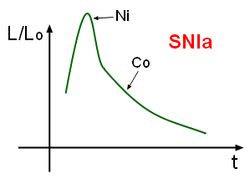
![Dark matter map for a patch of sky based on gravitational lensing analysis of a Kilo-Degree Survey[93]](/images/6e/d6/6ed6737ba547a6b112bd40b9c997972c4d06e14c5899ff0451da7d7ff90518ab.jpg)
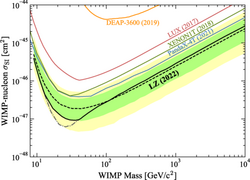
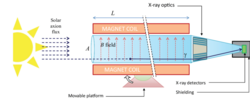
![November 2025 JWST observations confirmed an actively growing supermassive black hole within a "little red dot" galaxy named CANUCS-LRD-z8.6.[158]](/images/35/45/3545006d60a2907fcb584e87a090df5472b4fa34c8a58b3c20f53ebb6f2e494f.jpg)
![Collage of six cluster collisions with dark matter maps. The clusters were observed in a study of how dark matter in clusters of galaxies behaves when the clusters collide.[174]](/images/d3/86/d3864b58ca8bc48cd5624862bd59eb299b3b9ec3e3b0a40b67e42c992b0d884e.jpg)