現代社会のあらゆる側面に浸透している人工知能(AI)は、単なるブームを超え、産業構造や私たちの生活様式を根本から変えつつあります。AIとは、人間の知的な振る舞いをコンピュータで再現しようとする技術の総称であり、その目的は単純なタスクの自動化から、人間と同等かそれ以上の能力を持つ「汎用人工知能(AGI)」の実現まで多岐にわたります。
Key Facts
- AIの階層構造: AIという大きな枠組みの中に「機械学習」があり、さらにその一部として「ディープラーニング」が存在します。
- 主要なアプローチ: 記号的AI(ルールベース)から、データから学習する統計的・確率的な手法へと進化してきました。
- 広範な応用: 検索エンジン、自動運転、医療診断、生成AIなど、現代の主要インフラの多くに組み込まれています。
- グローバルな競争: 特に米国と中国が特許数などの指標で世界的な主導権を争っています。
- 倫理的リスク: プライバシー侵害、バイアス、環境負荷、そして人類への存亡リスク(存亡リスク)が議論されています。
AIを支える技術的アプローチと学習モデル
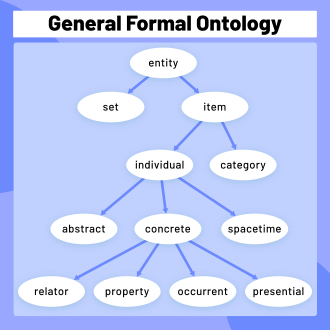
AIを実現するための手法は多岐にわたります。初期のAIは、知識を概念と関係性のセットとして定義するオントロジーなどの記号的アプローチが主流でした。
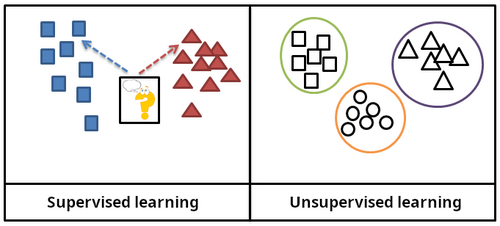
しかし、現代の主流はデータからパターンを抽出する機械学習(Machine Learning)です。これには、正解データを与える「教師あり学習」と、データ自体の構造を分析する「教師なし学習」の2つの主要な形式があります。
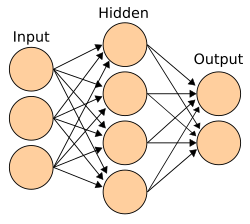
さらに、人間の脳の神経回路を模したニューラルネットワークの層を深くしたものがディープラーニング(深層学習)です。これにより、画像認識や複雑な言語理解が飛躍的に向上しました。
![Deep learning is a subset of machine learning, which is itself a subset of artificial intelligence.[116]](/images/fc/77/fc77552415ea92b9a330cb87489e069344686494b8b8851acd71a5a4afaa7992.webp)
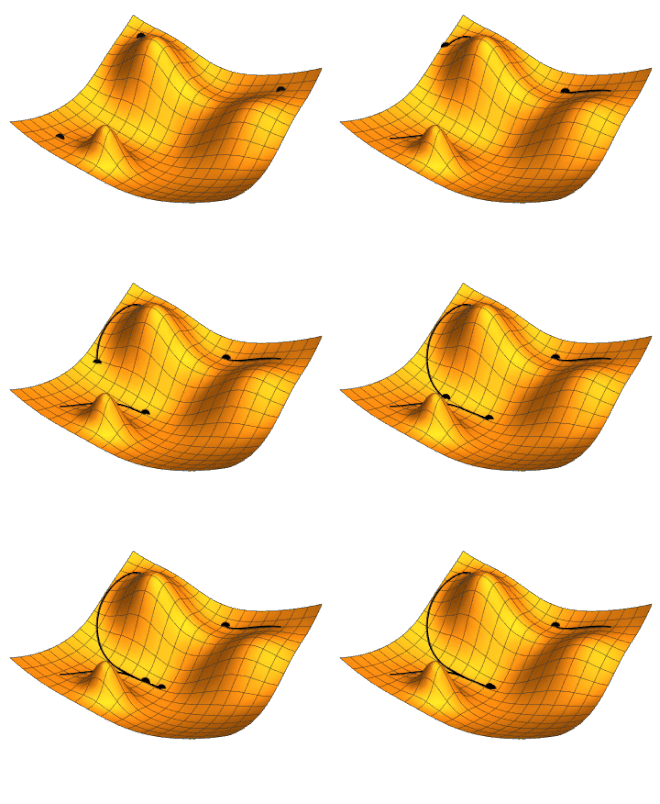
学習の最適化には、損失関数(予測と正解の誤差)を最小化するためにパラメータを調整する勾配降下法などの数学的手法が用いられます。
確率的推論と最適化
不確実な状況下での意思決定には、条件付き確率を用いるベイジアンネットワークなどの確率的手法が活用されます。また、最適な解を導き出すための「状態空間探索」や「局所探索」といったアルゴリズムもAIの根幹を成しています。

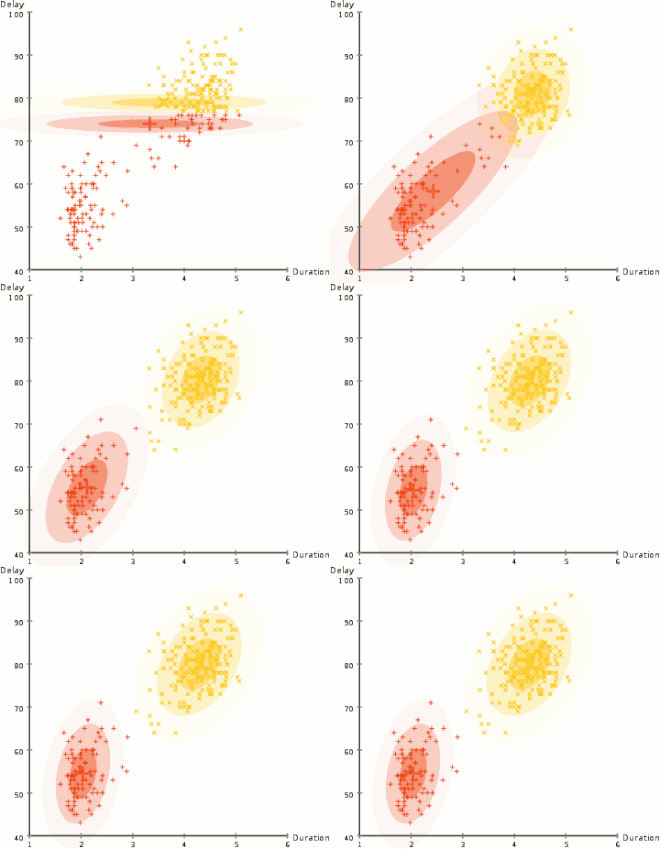
データのグループ分けを行うクラスタリングにおいては、期待値最大化(EM)法などの手法が用いられ、物理的に異なるモードを正確に分類することが可能です。
AIの具体的な応用分野と実装
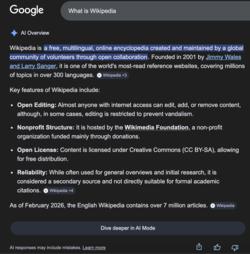
AIはすでに、私たちの日常的なデジタル体験の裏側で動作しています。Google検索のような検索エンジンや、Netflix、Amazonなどのレコメンデーションシステム、SiriやAlexaといった仮想アシスタントがその代表例です。
また、物理的な世界への展開としてロボティクスが挙げられます。1990年代の感情認識ロボット「Kismet」から、現代の高度な自律走行車やドローンに至るまで、AIは「身体」を持つことで現実世界に干渉しています。
![Kismet, a robot head made in the 1990s, is a machine that can recognise and simulate emotions.[68]](/images/05/0d/050d52fdcb5c75cde82ceaa8cf67819d56402fad4ed6688f7653726a27dd32c3.jpg)
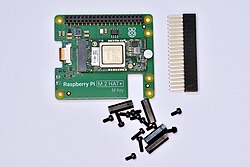
ハードウェア面では、Raspberry Pi AI Kitのようなエッジデバイスから、膨大な計算資源を必要とする巨大なAIデータセンターまで、インフラの規模が拡大しています。この計算需要の増大は、電力消費の増加という環境課題も引き起こしています。
![Fuelled by a growth in AI, data centres' demand for power increased in the 2020s.[224]](/images/a0/ee/a0ee493567435e4fd9643b80c44ae4d118fa261e522b542c4812d1a33abb4e1d.webp)
生成AIとLLMの台頭
近年、特に注目を集めているのが生成AI(Generative AI)です。大規模言語モデル(LLM)は、テキスト、画像、音声、ビデオなどを自動生成し、ソフトウェア開発の支援や翻訳、芸術創作など、クリエイティブな領域にまで浸透しています。
AIの歴史と社会的・倫理的影響
AIの概念は古く、1921年にカレル・チャペックが戯曲の中で「ロボット」という言葉を造ったことにまで遡ります。その後、知能の判定基準として「チューリングテスト」が提案されましたが、これは人間のような振る舞いを重視するため、非人間的な知能を過小評価するという側面もあります。
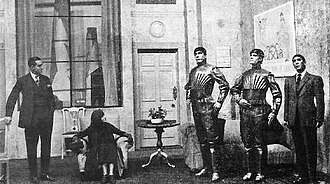
![The Turing test can provide some evidence of intelligence, but it penalises non-human intelligent behaviour.[409]](/images/25/5d/255dd4f8ab1e409c3c7b509b5a57b3d38fce3f7735042306ec00a4db49bda0e9.webp)
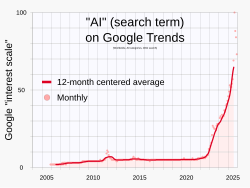
AIの発展は直線的ではなく、「AIの冬」と呼ばれる停滞期と、爆発的な普及期を繰り返してきました。2022年頃からは、一般消費者の間でもAIへの関心が急増しています。
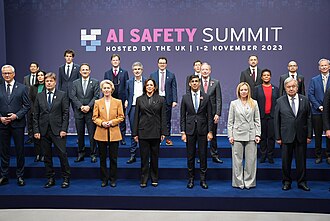
現在、AIの普及に伴い、知的財産権の侵害、アルゴリズムによる偏見(バイアス)、ディープフェイクによる誤情報の拡散といった深刻なリスクが顕在化しています。これに対処するため、2023年には英国で世界初のAI安全サミットが開催され、国際的な協力体制の構築が模索されています。
また、国家間の競争も激化しており、特に米国と中国が世界的なAI特許の大部分を占めています。中国は特許数でリードしていますが、1社あたりの特許効率では米国が高い傾向にあります。
![In 2024, AI patents in China and the US numbered more than three-fourths of AI patents worldwide.[365] Though China had more AI patents, the US had 35% more patents per AI patent-applicant company than China.[365]](/images/ba/c6/bac689381252aa9a640c8fe80c2c25a3cd82f27a30fd5c9bfe33dc49c807b299.webp)
AIがもたらす文化的影響は、ストリートアートのような芸術形式から、人間同士のコミュニケーションの代替に至るまで、社会のあらゆる層に及んでいます。
![Street art in Tel Aviv[199][200]](/images/e2/e2/e2e2e6efcb32360597e40ae4fa630dc51c86fbb1efd75346493c500761119726.jpg)
AI技術の概要まとめ
| アプローチ | 主な特徴 | 代表的な手法・モデル |
|---|---|---|
| 記号的AI | 明示的なルールと論理に基づく | エキスパートシステム、オントロジー |
| 機械学習 | データからパターンを学習する | 決定木、SVM、ベイジアンネットワーク |
| ディープラーニング | 多層ニューラルネットワークを利用 | CNN, RNN, Transformer, GPT |
| 生成AI | 新しいコンテンツを創造する | LLM, 拡散モデル (Stable Diffusion等) |
Frequently Asked Questions
AI、機械学習、ディープラーニングの違いは何ですか?
AIはコンピュータに知能を持たせる技術全般を指します。機械学習はその中の手法の一つで、データから学習する能力を指します。ディープラーニングはさらに機械学習の特殊な形態であり、多層のニューラルネットワークを用いて複雑なパターンを学習する技術です。
汎用人工知能(AGI)とは何ですか?
特定のタスク(例:囲碁や翻訳)だけでなく、人間のようにあらゆる知的タスクをこなすことができるAIのことです。現在のAIの多くは「特化型AI」であり、AGIの実現はAI研究の大きな目標の一つとなっています。
AIによる失業のリスクはありますか?
AIによる自動化は、一部の定型業務やデータ処理業務において人間の代替となる可能性があります。一方で、AIを使いこなす新しい職種の創出や、人間ならではの創造性・共感力が求められる業務の価値が高まると考えられています。
AIの「バイアス」とはどういう意味ですか?
AIが学習に使用したデータに偏りがある場合、AIが導き出す結果に人種的、ジェンダー的な差別や偏見が含まれてしまうことを指します。これは公平性の観点から、AI開発における重要な課題となっています。
AIの安全性を確保するための取り組みはありますか?
AIの目的を人間の価値観に一致させる「AIアライメント」の研究や、政府による規制(EU AI法など)、国際的な安全基準の策定などが進められています。
References
- This list of intelligent traits is based on the topics covered by the major AI textbooks, including: , , and .
- This list of tools is based on the topics covered by the major AI textbooks, including: , , and .
- It is among the reasons that proved to be inefficient for capturing knowledge.
- "Rational agent" is general term used in , and theoretical artificial intelligence. It can refer to anything that directs its behaviour to accomplish goals, such as a person, an animal, a corporation, a nation, or in the case of AI, a computer program.
- discussed the centrality of learning as early as 1950, in his classic paper "". In 1956, at the original Dartmouth AI summer conference, wrote a report on unsupervised probabilistic machine learning: "An Inductive Inference Machine".
- See .
- Compared with symbolic logic, formal Bayesian inference is computationally expensive. For inference to be tractable, most observations must be of one another. uses a Bayesian network with over 300 million edges to learn which ads to serve.
- Expectation–maximisation, one of the most popular algorithms in machine learning, allows clustering in the presence of unknown .
- Some form of deep neural networks (without a specific learning algorithm) were described by: and (1943); (1948); and (1961). Deep or recurrent networks that learned (or used gradient descent) were developed by: (1957); (1959); and (1965); (1971); (1972); and (1982). Precursors to backpropagation were developed by: (1960); (1962); (1962); and (1969). Backpropagation was independently developed by: (1970); and (1974).
- said, of his work on neural networks in the 1990s, "our labeled datasets were thousands of times too small. [And] our computers were millions of times too slow."
📸 フォトギャラリー