現代の科学や工学、そして最新のAI技術を支える数学的基盤の一つにテンソルがあります。多くの人が「多次元配列」としてテンソルを認識していますが、数学的な本質は単なるデータの並びではなく、ベクトル空間における多重線形な関係性を記述する代数的なオブジェクトです。スカラーやベクトルといった馴染み深い概念も、実はテンソルという大きな枠組みの中の特殊なケースに過ぎません。
Key Facts
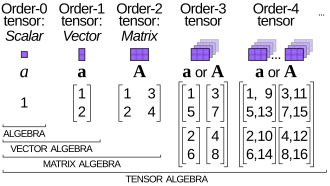
- 階数(オーダー)によって、0階はスカラー、1階はベクトル、2階は行列(線形写像)として表現される。
- 座標系(基底)を変更しても、特定の変換則に従って成分が変化するため、物理的な実体(不変量)を記述できる。
- 物理学では、応力、電磁場、時空の曲率など、方向性と強度を同時に持つ現象の記述に不可欠である。
- 機械学習においては、高次元のデータ構造を効率的に扱うための多次元配列として利用されている。
テンソルの基礎概念と階層構造
テンソルを理解する最も簡単な方法は、その「階数(ランクまたはオーダー)」に注目することです。階数とは、そのオブジェクトを特定するために必要なインデックス(添字)の数であり、データの次元数に対応します。
- 0階テンソル(スカラー):方向を持たない単一の値。例:温度、質量。
- 1階テンソル(ベクトル):大きさと方向を持つ量。例:速度、力。
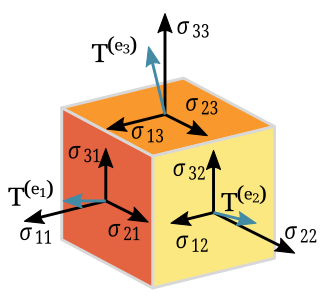
- 2階テンソル:ベクトルを別のベクトルへ変換する線形写像。行列として表現され、物理学では応力テンソルなどが代表的です。
このように、テンソルは低次元の概念を包含し、より複雑な高次元の関係性へと拡張できる柔軟な構造を持っています。
数学的な定義の視点
数学的に厳密に定義すると、テンソルはベクトル空間とその双対空間(共変ベクトル空間)のテンソル積の要素として定義されます。また、複数のベクトルを入力として受け取り、一つのスカラーを出力する「多重線形写像」としても捉えることができます。重要なのは、テンソルが特定の座標系に依存せず定義される点です。座標系を変えても、成分が特定の変換則(共変・反変変換)に従うため、物理的な意味が保存されます。
物理学における実用的な応用
テンソルが物理学で不可欠な理由は、空間のあらゆる方向における物理量の相互作用を簡潔に記述できるためです。特に、物体内部の力学的な状態を示すコーシー応力テンソルは、ある面に対して垂直に働く力だけでなく、せん断力などの複雑な応力状態を一つの数学的オブジェクトで表現します。
また、以下のような広範な分野で活用されています。
- 一般相対性理論:アインシュタインは、時空の歪みを記述するためにリーマン曲率テンソルやエネルギー・運動量テンソルを用いました。
- 電磁気学:電場と磁場を統合して扱う電磁テンソル(ファラデーテンソル)が利用されます。
- 連続体力学:材料の変形や歪みを記述する歪みテンソルなどが用いられます。
テンソル場という概念
現実の物理現象では、テンソルの値が場所によって異なることが一般的です。例えば、ある物体の内部で場所ごとに応力が異なる場合、空間の各点にテンソルを割り当てたものをテンソル場と呼びます。微分幾何学において、この概念は多様体上の幾何学的構造を解析するための中心的な道具となります。
その他の現代的応用:光学からAIまで
テンソルの概念は純粋物理学に留まらず、現代のテクノロジーにも浸透しています。光学分野では、非線形感受率などの高階テンソルを用いて、ポッケルス効果やカー効果といった光学的現象を解析します。
さらに、現在の機械学習(ディープラーニング)において、「テンソル」という言葉は日常的に使われています。ここでは主に多次元配列としての意味で使われ、ニューラルネットワークにおける重みやデータのバッチ処理を効率的に計算するために、テンソル演算(行列演算の拡張)が基盤となっています。
テンソルの特性まとめ
| 階数 (Order) | 名称 | 数学的表現 | 物理的・実用的例 |
|---|---|---|---|
| 0 | スカラー | 単一の数値 | 曲率スカラー、温度 |
| 1 | ベクトル | 1次元配列 | 勾配、双極子モーメント |
| 2 | 2階テンソル | 2次元配列(行列) | 計量テンソル、応力テンソル |
| 3以上 | 高階テンソル | 多次元配列 | リーマン曲率テンソル、弾性テンソル |
Frequently Asked Questions
行列とテンソルの違いは何ですか?
行列は2次元の数値配列ですが、テンソルはより一般的な概念です。2階テンソルは特定の基底において行列として表現されますが、テンソルであるためには、座標変換に対して特定の変換則に従う必要があります。つまり、すべての行列がテンソルであるわけではなく、物理的・幾何学的な不変性を持つ行列がテンソルと呼ばれます。
「共変」と「反変」とはどういう意味ですか?
これらは座標変換時の成分の変化の仕方を指します。座標系のスケールを大きくしたときに、成分がそれに合わせて大きくなるものが「反変(contravariant)」、逆に小さくなるものが「共変(covariant)」です。ベクトルは通常反変であり、勾配などの線形形式(1形式)は共変として振る舞います。
なぜ機械学習で「テンソル」という言葉が使われるのですか?
機械学習では、画像(高さ×幅×チャンネル)や動画(時間×高さ×幅×チャンネル)のように、多次元のデータを一括して処理する必要があります。これらの多次元配列を数学的に扱うための演算(テンソル積や縮約など)が線形代数の拡張であるため、便宜的にテンソルと呼ばれています。
テンソル積とはどのような操作ですか?
2つのテンソルを組み合わせて、より高い階数の新しいテンソルを作成する操作です。例えば、1階テンソル(ベクトル)と1階テンソルをテンソル積で結ぶと、2階テンソル(行列)が生成されます。これにより、複数の線形空間の情報を統合して表現することが可能になります。
References
- The Einstein summation convention, in brief, requires the sum to be taken over all values of the index whenever the same symbol appears as a subscript and superscript in the same term. For example, under this convention
- The , for instance, is used to identify V with the double dual space V∗∗, which consists of multilinear forms of degree one on V∗. It is typical in linear algebra to identify spaces that are naturally isomorphic, treating them as the same space.
- Namely, the in a vector space.

📸 フォトギャラリー