海洋や湖沼などの水圏において、自力で強い流れに抗うことができず、漂流しながら生活する生物をプランクトンと呼びます。その中でも、他の生物を摂取してエネルギーを得る従属栄養生物(ヘテロトロフ)のグループが「動物プランクトン」です。ギリシャ語で「動物」を意味する「zōîon」と、「漂流者」を意味する「planktós」に由来しており、文字通り「漂う動物」を指します。
植物プランクトンが太陽光を利用して自ら栄養分を作り出す(独立栄養)のに対し、動物プランクトンは植物プランクトンなどのより小さな生物を食べることで生存しています。そのサイズは、顕微鏡でしか見えない微小なものから、クラゲのように肉眼で容易に確認できる大型のものまで非常に多岐にわたります。
Key Facts
- 栄養形態: 自ら餌を作れない従属栄養生物であり、他生物を消費して生きる。
- 多様なサイズ: 2μm未満のピコサイズから、数ミリメートル以上のメソサイズまで存在する。
- 生態的地位: 植物プランクトンと大型海洋生物(魚類など)を繋ぐ重要な食物網の結節点となる。
- 炭素循環への寄与: 排泄物や死骸を通じて、表層の炭素を深海へ運ぶ役割を担う。
動物プランクトンの分類とサイズ
動物プランクトンは、その体長によって以下のように分類されます。サイズによって摂食対象や生態的役割が異なります。
| 分類名 | サイズ範囲 |
|---|---|
| ピコ動物プランクトン (picozooplankton) | 2μm未満 |
| ナノ動物プランクトン (nanozooplankton) | 2~20μm |
| ミクロ動物プランクトン (microzooplankton) | 20~200μm |
| メソ動物プランクトン (mesozooplankton) | 0.2~20mm |
単細胞生物から多細胞動物まで
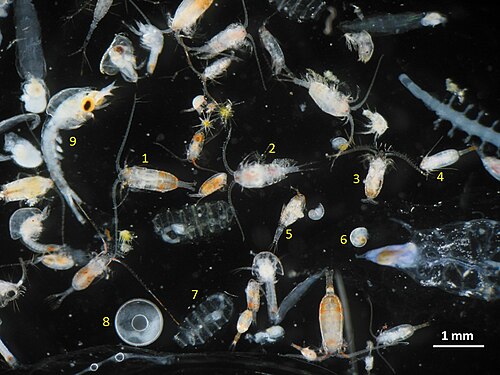
微小なグループには、放射虫や有孔虫などの原生動物が含まれます。放射虫はケイ酸の殻を持つものが多く、有孔虫は複雑な室を持つ構造が特徴です。また、一部の渦鞭毛藻(うずべんもうそう)のように、寄生性のものや毒素を産生して赤潮を引き起こす種も存在します。
一方、多細胞の動物プランクトンでは、カイアシ類(コペポーダ)が代表的です。彼らは頭部・胸部・腹部の3つの節に分かれた体と、カルシウム成分を含む外骨格を持っており、海洋において極めて優占的な種となっています。
特殊な生存戦略:ミクソトロフ
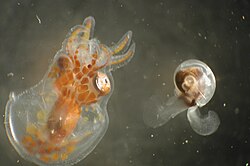
光合成を行う能力と、他の生物を食べる能力の両方を併せ持つミクソトロフ(混合栄養生物)というグループが存在します。彼らは環境に応じてエネルギー獲得手段を切り替えることができるため、栄養分が乏しい海域でも生存しやすいという利点があります。
採取方法と調査技術
動物プランクトンの研究には、多様なネット(網)を用いた採取が行われます。海面付近の生物を狙うネウストンネットや、特定の水深を効率的に採取するボンゴネット、PairoVETなどが活用されています。
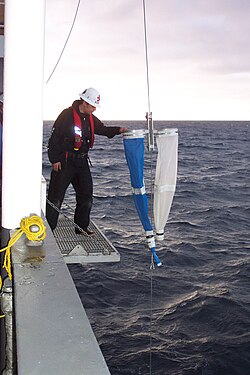
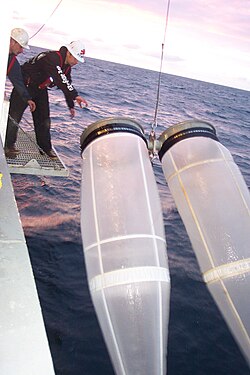
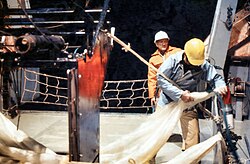
また、夜間にネットを回収する作業や、サンプルを慎重に回収するプロセスを経て、詳細な分析が行われます。最近では、船が航行しながら水深3mから毎分640リットルの海水をポンプで吸い上げ、プランクトンを濃縮して回収するCUFES(連続航行魚卵サンプラー)のような装置も導入されており、位置情報や環境データと同期した高精度なサンプリングが可能になっています。

![In addition to net tows, plankton is collected while the research vessel is moving using (e.g. for ichthyoplankton) a Continuous Underway Fish Egg Sampler, or CUFES. Water is pumped aboard the vessel from 3 m depth at 640 liters/min. The water is sent through a concentrator where it passes through a net, and the plankton is diverted to a collector. While CUFES is running, a data logger is recording the date, time, and position for each sample as well as other environmental data from the ship's sensors (e.g. wind speed, direction, SST).[31]](/images/e8/ac/e8acdd84aead77cb7c7ac065e1de91ce6005a5bb67f8a1ef00f439f980544c48.jpg)
海洋生態系と地球環境への影響
動物プランクトンは、単に「食べられる側」であるだけでなく、海洋の化学的組成にも大きな影響を与えています。特に「スロッピーフィーディング(雑な摂食)」と呼ばれる現象が重要です。これは、獲物を食べる際に細胞を破壊し、溶解有機炭素(DOC)などを周囲に放出することを指します。
![Schematic of how common seawater constituents, including particulate and dissolved components, could both be generated and altered through the process of herbivorous zooplankton grazing [75]](/images/ea/81/ea81a2bbd2a32d591963b1275464db6c2f380214457cf7fac6ec3dc1cfcf6c38.jpg)
![Sloppy feeding by zooplanktonDOC = dissolved organic carbonPOC = particulate organic carbonAdapted from Møller et al. (2005),[84]Saba et al. (2009)[85] and Steinberg et al. (2017).[79]](/images/ee/15/ee15e37274119acb6ee8f703edae21204e27a4e0f48ad9c7cad7b9b3030e171f.jpg)
このプロセスにより、粒子状の有機物が溶解した形に変換され、微生物が利用可能な形になります。また、彼らが排泄する糞粒(フェカルペレット)は、重力によって深海へと沈降するため、大気中の二酸化炭素を海洋深層に固定する「生物ポンプ」の重要な駆動源となっています。
Frequently Asked Questions
植物プランクトンとの決定的な違いは何ですか?
最大の違いは栄養獲得方法です。植物プランクトンは光合成によって自らエネルギーを作り出す「独立栄養生物」ですが、動物プランクトンは他の生物を食べることでエネルギーを得る「従属栄養生物」です。
動物プランクトンにはどのような種類がいますか?
単細胞の原生動物(放射虫、有孔虫など)から、甲殻類(カイアシ類、オキアミ)、刺胞動物(クラゲ)、さらには魚類やイカの幼生(魚類プランクトン)まで、非常に幅広い生物群が含まれます。
「ミクソトロフ」とはどのような生物ですか?
光合成によるエネルギー生産と、他の生物の捕食という2つの栄養摂取方法を使い分ける生物のことです。これにより、環境の変化に柔軟に対応して生存することが可能です。
動物プランクトンが地球温暖化にどう関わっていますか?
彼らが表層で摂取した炭素を、糞粒や死骸として深海へ沈めることで、大気中の炭素を海洋底に隔離する役割を果たしています。このプロセスが地球の気候調節に寄与しています。
プランクトンはすべて海にしかいないのですか?
いいえ。海洋だけでなく、湖や川などの淡水域にも存在します。また、空気中を漂うエアロプランクトンなどの概念も存在します。
References
- Sardet, Christian (2015-06-05). Plankton: Wonders of the Drifting World. University of Chicago Press. .
- "zooplankton". UK English Dictionary. . Archived from the original on March 1, 2020.
- "zooplankton". . Merriam-Webster. 1032680871.
- Thurman, H. V. (1997). Introductory Oceanography. New Jersey, USA: Prentice Hall College. .
- Lalli, C.M. & Parsons, T.R. (1993). Biological Oceanography An Introduction. Burlington, MA: Elsevier. p. 314. .
- "How We Do Things at IISD-ELA: Researching Mercury". IISD. 2017-04-05. Retrieved 2020-07-06.
- Everett, J.D., Baird, M.E., Buchanan, P., Bulman, C., Davies, C., Downie, R., Griffiths, C., Heneghan, R., Kloser, R.J., Laiolo, L. and Lara-Lopez, A. (2017) "Modeling what we sample and sampling what we model: challenges for zooplankton model assessment". Frontiers in Marine Science, 4: 77. :10.3389/fmars.2017.00077. Material was copied from this source, which is available under a Creative Commons Attribution 4.0 International License.
- Jude, B.A.; Kirn, T.J.; Taylor R.K. (2005). "A colonization factor links Vibrio cholerae environmental survival and human infection". . 438 (7069): 863–6. :2005Natur.438..863K. :10.1038/nature04249. 16341015. 1964530.
- Litchman, Elena; Ohman, Mark D.; Kiørboe, Thomas (2013). "Trait-based approaches to zooplankton communities". Journal of Plankton Research. 35 (3): 473–484. :10.1093/plankt/fbt019.
- Kiørboe, Thomas; Hirst, Andrew G. (2014). "Shifts in Mass Scaling of Respiration, Feeding, and Growth Rates across Life-Form Transitions in Marine Pelagic Organisms". The American Naturalist. 183 (4): E118–E130. :2014ANat..183E.118K. :10.1086/675241. 24642502. 15891709.
📸 フォトギャラリー