宇宙の広大なスケールの中で、私たちの住む天の川銀河は孤独に浮かんでいるわけではありません。銀河は互いに集まり「銀河群」を形成し、さらにそれらが集まって「銀河団」、そしてさらに巨大な「超銀河団」という階層構造を作っています。私たちが属しているのが、おとめ座超銀河団(別名:局所超銀河団)です。
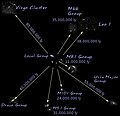
この構造は、中心にある巨大な「おとめ座銀河団」を核とし、その周囲に多くの銀河群が分布しています。私たちの天の川銀河を含む「局所群」は、この超銀河団の端の方に位置しています。
Key Facts
- 構成要素: おとめ座銀河団を中心に、局所群を含む100以上の銀河群・銀河団で構成される。
- 規模: 長軸は約1億4700万光年(45メガパーセク)に及ぶ。
- 位置づけ: さらに巨大な「ラニアケア超銀河団」という構造の一部である。
- 質量: 光に見える物質よりも遥かに多い質量を持ち、ダークマターの存在を強く示唆している。
- ダイナミクス: 全体が「グレートアトラクター」と呼ばれる巨大な質量中心に向かって移動している。
超銀河団の構造と分布
おとめ座超銀河団は、単純な球形ではなく、平坦なディスク状の領域と、それを包む球状のハローという2つの主要コンポーネントから成り立っています。光り輝く銀河の約3分の2はこのディスク部分に集中しており、非常に薄い楕円体のような形状をしています。
このディスク状の主体系は「おとめ座ストランド」と呼ばれ、さらに広大な銀河フィラメント(宇宙の網目構造)の一部となっています。このフィラメントは、ケンタウルス座銀河団からおとめ座銀河団を経て、おおぐま座銀河団、そしてペルセウス・うお座超銀河団まで長く伸びています。
![An old diagram showing the location of the Local Group, including the Solar System, within the Virgo Supercluster, revealing its location at the supercluster's outskirts with the Virgo Cluster forming its heart.[2] The Fornax Cluster shown at the left was later revealed to be a separated part of the Southern Supercluster. Both superclusters are part of the greater Laniakea Supercluster cocoon (see below).](/images/68/c1/68c196d2dc7e0346cd343ab0748949435e01be73b9f86532c7734a233ab1fd2e.jpg)
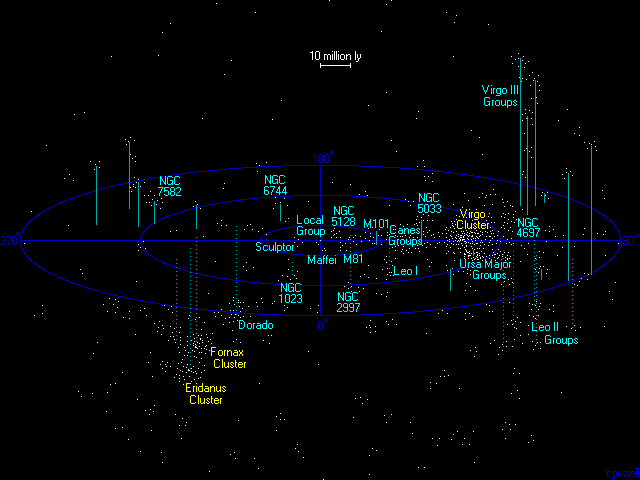
銀河の分布を詳しく見ると、中心のおとめ座銀河団付近で密度が最も高く、離れるにつれて急激に減少します。興味深いことに、多くの銀河は「クラウド」と呼ばれる少数のグループに集中しており、その間の大部分は「ボイド」と呼ばれる巨大な空洞になっています。これは、宇宙の構造がまるで石鹸の泡のような形態をしていることを示唆しています。
局所群の立ち位置
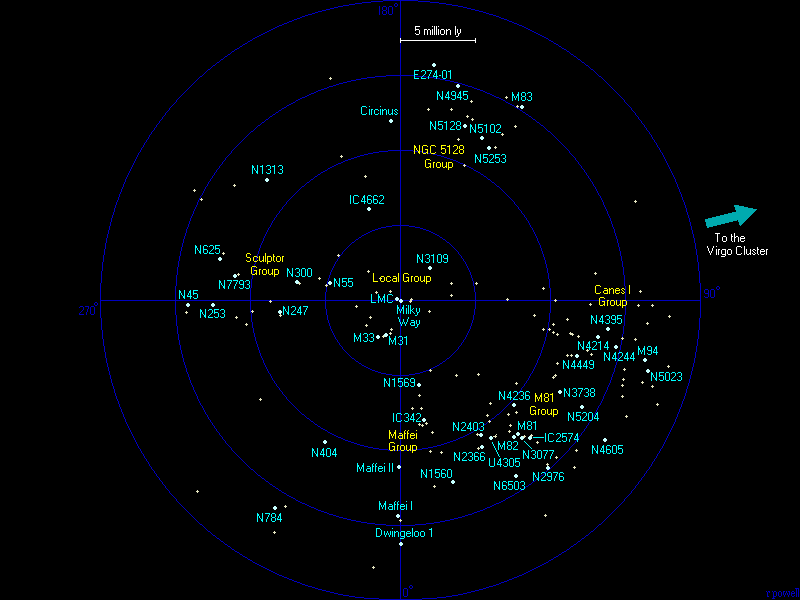
私たちが属する局所群(天の川銀河やアンドロメダ銀河を含むグループ)は、この超銀河団の辺縁部に位置しています。体積で比較すると、おとめ座超銀河団は局所群の約7,000倍、天の川銀河単体と比較すると約1,000億倍という圧倒的なスケールを誇ります。
宇宙論的視点:ラニアケアとダークマター
「盆地」としての超銀河団
かつて超銀河団は単なる「高密度領域」として定義されていました。しかし2014年の研究により、重力的な吸引範囲(盆地)という概念に基づいた新しい定義が提案されました。これにより、おとめ座超銀河団はさらに巨大なラニアケア超銀河団という「超銀河団コクーン」の一部であることが判明しました。
このラニアケア全体の物質は、秒速約600kmという猛烈な速度で「グレートアトラクター」と呼ばれる質量中心に向かって流れています。さらに、この巨大な構造全体が、さらに遠方のシャプレー超銀河団へと引き寄せられていると考えられています。
見えない質量の謎
おとめ座超銀河団の総質量と光度の比率(質量光度比)を計算すると、太陽の比率の約300倍という数値になります。これは、目に見える星やガスだけでは、現在の銀河団を維持するのに十分な重力が得られないことを意味しており、正体不明のダークマター(暗黒物質)が大量に存在する強力な証拠となっています。
おとめ座超銀河団の概要まとめ
| 項目 | 詳細データ |
|---|---|
| 主要構成要素 | おとめ座銀河団、局所群、その他100以上の銀河群 |
| 最大直径(長軸) | 約1億4700万光年 (45 Mpc) |
| 中心銀河団までの距離 | 約5562万光年 (±840万光年) |
| 所属する上位構造 | ラニアケア超銀河団 → うお座・くじら座超銀河団複合体 |
| 推定総質量 | 約 1.48 × 10¹⁵ 太陽質量 |
| 総光度 | 約 3 × 10¹² 太陽光度 |
Frequently Asked Questions
おとめ座超銀河団とラニアケア超銀河団の違いは何ですか?
伝統的な定義では、おとめ座超銀河団は銀河が密集している「高密度領域」を指していました。一方、ラニアケアは重力的に物質が流れ込む「吸引盆地」として定義されており、おとめ座超銀河団はその巨大な盆地の中にある一つの構成要素(コクーン内の一部)という関係になります。
私たちの銀河系は超銀河団のどこにありますか?
天の川銀河を含む局所群は、超銀河団の中心にあるおとめ座銀河団から離れた、外縁部のフィラメント上に位置しています。
「グレートアトラクター」とは何ですか?
おとめ座超銀河団を含む広大な領域の銀河が、共通して引き寄せられている巨大な質量中心のことです。現在は、ラニアケア超銀河団の重心であると考えられています。
なぜダークマターが存在すると言えるのですか?
超銀河団全体の光(星の量)から推定される質量よりも、実際の重力的な影響による質量の方が遥かに大きいためです。この「見えない質量」の正体がダークマターであると推測されています。
おとめ座超銀河団はどのような形状をしていますか?
大部分の銀河が集中する平坦なディスク状の構造(おとめ座ストランド)と、その周囲を囲む球状のハローという2つの部分で構成されています。
References
- "Virgo Supercluster". . . Retrieved 2025-11-10.
- Klypin, Anatoly; et al. (October 2003). "Constrained Simulations of the Real Universe: The Local Supercluster". The Astrophysical Journal. 596 (1): 19–33. :astro-ph/0107104. :2003ApJ...596...19K. :10.1086/377574. 1830859.
- https://ned.ipac.caltech.edu/level5/Sept01/Rood/Rood2_2.html.
{{}}: Missing or empty|title=() - Virgo Cluster on
- Einasto, M.; et al. (December 2007). "The richest superclusters. I. Morphology". Astronomy and Astrophysics. 476 (2): 697–711. :0706.1122. :2007A&A...476..697E. :10.1051/0004-6361:20078037. 15004251.
- "Imagine the Universe!".
- "The Virgo Supercluster". 18 November 2025.
- Pomarède, Daniel; Hoffman, Yehuda; Courtois, Hélène M.; Tully, R. Brent (August 2017). "The Cosmic V-Web". The Astrophysical Journal. 845 (1): 55. :1706.03413. :2017ApJ...845...55P. :10.3847/1538-4357/aa7f78. 0004-637X.
- Tully, R. B. (April 1986). "Alignment of clusters and galaxies on scales up to 0.1 C". The Astrophysical Journal. 303: 25. :1986ApJ...303...25T. :10.1086/164049. 0004-637X.
- Tully, R. Brent (December 1987). "More about clustering on a scale of 0.1 C". The Astrophysical Journal. 323: 1. :1987ApJ...323....1T. :10.1086/165803. 0004-637X.
📸 フォトギャラリー