私たちの身の回りには、一見すると不規則で予測不能な現象が数多く存在します。株価の激しい変動、空気中の微粒子の不規則な動き、あるいはコールセンターへの着信タイミングなど、これらはすべて確率過程(Stochastic Process)という数学的枠組みで解析することが可能です。確率過程とは、時間の経過とともに変化するランダムな変数の集まりであり、単一の確率変数ではなく「時間の関数としての確率」を扱う学問です。
主要な事実(Key Facts)
- 定義: 確率過程は、インデックス集合(通常は時間)と状態空間を持つ確率変数のコレクションである。
- 代表例: ウィーナー過程(ブラウン運動)、ポアソン過程、マルコフ連鎖などが基本モデルとして知られている。
- 数学的基礎: 現代の理論は測度論に基づいた確率論によって構築されており、フィルタリングやマルチンゲール理論などが重要な役割を果たす。
- 広範な応用: 金融(オプション価格決定)、生物学(個体群動態)、計算機科学(キューイング理論)など多岐にわたる分野で利用されている。
確率過程の基礎概念と分類
確率過程を理解するためには、まずそれが「どのような値(状態空間)」を「どのようなタイミング(インデックス集合)」で取るのかを定義する必要があります。例えば、離散的な時間ステップで状態が変化するものは離散時間過程と呼ばれ、連続的に変化するものは連続時間過程と呼ばれます。
代表的なモデルの一つにランダムウォークがあります。これは、各ステップでランダムな方向に移動する単純なモデルであり、多くの複雑な確率過程の基礎となっています。
ウィーナー過程とブラウン運動
連続時間確率過程の中で最も中心的な役割を果たすのがウィーナー過程です。これは物理学におけるブラウン運動の数学的モデルであり、連続的な経路を持ちながらも、至る所で微分不可能という特異な性質を持っています。ノルベルト・ウィーナーによって数学的な存在証明がなされましたが、その概念はアインシュタインやバシュリエらの研究にも先駆けて現れていました。
![Norbert Wiener gave the first mathematical proof of the existence of the Wiener process. This mathematical object had appeared previously in the work of Thorvald Thiele, Louis Bachelier, and Albert Einstein.[21]](/images/72/88/7288d1e754ac5fd7961cdaf2e6d442670fda850bc28ad5286294e3744bf7cf53.jpg)
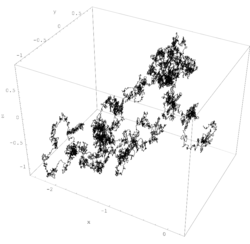
ウィーナー過程は、3次元空間などの多次元的な広がりを持つ場合や、球面上での運動としてシミュレーションされることもあります。
![A computer-simulated realization of a Wiener or Brownian motion process on the surface of a sphere. The Wiener process is widely considered the most studied and central stochastic process in probability theory.[1][2][3]](/images/c9/44/c944864e76fd5117e583beea5ee36f3bca4abe07a34b111fad13f94e344db64b.jpg)
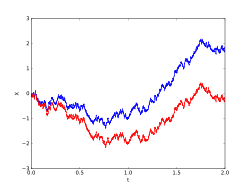
また、この過程に一定の方向性(トレンド)を加えたものが「ドリフト付きウィーナー過程」であり、金融市場の価格変動モデルなどで頻繁に利用されます。
その他の重要なプロセス
他にも、イベントの発生回数をカウントするポアソン過程や、次の方針が現在の状態のみに依存するマルコフ過程(マルコフ連鎖)などがあります。さらに、期待値が時間的に不変であるマルチンゲールという概念は、公正な賭けのモデルとして知られ、現代の確率解析において不可欠な道具となっています。
![Mathematician Joseph Doob did early work on the theory of stochastic processes, making fundamental contributions, particularly in the theory of martingales.[262][260] His book Stochastic Processes is considered highly influential in the field of probability theory.[263]](/images/ed/53/ed53c1fbdcc818e31b6ea34a3c61c6003cd1102d4b8c4c23d51bde5482511a85.jpg)
理論のまとめと応用分野
確率過程は単なる理論に留まらず、実社会の複雑なシステムをモデル化するために不可欠です。以下に主要なモデルとその応用先をまとめます。
| モデル名 | 主な特徴 | 主な応用分野 |
|---|---|---|
| ウィーナー過程 | 連続的な経路、独立増分 | 金融工学(ブラック・ショールズモデル) |
| ポアソン過程 | 離散的なイベント発生のカウント | 待ち行列理論、通信トラフィック解析 |
| マルコフ連鎖 | 次状態が現状のみに依存 | Googleのページランク、遺伝学 |
| ランダムウォーク | ステップごとのランダム移動 | 物理学(拡散現象)、統計学 |
分野別の具体的な活用
- 金融: ブラック・ショールズモデルなどのオプション価格決定理論や、ボラティリティ・モデルに活用されています。
- 生物学: 細胞内の分子挙動や、個体群の増減を扱う個体群動態の解析に用いられます。
- 計算機科学: ランダム化アルゴリズムの設計や、サーバーの待ち行列(キューイング理論)の最適化に利用されています。
Frequently Asked Questions
確率過程と単なる確率変数の違いは何ですか?
確率変数が「ある一回の手続きで得られるランダムな値」を扱うのに対し、確率過程は「時間の経過とともに変化する確率変数の列」を扱います。つまり、単一の点ではなく、時間の関数としての挙動(パス)を解析するのが特徴です。
ブラウン運動とウィーナー過程は同じものですか?
実質的に同じものを指します。ブラウン運動は物理的な粒子の不規則な運動という現象面からの呼称であり、ウィーナー過程はその現象を厳密に数学的に定義したモデルのことです。
マルコフ性とは何を意味しますか?
「未来の状態は、過去の経緯に関わらず、現在の状態のみによって決定される」という性質のことです。これをマルコフ性と呼び、計算を大幅に簡略化できるため、多くの実用的モデルに採用されています。
なぜ金融分野で確率過程が重要視されるのですか?
株価や為替などの資産価格は、予測不可能なニュースや要因によって常に変動しており、決定論的な方程式では記述できないためです。確率過程を用いることで、価格変動の不確実性を数学的に管理し、リスク評価や価格設定を行うことが可能になります。
References
- The term Brownian motion can refer to the physical process, also known as Brownian movement, and the stochastic process, a mathematical object, but to avoid ambiguity this article uses the terms Brownian motion process or Wiener process for the latter in a style similar to, for example, and or Rosenblatt.
- The term "separable" appears twice here with two different meanings, where the first meaning is from probability and the second from topology and analysis. For a stochastic process to be separable (in a probabilistic sense), its index set must be a separable space (in a topological or analytic sense), in addition to other conditions.
- The definition of separability for a continuous-time real-valued stochastic process can be stated in other ways.
- In the context of point processes, the term "state space" can mean the space on which the point process is defined such as the real line, which corresponds to the index set in stochastic process terminology.
- Also known as James or Jacques Bernoulli.
- It has been remarked that a notable exception was the St Petersburg School in Russia, where mathematicians led by Chebyshev studied probability theory.
- The name Khinchin is also written in (or transliterated into) English as Khintchine.
- Doob, when citing Khinchin, uses the term 'chance variable', which used to be an alternative term for 'random variable'.
- Later translated into English and published in 1950 as Foundations of the Theory of Probability
- The theorem has other names including Kolmogorov's consistency theorem, Kolmogorov's extension theorem or the Daniell–Kolmogorov theorem.
📸 フォトギャラリー