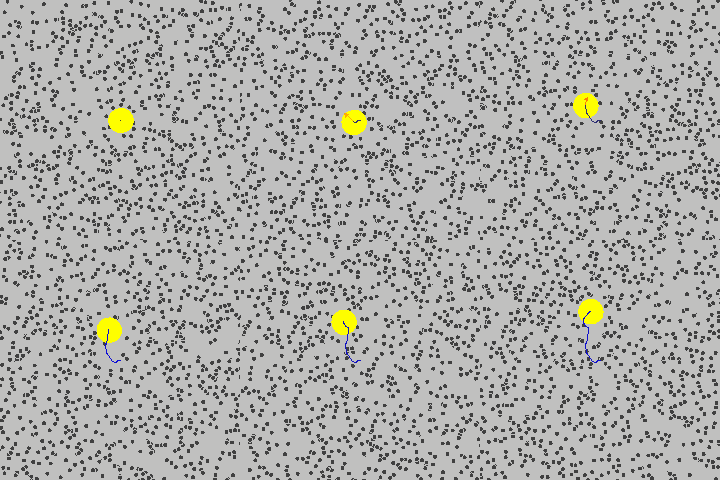
液体や気体などの流体の中で、微小な粒子が不規則に動き回る現象をブラウン運動と呼びます。この一見すると混沌とした動きは、単なる偶然ではなく、流体を構成する分子が粒子に衝突し続けることで発生します。この現象の解明は、かつては仮説に過ぎなかった「原子」や「分子」の存在を科学的に証明する決定的な鍵となりました。
物理学的な視点で見ると、この運動は熱平衡状態にある流体の中で起こります。特定の方向への流れがないため、全体の線形運動量や角運動量は時間的にゼロに保たれます。粒子が持つ運動エネルギーは、分子の回転や振動のエネルギーと共に、流体の内部エネルギー(熱量)の一部を構成しています。
Key Facts
- 発見: 1827年に植物学者ロバート・ブラウンが花粉の観察中に発見した。
- 物理的本質: 周囲の液体や気体分子によるランダムな衝突が原因である。
- 科学的意義: アインシュタインの理論とペランの実験により、原子の実在が証明された。
- 数学的モデル: 「ウィーナー過程」として定式化され、確率論や金融工学など幅広く応用されている。
- 特徴: 粒子の移動距離(平均二乗変位)は、経過時間の平方根に比例する。
ブラウン運動の歴史的展開
ロバート・ブラウンによる観察
この現象が初めて報告されたのは1827年のことです。スコットランドの植物学者ロバート・ブラウンは、顕微鏡で水に浸した植物(クラーキア・プルチェラ)の花粉を観察していたところ、粒子が絶えずジタバタと不規則に動いていることに気づきました。ブラウンは、これが生命活動によるものかを確認するため、ガラス粉や岩石の微粉末など無機物でも同様の実験を行いましたが、結果は同じでした。これにより、運動の原因が生物学的なものではないことが判明しましたが、その物理的な正体は長い間謎のままでした。
![Reproduced from the Jean Baptiste Perrin book Les Atomes: tracings of the motions of three colloidal particles of radius 0.53 μm, as seen under the microscope, with each point representing that particle's successive position every 30 seconds; the points are then joined by straight line segments (mesh size = 3.2 μm)[9]](/images/49/07/49078fa021e397480beee89cf3798ee0f4fd9f2d33388a451dea8c5bfe4789fe.webp)
アインシュタインの理論的突破口
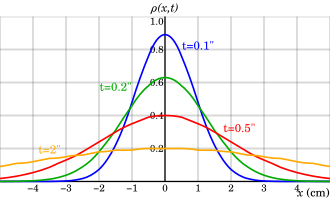
1905年、アルベルト・アインシュタインはこの現象を数学的にモデル化し、粒子が個々の水分子によって突き動かされていることを理論的に示しました。彼は拡散方程式を導入し、粒子の「平均二乗変位」と拡散係数の関係を導き出しました。この理論により、目に見えない原子の大きさや、1モルあたりの原子数(アボガドロ定数)を算出することが可能になりました。
実験による実証
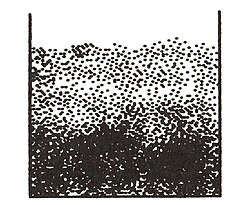
アインシュタインの理論を証明するのは容易ではありませんでしたが、1908年のショーデシグや1909年のジャン・バティスト・ペランによる精密な実験によって、その正しさが裏付けられました。ペランは顕微鏡を用いてコロイド粒子の分布を観察し、重力に抗して粒子が拡散する様子を捉えることで、熱力学の第二法則が本質的に統計的な法則であることを証明しました。
統計力学と数学的アプローチ
拡散のメカニズム
アインシュタインは、粒子が時間 $\tau$ の間に移動する距離を確率変数として扱い、テイラー展開を用いて解析しました。その結果、粒子の密度 $\rho$ は拡散方程式 $\frac{\partial \rho}{\partial t} = D \frac{\partial^2 \rho}{\partial x^2}$ に従うことを導きました。ここで $D$ は拡散係数です。特筆すべきは、粒子の変位が時間 $t$ に比例するのではなく、$\sqrt{t}$(時間の平方根)に比例するという点です。
![2-dimensional random walk of a silver adatom on an Ag(111) surface[1]](/images/b2/0e/b20ea8f1b632e2fb92df6d1f96642fd11022b2ae8fa18791588fd6e5fde496cc.gif)
スモルホフスキーのモデルと差異
後にマリアン・スモルホフスキーも同様の確率分布を導き出しましたが、ストークスの法則に基づく摩擦力を考慮した計算において、アインシュタインの係数と 27/64 という差異が生じました。しかし、後の検証によりアインシュタインの係数が正しいことが確認されています。
数学的な「ウィーナー過程」
数学の世界では、ブラウン運動は「ウィーナー過程」として定義されます。これは以下の特性を持つ連続時間確率過程です:
- 開始点 $W_0 = 0$ であること。
- 軌跡がほぼ確実に連続であること。
- 増分が独立であること(ある期間の動きが別の期間の動きに影響しない)。
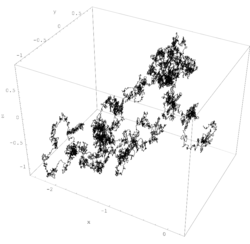
また、この運動は平面だけでなく、球面上や高次元空間など、様々な幾何学的構造(リーマン多様体など)の上でも定義され、研究されています。

ブラウン運動のまとめ
| 項目 | 内容 | 備考 |
|---|---|---|
| 物理的原因 | 流体分子による不規則な衝突 | 熱平衡状態での現象 |
| 主要な指標 | 平均二乗変位 $\mathbb{E}[x^2] = 2Dt$ | 時間 $t$ の平方根に比例 |
| 数学的名称 | ウィーナー過程 | 独立増分を持つ連続過程 |
| 科学的成果 | アボガドロ定数の決定 | 原子の実在を証明 |
Frequently Asked Questions
ブラウン運動は生きている粒子だけに見られる現象ですか?
いいえ。ロバート・ブラウン自身が、ガラス粉や岩石の微粒子などの無機物でも同様の運動が起こることを確認しており、生命活動とは無関係な物理現象であることが分かっています。
なぜ粒子の動きは直線的ではなく、ジグザグになるのですか?
粒子は周囲にある無数の小さな分子から、あらゆる方向からランダムに衝突を受けているためです。一瞬一瞬の衝突方向が異なるため、結果として不規則な軌跡を描きます。
アインシュタインはこの現象から何を導き出しましたか?
粒子の拡散速度と分子の熱運動を結びつける理論を構築し、それを用いて原子の大きさやアボガドロ定数を計算しました。これにより、物質が分子や原子から構成されているという説を理論的に裏付けました。
ブラウン運動の数学的な応用例はありますか?
非常に多岐にわたります。物理学だけでなく、株価の変動をモデル化する金融工学(ブラック・ショールズ方程式など)や、生物学における細胞内輸送の解析などに広く応用されています。
References
- Meyburg, Jan Philipp; Diesing, Detlef (2017). "Teaching the Growth, Ripening, and Agglomeration of Nanostructures in Computer Experiments". Journal of Chemical Education. 94 (9): 1225–1231. :2017JChEd..94.1225M. :10.1021/acs.jchemed.6b01008.
- Feynman, Richard (1964). "The Brownian Movement". The Feynman Lectures of Physics, Volume I. p. 41.
- Pathria, RK (1972). Statistical Mechanics. Pergamon Press. pp. 43–48, 73–74. ISBN 0-08-016747-0.
- Einstein, Albert (1905). "Über die von der molekularkinetischen Theorie der Wärme geforderte Bewegung von in ruhenden Flüssigkeiten suspendierten Teilchen" [On the Movement of Small Particles Suspended in Stationary Liquids Required by the Molecular-Kinetic Theory of Heat] (PDF). Annalen der Physik (in German). 322 (8): 549–560. :1905AnP...322..549E. :10.1002/andp.19053220806. Archived (PDF) from the original on 9 October 2022.
- "The Nobel Prize in Physics 1926". NobelPrize.org. Retrieved 29 May 2019.
- Tsekov, Roumen (1995). "Brownian motion of molecules: the classical theory". Ann. Univ. Sofia. 88: 57. :1005.1490. :1995AUSFC..88...57T.
the behavior of a Brownian particle is quite irregular and can be described only in the frames of a statistical approach.
- Knight, Frank B. (1 February 1962). "On the random walk and Brownian motion". Transactions of the American Mathematical Society. 103 (2): 218–228. :10.1090/S0002-9947-1962-0139211-2. 0002-9947.
- "Donsker invariance principle – Encyclopedia of Mathematics". encyclopediaofmath.org. Retrieved 28 June 2020.
- Perrin, Jean (1914). Atoms. London : Constable. p. 115.
{{}}: CS1 maint: publisher location () - (1951). On the Nature of the Universe. Translated by Latham, R. E. London: Penguin Books. pp. 63–64.
📸 フォトギャラリー