Diagram of a space elevator. At the bottom of the tall diagram is the Earth as viewed from high above the North Pole. About six earth-radii above the Earth an arc is drawn with the same center as the Earth. The arc depicts the level of geosynchronous orbit. About twice as high as the arc and directly above the Earth's center, a counterweight is depicted by a small square. A line depicting the space elevator's cable connects the counterweight to the equator directly below it. The system's center of mass is described as above the level of geosynchronous orbit. The center of mass is shown roughly to be about a quarter of the way up from the geosynchronous arc to the counterweight. The bottom of the cable is indicated to be anchored at the equator. A climber is depicted by a small rounded square. The climber is shown climbing the cable about one third of the way from the ground to the arc. Another note indicates that the cable rotates along with the Earth's daily rotation, and remains vertical.
← ホームへ戻る

宇宙エレベーターの仕組みと実現への挑戦地球から宇宙への新たな架け橋

🗓 2026年8月11日

SF映画や小説の世界で描かれる「宇宙エレベーター(別名:スペースブリッジ、スターラダー)」は、ロケットを使わずに地上から宇宙空間へ直接アクセスすることを可能にする究極の輸送システムです。巨大なケーブルを地球から宇宙まで伸ばし、その上を昇降機が移動するというこの構想は、現代の宇宙開発におけるコストとリスクを劇的に削減する可能性を秘めています。

Key Facts

  • 基本構造:赤道付近に固定されたケーブル(テザー)と、静止軌道外に配置されたカウンターウェイトで構成される。
  • 物理的原理:地球の重力と、回転による遠心力の均衡によってケーブルがピンと張った状態に維持される。
  • 最大の課題:自重に耐えうる極めて高い「比強度」を持つ素材の確保。
  • 期待される効果:輸送コストを現在のロケット輸送(1kgあたり約12,125ドル)から、大幅に低減(220ドル程度まで)できる可能性がある。

宇宙エレベーターを支える物理的メカニズム

宇宙エレベーターの核心は、地球の自転を利用したダイナミックなバランスにあります。地上(赤道付近)に固定されたケーブルの先端に、静止軌道(高度35,786km)を越えた位置に巨大な重り(カウンターウェイト)を設置します。これにより、下方向へ引く重力と、外側へ押し出す遠心力が拮抗し、ケーブルは常に緊張状態を保ちながら垂直に直立します。
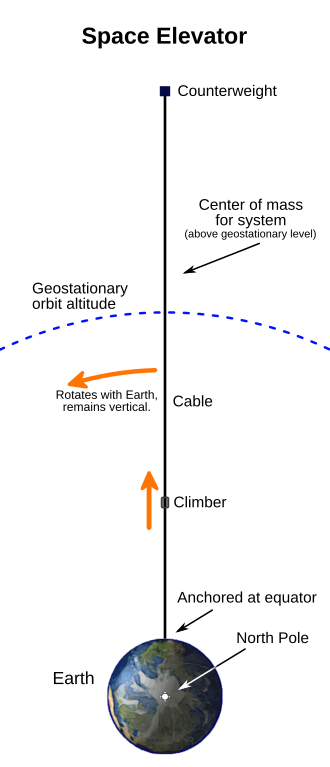
Diagram of a space elevator. At the bottom of the tall diagram is the Earth as viewed from high above the North Pole. About six earth-radii above the Earth an arc is drawn with the same center as the Earth. The arc depicts the level of geosynchronous orbit. About twice as high as the arc and directly above the Earth's center, a counterweight is depicted by a small square. A line depicting the space elevator's cable connects the counterweight to the equator directly below it. The system's center of mass is described as above the level of geosynchronous orbit. The center of mass is shown roughly to be about a quarter of the way up from the geosynchronous arc to the counterweight. The bottom of the cable is indicated to be anchored at the equator. A climber is depicted by a small rounded square. The climber is shown climbing the cable about one third of the way from the ground to the arc. Another note indicates that the cable rotates along with the Earth's daily rotation, and remains vertical.

このケーブル上を、機械的な昇降機(クライマー)が往来することで、物資や人員を宇宙へ運びます。従来のロケットのような膨大な燃料を必要とせず、効率的に軌道上へ到達できるのが最大の特徴です。
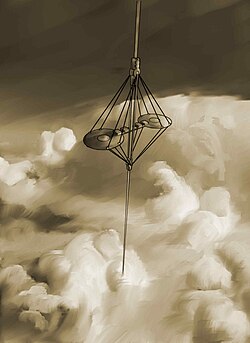
A conceptual drawing of a space elevator climber ascending through the clouds.

コリオリの力による影響

クライマーが上昇する際、地球の自転に伴うコリオリの力(回転座標系で運動する物体に働く見かけ上の力)の影響を受けます。これにより、ケーブルはわずかに傾斜し、上昇速度に応じて水平方向への加速が生じます。
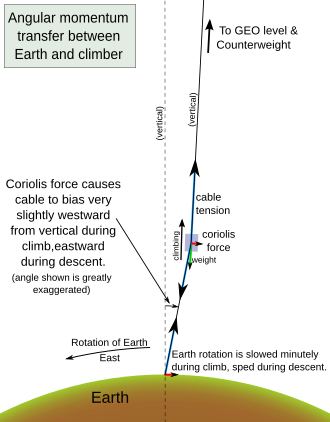
As the car climbs, the cable takes on a slight lean due to the Coriolis force. The top of the cable travels faster than the bottom. The climber is accelerated horizontally as it ascends by the Coriolis force which is imparted by angles of the cable. The lean-angle shown is exaggerated.

実現を阻む最大の壁:ケーブル素材の強度

理論上の最大の難関は、ケーブルが自らの重さで切れない強度を持つことです。特に、張力が最大となる静止軌道付近での負荷は凄まじく、素材には極めて高い比強度(密度あたりの強度)が求められます。

効率的な設計のためには、地上部分を細くし、張力が最大となる高度で太くする「テーパー構造」が不可欠です。この断面の変化率(テーパー比)は、素材の比強度に依存します。
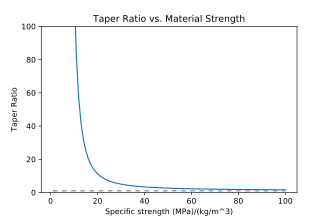
Taper ratio as a function of specific strength

候補となる次世代素材

従来の鋼鉄やケブラーでは強度が全く足りず、現在最も期待されているのがカーボンナノチューブです。これは炭素原子が筒状に結合した構造を持つ素材で、理論上の強度は極めて高いとされています。

Carbon nanotubes are one of the candidates for a cable material.[35]

しかし、現実には数センチメートル以上の長い繊維として製造することが困難であり、微細な欠陥が全体の強度を著しく低下させるという課題が残っています。

インフラ設計と運用構想

地上側の基点となるベースステーションは、固定式だけでなく、海洋上の移動式プラットフォームとして運用する案が検討されています。これにより、気象条件や安全上の理由で位置を調整することが可能になります。
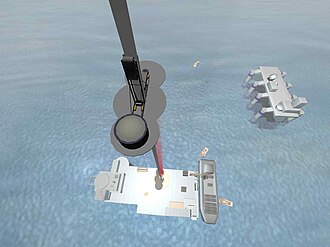
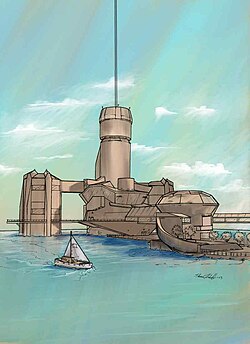
One concept for the space elevator has it tethered to a mobile seagoing platform.
A seagoing anchor station would also act as a deep-water seaport.

エネルギー供給とカウンターウェイト

クライマーへの電力供給については、高度40km以上の宇宙空間では太陽光発電を利用する案が有力です。また、上端のカウンターウェイトとしては、捕獲した小惑星や、静止軌道外に建設した巨大な宇宙ステーションなどが想定されています。
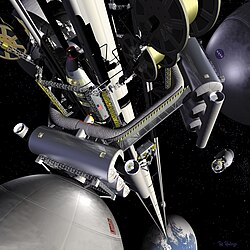
Space elevator with space station (NASA image)

地球以外での展開:月や火星の可能性

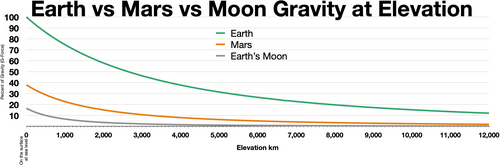
地球よりも重力が小さい天体では、現在の技術レベルでも宇宙エレベーターの実現可能性が高まります。例えば、火星の衛星フォボスを利用した構想では、フォボスから火星表面近くまでケーブルを伸ばすことで、極めて少ないエネルギーで輸送が可能になります。
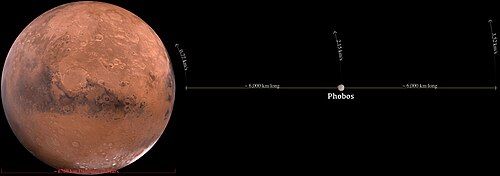
Space elevator Phobos
Earth vs Mars vs Moon gravity at elevation

また、小惑星プシケやケレスのような低重力天体では、地球のような超高強度素材がなくとも、現実的な素材でエレベーターを構築できると考えられています。

16 Psyche space elevator concept—the surface gravity is less than 2% of earths at ~0.144 m/s2[79]
Ceres space elevator concept –Surface gravity is 0.284 m/s2[80]0.029 g less than 3% of Earth's

開発の歴史と今後の展望

1999年のNASAによるワークショップ以降、専門家による研究が進んできました。2007年には賞金付きのコンペティションが開催され、MITのチームがカーボンナノチューブを用いたエントリーを行うなど、技術的な挑戦が続いています。日本では大林組が、カーボンナノチューブ技術を用いて2050年までに実現させるという意欲的な目標を掲げています。

また、国際宇宙エレベーターコンソーシアム(ISEC)などの非営利団体が、人類共通のインフラとしての開発を推進しています。

素材別性能比較まとめ

ケーブル素材の特性比較
素材 引張強度 (MPa) 密度 (kg/m³) 比強度 (MPa/(kg/m³)) テーパー比
鋼鉄 2,000 7,900 0.25 1.6 × 1024
ケブラー 3,600 1,440 2.5 2.5 × 10¹⁶
UHMWPE (23°C) 3,600 980 3.7 5.4 × 10¹⁵
単層カーボンナノチューブ 130,000 1,300 100 1.6

Frequently Asked Questions

宇宙エレベーターが完成すると、何が変わりますか?

最大のメリットは輸送コストの劇的な低下です。ロケットのような使い捨ての推進剤を大量に消費せず、電気的に昇降させるため、1kgあたりの輸送コストが現在の数十分の一から数百分の一になると期待されています。

なぜ赤道に設置しなければならないのですか?

地球の自転による遠心力を最大限に利用してケーブルを直立させる必要があるためです。赤道上であれば、静止軌道上の点と地上の点が常に同じ位置に留まるため、効率的な固定が可能です。

カーボンナノチューブがあればすぐに作れるのでしょうか?

いいえ。理論上の強度は十分ですが、数万キロメートルという超長尺のケーブルを、欠陥なく均一に製造する技術がまだ確立されていません。現在は数センチメートル程度の製造に留まっています。

ケーブルが切れたらどうなりますか?

これは大きな安全上の懸念事項です。切断箇所によって挙動は異なりますが、重力と遠心力のバランスが崩れるため、ケーブルが地上または宇宙空間へ激しく巻き込まれるリスクがあります。そのため、高度な安全設計と冗長性が求められます。

月や火星に作る方が簡単だというのは本当ですか?

はい。月や火星は地球よりも重力が大幅に小さいため、ケーブルに掛かる負荷が少なくなります。地球では不可能な既存の高性能素材でも、低重力天体であれば十分な強度を確保できるため、実現のハードルは格段に低くなります。

References

  1. Specific substitutions used to produce the factor 4.85×10⁷:
    A ( R g ) / A s = exp [ ρ × 9.81 × ( 6.378 × 10 6 ) 2 T ( 1 6.378 × 10 6 + ( 6.378 × 10 6 ) 2 2 ( 4.2164 × 10 7 ) 3 1 4.2164 × 10 7 ( 4.2164 × 10 7 ) 2 2 ( 4.2164 × 10 7 ) 3 ) ] {\displaystyle A(R_{g})/A_{s}=\exp \left[{\frac {\rho \times 9.81\times (6.378\times 10^{6})^{2}}{T}}\left({\frac {1}{6.378\times 10^{6}}}+{\frac {(6.378\times 10^{6})^{2}}{2(4.2164\times 10^{7})^{3}}}-{\frac {1}{4.2164\times 10^{7}}}-{\frac {(4.2164\times 10^{7})^{2}}{2(4.2164\times 10^{7})^{3}}}\right)\right]}

📸 フォトギャラリー

Diagram of a space elevator. At the bottom of the tall diagram is the Earth as viewed from high above the North Pole. About six earth-radii above the Earth an arc is drawn with the same center as the Earth. The arc depicts the level of geosynchronous orbit. About twice as high as the arc and directly above the Earth's center, a counterweight is depicted by a small square. A line depicting the space elevator's cable connects the counterweight to the equator directly below it. The system's center of mass is described as above the level of geosynchronous orbit. The center of mass is shown roughly to be about a quarter of the way up from the geosynchronous arc to the counterweight. The bottom of the cable is indicated to be anchored at the equator. A climber is depicted by a small rounded square. The climber is shown climbing the cable about one third of the way from the ground to the arc. Another note indicates that the cable rotates along with the Earth's daily rotation, and remains vertical.
Taper ratio as a function of specific strength
One concept for the space elevator has it tethered to a mobile seagoing platform.
Carbon nanotubes are one of the candidates for a cable material.[35]
A seagoing anchor station would also act as a deep-water seaport.
A conceptual drawing of a space elevator climber ascending through the clouds.
As the car climbs, the cable takes on a slight lean due to the Coriolis force. The top of the cable travels faster than the bottom. The climber is accelerated horizontally as it ascends by the Coriolis force which is imparted by angles of the cable. The lean-angle shown is exaggerated.
Space elevator with space station (NASA image)
Space elevator Phobos
Earth vs Mars vs Moon gravity at elevation
16 Psyche space elevator concept—the surface gravity is less than 2% of earths at ~0.144 m/s2[79]
Ceres space elevator concept –Surface gravity is 0.284 m/s2[80]0.029 g less than 3% of Earth's