地球の歴史を物語る化石や、宝石のように美しい鉱物の中には、もともとは木や骨、あるいは別の種類の岩石だったものが、シリカ(二酸化ケイ素:SiO2)に置き換わって形成されたものが多く存在します。この現象を地質学では「珪化作用(けいかさよう)」と呼びます。シリカに富んだ流体が物質の隙間に浸透し、元の成分を置き換えることで、極めて保存状態の良い構造が維持されたまま石へと変化するのです。
Key Facts
- 定義:シリカに富む流体が岩石や有機物の空隙に浸透し、元の物質を二酸化ケイ素に置き換えるプロセス。
- 主な形態:石英、オパール、カルセドニー(玉髄)などの形態で沈殿する。
- 発生条件:熱水活動、地下水の流れ、火山灰の堆積などが関与し、温度は25°Cから190°Cまで幅広く分布する。
- 2つの主要メカニズム:元の物質を溶かしながら置き換える「置換」と、隙間に充填する「浸透」がある。
- シリカの供給源:プランクトンや植物などの生物由来(生物源シリカ)と、地殻やマントルなどの無機的な供給源がある。
シリカの供給源:生物的・無機的なルート
珪化作用に不可欠なシリカは、大きく分けて2つのルートから供給されます。一つは生物が作り出す「生物源シリカ」です。例えば、イネ科などの植物が葉に蓄えるフィトリスや、海に生息する海綿の骨針、そして微細藻類である珪藻の細胞壁(被殻)などが挙げられます。これらの生物遺骸が堆積することで、海洋底や地層に大量のシリカが蓄積されます。
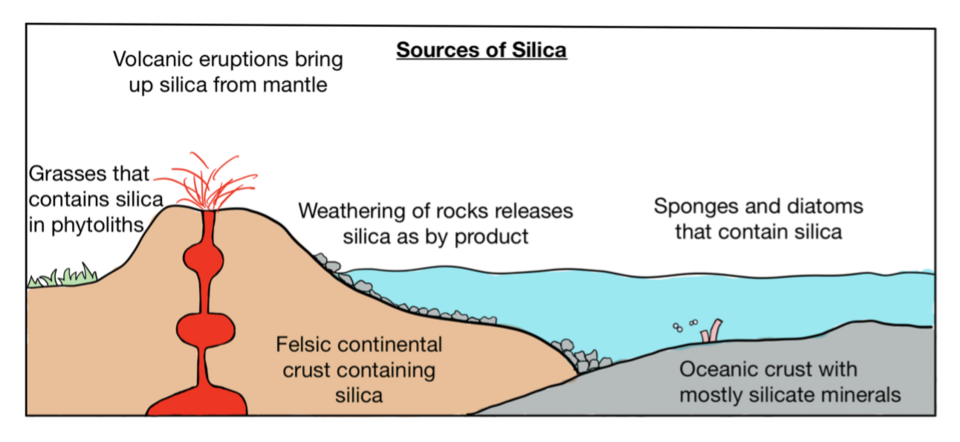
もう一つは、地球の地殻やマントルに豊富に含まれる無機的なシリカです。火山岩に含まれる石英や、既存の岩石が化学的風化を受けて溶け出したケイ酸(H4SiO4)が水に溶け込み、流体として移動します。特に熱水活動に伴う流体は、効率的にシリカを運び、周囲の物質を珪化させる強力な媒体となります。
珪化作用が起こる2つのメカニズム
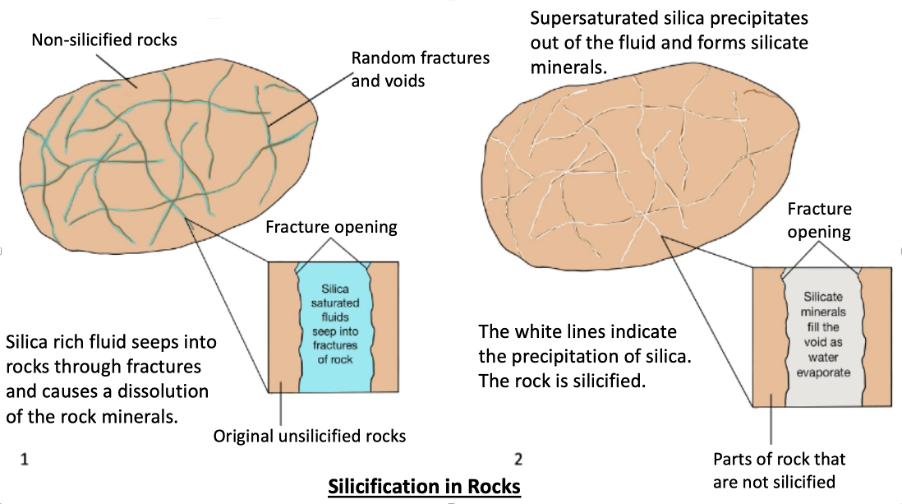
物質がどのようにシリカに置き換わるかは、対象となる素材によって異なります。主に「置換」と「浸透」という2つのプロセスに分けられます。
1. 置換作用(Replacement)
主に炭酸塩岩などの岩石で見られるプロセスです。シリカが過飽和状態で、一方で炭酸塩が不飽和状態である熱水流体が岩石に接触すると、元の鉱物が溶解して流出すると同時に、そこにシリカが沈殿して結晶化します。このとき、元の体積がほぼ維持されたまま成分だけが入れ替わるため、元の岩石の構造が精巧に保存されます。
2. 浸透作用(Permeation)
木材などの有機物の珪化で顕著に見られるプロセスです。シリカを含む流体が細胞壁や導管などの微細な隙間に染み込み、そこでシリカが沈殿します。有機物は時間をかけてゆっくりと分解されますが、先に形成されたシリカの骨格が構造を支えるため、細胞レベルの形態が維持された「珪化木」となります。
![This diagram shows the mechanism of silicification of wood in a cell. Silica penetrates through the cell wall. Cell structures gradually deteriorate and silica deposits in the entire cell. Adapted and modified from Furuno,1986 and Fengel, 1991.[18][19]](/images/6d/75/6d7583c4c74eca7fd6bb2b3a70519defcc8216be11cf70772d7a7a61034942be.png)
多様な珪化の事例
珪化作用は、地球上のあらゆる環境で発生しています。以下に代表的な例を挙げます。
火山岩と変成岩
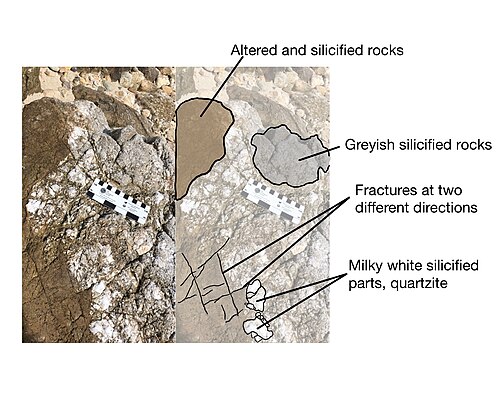
カナダのコンセプション湾では、流紋岩や玄武岩などの火山岩が熱水流体によって珪化し、白いカルセドニーや石英の脈を形成しています。また、オマーンのセマイル・ナップでは、通常は稀な「蛇紋岩の珪化」が確認されており、断層に沿って流れた地下水が要因となったと考えられています。
炭酸塩岩とカルスト
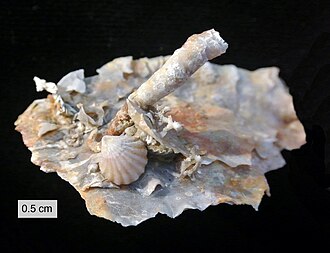
スペインのマドリード盆地では、湖底に堆積した炭酸塩岩が珪化し、チャートや石英の層を形成しています。また、石灰岩などが溶けてできた洞窟(カルスト)にシリカ流体が流入し、洞窟内部が完全に石化する場合もあります。アリゾナ州のメスカル石灰岩では、上層にある玄武岩の風化によって供給されたシリカが、下層の石灰岩を珪化させた例が知られています。
有機物の石化(珪化木)
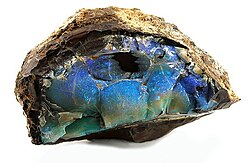
日本の立山温泉のような高温の温泉水(約70°C、pH3程度)では、周囲の倒木などが急速に珪化します。この環境では、微小なシリカ球がランダムに集まったオパールが主成分となり、有機物を保存します。
地球初期の歴史と珪化作用
珪化作用は、地球の初期段階における大陸地殻の形成にも深く関わっています。約39億年前の冥王代から太古代への移行期、海底の玄武岩などが海水による激しい珪化作用を受けたことで、後の大陸地殻の基礎となる岩石(TTG suiteなど)が形成されたと考えられています。西オーストラリアのピルバラクラトンや南アフリカのバーバートン・グリーンストーンベルトに残る最古の珪化岩は、当時の海水温度や二酸化炭素濃度などの環境を解明する重要な手がかりとなっています。
珪化作用のまとめ
| 項目 | 置換作用(主に岩石) | 浸透作用(主に有機物) |
|---|---|---|
| 主な対象 | 炭酸塩岩、蛇紋岩など | 木材、骨、貝殻など |
| プロセス | 元の鉱物の溶解 + シリカの沈殿 | 空隙への浸透 + シリカの充填 |
| 結果 | 成分の完全な入れ替え | 構造の維持と内部の石化 |
| 代表的な鉱物 | 石英、チャート、カルセドニー | オパール、微結晶石英 |
Frequently Asked Questions
珪化作用が起こるために最も重要な条件は何ですか?
シリカを豊富に含んだ流体(熱水や地下水)が存在し、それが対象となる物質に接触することです。また、pH値(特にpH 9が境界線となり、それ以下で沈殿しやすい)や温度などの化学的条件が、シリカが沈殿して固まるかどうかに大きく影響します。
なぜ珪化木は元の木の形を正確に保っているのですか?
シリカが細胞壁などの微細な隙間に浸透し、有機物が分解されるよりも早くに鉱物の骨格を形成するためです。この「浸透」プロセスにより、内部から支えられた状態で石化するため、精巧な構造が維持されます。
生物源シリカとは具体的にどのようなものですか?
植物のフィトリス(植物石)や、海綿の骨針、珪藻の細胞壁などが代表的です。これらは生物が生命活動の一環として取り込んだシリカであり、死後に堆積して地層となり、後の珪化作用のシリカ供給源となります。
珪化作用はどのくらいの温度で起こりますか?
環境によって大きく異なります。地表付近や堆積物中での珪化は25°Cから50°C程度の低温で起こりますが、熱水流体に含まれる包有液の分析からは、150°Cから190°Cという高温条件下で進行した場合があることが分かっています。
岩石の置換と有機物の浸透はどう違うのですか?
置換は「元の物質を溶かし出しながら、同じ体積をシリカで埋める」という引き算と足し算の同時進行です。一方、浸透は「もともとある隙間にシリカを流し込む」という充填プロセスであり、元の物質が完全に消えなくても構造が維持される点に違いがあります。
References
- Akahane, Hisatada; Furuno, Takeshi; Miyajima, Hiroshi; Yoshikawa, Toshiyuki; Yamamoto, Shigeru (July 2004). "Rapid wood silicification in hot spring water: an explanation of silicification of wood during the Earth's history". Sedimentary Geology. 169 (3–4): 219–228. :2004SedG..169..219A. :10.1016/j.sedgeo.2004.06.003. 0037-0738.
- Sigleo, Anne C. (September 1978). "Organic geochemistry of silicified wood, Petrified Forest National Park, Arizona". Geochimica et Cosmochimica Acta. 42 (9): 1397–1405. :1978GeCoA..42.1397S. :10.1016/0016-7037(78)90045-5. 0016-7037.
- Götz, Annette E.; Montenari, Michael; Costin, Gelu (2017). "Silicification and organic matter preservation in the Anisian Muschelkalk: implications for the basin dynamics of the central European Muschelkalk Sea". Central European Geology. 60 (1): 35–52. :2017CEJGl..60...35G. :10.1556/24.60.2017.002. 1789-3348.
- Liesegang, Moritz; Milke, Ralf; Kranz, Christine; Neusser, Gregor (2017-11-06). "Silica nanoparticle aggregation in calcite replacement reactions". Scientific Reports. 7 (1): 14550. :2017NatSR...714550L. :10.1038/s41598-017-06458-8. 2045-2322. 5673956. 29109392.
- S.K. Haldar and Josip Tišljar (2014). Introduction to Mineralogy and Petrology. Elsevier. p. 198. .
- Klein, Robert T.; Walter, Lynn M. (September 1995). "Interactions between dissolved silica and carbonate minerals: An experimental study at 25–50°C". Chemical Geology. 125 (1–2): 29–43. :1995ChGeo.125...29K. :10.1016/0009-2541(95)00080-6. 0009-2541.
- You, Donghua; Han, Jun; Hu, Wenxuan; Qian, Yixiong; Chen, Qianglu; Xi, Binbin; Ma, Hongqiang (2018-02-19). "Characteristics and formation mechanisms of silicified carbonate reservoirs in well SN4 of the Tarim Basin". Energy Exploration & Exploitation. 36 (4): 820–849. :2018EExEx..36..820Y. :10.1177/0144598718757515. 0144-5987. 135282628.
- Sugitani, Kenichiro; Yamashita, Fumiaki; Nagaoka, Tsutomu; Yamamoto, Koshi; Minami, Masayo; Mimura, Koichi; Suzuki, Kazuhiro (June 2006). "Geochemistry and sedimentary petrology of Archean clastic sedimentary rocks at Mt. Goldsworthy, Pilbara Craton, Western Australia: Evidence for the early evolution of continental crust and hydrothermal alteration". Precambrian Research. 147 (1–2): 124–147. :2006PreR..147..124S. :10.1016/j.precamres.2006.02.006. 0301-9268.
- Monger, H. Curtis; Kelly, Eugene F. (2018-09-11), "Silica Minerals", Soil Mineralogy with Environmental Applications, SSSA Book Series, Madison, WI, USA: Soil Science Society of America, pp. 611–636, :10.2136/sssabookser7.c20, , 240182586
- "A collector's guide to rock, mineral, & fossil localities of Utah". 1995. :10.34191/mp-95-4.
{{}}: Cite journal requires|journal=()
📸 フォトギャラリー