私たちが日常的に「暑い」や「寒い」と感じる温度は、物理学の視点から見ると、物質を構成する粒子が持つ熱的な運動エネルギーの尺度です。タンパク質のアルファヘリックス構造のような微細な領域から、巨大な恒星の内部に至るまで、温度は物質の状態や化学反応の速度、さらには音速にまで影響を与える極めて重要な物理量です。
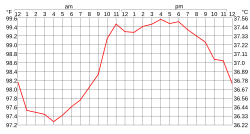
人間の体温も一定ではなく、一日の中でわずかに変動しています。このような生物学的な変動から、宇宙規模の極端な温度差まで、温度という概念は多層的な意味を持っています。
Key Facts
- 絶対零度(0 K)は理論上の最低温度であり、摂氏では −273.15 °C に相当します。
- SI単位系における温度の基本単位はケルビン (K) です。
- 2019年以降、ケルビンの定義はボルツマン定数に基づく微視的な現象によって規定されています。
- 絶対零度においても、量子力学的な「零点エネルギー」は保持されており、完全にエネルギーがゼロになるわけではありません。
- 温度の変化は、化学反応の進行速度や物体から放射される熱放射の特性を決定づけます。
温度を測る尺度と単位
世界中で広く利用されている摂氏(Celsius)は、標準大気圧下における水の凝固点(0 °C)と沸点(100 °C)を基準とした経験的な尺度です。かつては「百分度(centigrade)」と呼ばれていました。現在では、国際単位系(SI)のケルビンとの整合性が図られており、1度摂氏の変化量は1ケルビンの変化量と等しく、数値的な差は 273.15 という固定値で定義されています。
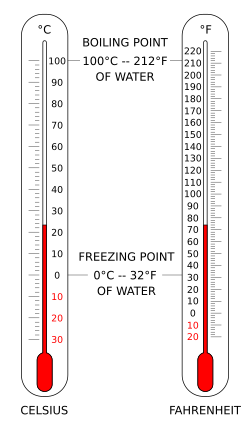
一方、華氏(Fahrenheit)やランキン(Rankine)など、歴史的に多様な温度目盛りが存在してきました。現代の科学研究では、物質の性質を物質の種類に依存せず絶対的に評価するため、絶対温度(ケルビン)が不可欠です。
絶対温度とケルビン尺度
絶対温度は、熱力学的なエネルギーの最小点である絶対零度を基準としています。かつては水の三重点(273.16 K)を基準としていましたが、現在はボルツマン定数を用いた定義へと移行しました。これにより、マクロな熱力学的な視点だけでなく、ミクロな統計力学的な視点からも温度を厳密に定義することが可能となりました。
熱力学と統計力学の視点
物理学において温度は、異なるアプローチで解釈されます。熱力学的なアプローチでは、カルノーサイクルのような熱機関の効率や、エントロピーの変化率として温度を捉えます。対して統計力学的なアプローチでは、気体分子の運動論に基づき、粒子の平均的な運動エネルギーとして温度を定義します。
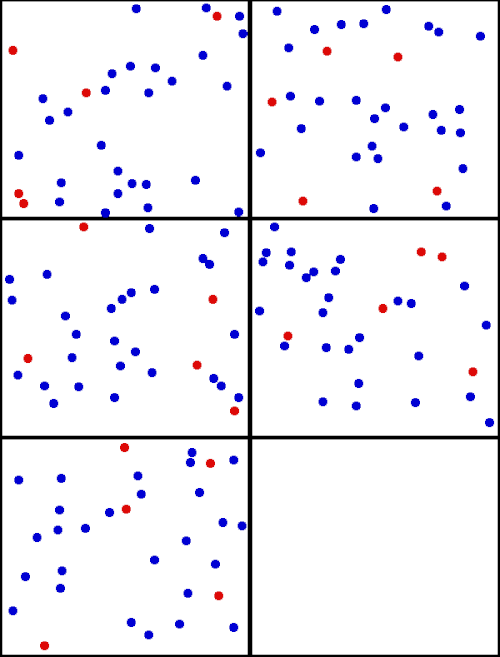
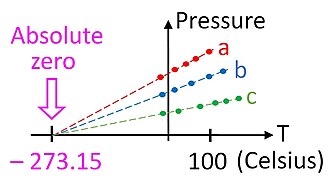
理想気体の状態方程式(pV = nRT)に示されるように、圧力、体積、温度は密接に関連しています。温度を絶対零度まで下げていくと、古典的な物理モデルでは粒子の運動は完全に停止しますが、実際には量子力学的な不確定性原理により、最低限のエネルギーが残ります。
極限の温度:絶対零度から超高温まで
熱力学第三法則により、いかなる有限の手順を用いても、物質を完全に絶対零度に到達させることは不可能です。しかし、実験的には極めて近い温度まで冷却することが可能であり、過去には 38 pK(ピコケルビン)という驚異的な低温が達成されています。
一方で、宇宙には想像を絶する高温領域が存在します。太陽の表面は約 5,778 K ですが、その中心部は約 1,600万 K に達します。さらに、中性子星の合体や粒子加速器(CERNなど)における衝突実験では、数兆度という極限状態が作り出されています。
![An illustration of the range of cosmic temperatures[104]](/images/ff/bf/ffbfebe317211534596e3de31d795c3228fcff23a48c2c6f05d641508b94554e.jpg)
| 対象・状態 | ケルビン (K) | 摂氏 (°C) | 特徴 |
|---|---|---|---|
| 絶対零度 | 0 K | −273.15 °C | 理論上の最低温度 |
| 宇宙マイクロ波背景放射 | 2.7260 K | −270.424 °C | 宇宙全体の平均温度 |
| 水の三重点 | 273.16 K | 0.01 °C | 気・液・固が共存 |
| 水の沸点 | 373.1339 K | 99.9839 °C | 標準大気圧下 |
| 太陽表面 | 5,778 K | 5,505 °C | 可視光を放射 |
| CERN衝突実験 | 10兆 K | 約10兆 °C | 極限の高エネルギー状態 |
Frequently Asked Questions
絶対零度になると物質はどうなりますか?
古典的な物理学ではすべての粒子の運動が停止すると考えられていますが、量子力学的には「零点エネルギー」と呼ばれる最小限のエネルギーが残ります。また、熱力学第三法則により、現実的に絶対零度に完全に到達させることは不可能です。
摂氏とケルビンの違いは何ですか?
摂氏は水の凝固点と沸点を基準にした相対的な尺度であり、ケルビンは絶対零度を基準とした絶対的な尺度です。温度の変化量(1度分)はどちらも同じですが、基準点が 273.15 K 異なります。
「負の温度」というものは存在するのでしょうか?
はい、特定の量子系などの特殊な条件下では、統計力学的に「負の絶対温度」という状態が存在し得ます。これは直感的な「冷たさ」ではなく、むしろ正の温度よりも「熱い」状態を指します。
温度が上がると化学反応が速くなるのはなぜですか?
温度が上昇すると、物質を構成する粒子の熱運動が激しくなり、化学反応に必要な活性化エネルギーを超える衝突回数が増えるため、反応速度が向上します。
2019年のケルビンの定義変更で何が変わりましたか?
それまでは「水の三重点」という物質の特性に基づいた定義でしたが、現在は「ボルツマン定数」という物理定数に基づいた定義になりました。これにより、物質の純度などに左右されない、より普遍的な定義となりました。
References
- The cited emission wavelengths are for black bodies in equilibrium. CODATA 2006 recommended value of 2.8977685(51)×10−3 m K used for Wien displacement law constant b.
- This is the for a of mass M = 4.145×10⁶ . It is too faint to be observed.
- A temperature of 450 ±80 pK in a Bose–Einstein condensate (BEC) of sodium atoms was achieved in 2003 by researchers at . Citation: Cooling Bose–Einstein Condensates Below 500 Picokelvin, A.E. Leanhardt et al., Science 301, 12 Sept. 2003, p. 1515. This record's peak emittance black-body wavelength of 6,400 kilometers is roughly the radius of Earth.
- The peak emittance wavelength of 2.89777 m is a frequency of 103.456 MHz
- Since 2019, Kelvin is now defined on the , so that the triple point is 273.16±0.0001 K
- Measurement was made in 2002 and has an uncertainty of ±3 kelvins. A 1989 measurement Archived 2010-02-11 at the produced a value of 5,777.0±2.5 K. Citation: Overview of the Sun (Chapter 1 lecture notes on Solar Physics by Division of Theoretical Physics, Dept. of Physical Sciences, University of Helsinki).
- The 350 MK value is the maximum peak fusion fuel temperature in a thermonuclear weapon of the Teller–Ulam configuration (commonly known as a hydrogen bomb). Peak temperatures in Gadget-style fission bomb cores (commonly known as an atomic bomb) are in the range of 50 to 100 MK. Citation: Nuclear Weapons Frequently Asked Questions, 3.2.5 Matter At High Temperatures. Link to relevant Web page. Archived 2007-05-03 at the All referenced data was compiled from publicly available sources.
- Peak temperature for a bulk quantity of matter was achieved by a pulsed-power machine used in fusion physics experiments. The term bulk quantity draws a distinction from collisions in particle accelerators wherein high temperature applies only to the debris from two subatomic particles or nuclei at any given instant. The >2 GK temperature was achieved over a period of about ten nanoseconds during shot Z1137. In fact, the iron and manganese ions in the plasma averaged 3.58±0.41 GK (309±35 keV) for 3 ns (ns 112 through 115). Haines, M. G.; LePell, P. D.; Coverdale, C. A.; Jones, B.; Deeney, C.; Apruzese, J. P. (23 February 2006). "Ion Viscous Heating in a Magnetohydrodynamically Unstable Z Pinch at Over 2 × 10 9 Kelvin". Physical Review Letters. 96 (7) 075003. :10.1103/PhysRevLett.96.075003. 16606100. Link to Sandia's news release. Archived 2010-05-30 at the
- Core temperature of a high–mass (>8–11 solar masses) star after it leaves the main sequence on the and begins the (which lasts one day) of into heavier elements in the following steps: sulfur–32 → argon–36 → calcium–40 → titanium–44 → chromium–48 → iron–52 → nickel–56. Within minutes of finishing the sequence, the star explodes as a Type II . Citation: Holland, Arthur; Williams, Mark. "Stellar Evolution: The Life and Death of Our Luminous Neighbors". GS265. University of Michigan. Archived from the original on 2009-01-16. More informative links can be found here "Chapter 21 Stellar Explosions". Archived from the original on 2013-04-11. Retrieved 2016-02-08., and here "Trans". Archived from the original on 2011-08-14. Retrieved 2016-02-08., and a concise treatise on stars by NASA is here "NASA - Star". Archived from the original on 2010-10-24. Retrieved 2010-10-12..
- Based on a computer model that predicted a peak internal temperature of 30 MeV (350 GK) during the merger of a binary neutron star system (which produces a gamma–ray burst). The neutron stars in the model were 1.2 and 1.6 solar masses respectively, were roughly 20 km in diameter, and were orbiting around their barycenter (common center of mass) at about 390 Hz during the last several milliseconds before they completely merged. The 350 GK portion was a small volume located at the pair's developing common core and varied from roughly 1 to 7 km across over a time span of around 5 ms. Imagine two city-sized objects of unimaginable density orbiting each other at the same frequency as the G4 musical note (the 28th white key on a piano). It's also noteworthy that at 350 GK, the average neutron has a vibrational speed of 30% the speed of light and a relativistic mass (m) 5% greater than its rest mass (m0). Oechslin, R.; Janka, H.- T. (2006). "Torus formation in neutron star mergers and well-localized short gamma-ray bursts". Monthly Notices of the Royal Astronomical Society. 368 (4): 1489–1499. :astro-ph/0507099. :2006MNRAS.368.1489O. :10.1111/j.1365-2966.2006.10238.x..
📸 フォトギャラリー