私たちは日常的に「音」を耳にしていますが、それは物理学的な現象であると同時に、生物学的な知覚プロセスでもあります。物理的な視点では、音は弾性を持つ媒体の中を伝わる圧力の乱れ、すなわち機械波として定義されます。一方で、生理学的な視点では、その振動が聴覚器官を刺激し、脳で認識される感覚のことを指します。
音の性質を研究する学問は音響学(Acoustics)と呼ばれ、気体、液体、固体といったさまざまな媒体における振動や超音波、低周波音までを幅広く扱います。この分野には、理論を研究する音響学者や、実用的な設計を行う音響エンジニア、そして録音やミキシングを専門とするオーディオエンジニアなどが存在します。
Key Facts
- 音は媒体(空気、水、金属など)を必要とし、真空状態では伝わりません。
- 人間の可聴周波数は一般的に20Hzから20kHzの間です。
- 音速は媒体の密度、圧力、温度によって変化し、固体ほど速く伝わります。
- 音波には、圧力変化で伝わる「縦波」と、固体のみで発生する「横波」があります。
- 音の強さは対数スケールのデシベル(dB)で測定されます。
音の物理的性質と伝播
音は、スピーカーの振動板のような音源が周囲の媒体を震わせることで発生します。この振動が波として広がる際、媒体の粒子自体が音源から目的地まで移動するのではなく、粒子が元の位置の周りで振動し、そのエネルギーだけが伝播していきます。
![A drum produces sound via a vibrating membrane[a]](/images/76/34/7634f54e22265275b9c487c131a0795ce1c9a2f547b21dde2540608d9d56ed9f.jpg)
音の伝わり方は、媒体の特性に大きく依存します。特に重要なのが「弾性」と「密度」であり、これらが音速を決定します。また、風などの媒体自体の動きがある場合、音の進行方向と同じ向きであれば速度が増し、逆向きであれば減少します。さらに、媒体の粘性は音の減衰率に影響を与えますが、空気や水のような媒体ではその影響はごくわずかです。

音速の変化
音速は物質によって劇的に異なります。例えば、20℃の空気中では秒速約343メートルですが、淡水では約1,482メートル、鋼鉄では約5,960メートルに達します。理論上の最高速は固体原子水素で、秒速約36,000メートルに及びます。
![U.S. Navy F/A-18 approaching the speed of sound. The white halo is formed by condensed water droplets thought to result from a drop in air pressure around the aircraft (see Prandtl–Glauert singularity).[26]](/images/ba/54/ba544cd5ac9da2a8d158fb5ee15ad23e44f92982486d7b4df446c9cda4275363.jpg)
波の形態と挙動
流体(気体や液体)の中を伝わる音は、圧縮と膨張を繰り返す縦波(圧縮波)として伝わります。一方、固体の中では縦波に加えて、進行方向と垂直に振動する横波としても伝播し、この横波には偏光という特性があります。音波は、境界線で反射したり、異なる媒体へ入る際に屈折したり、障害物を回り込む回折などの現象を起こします。
音圧レベルの測定
音の強さは、周囲の平均圧力と音波による圧力の差である「音圧」で表されます。人間の耳は非常に広い範囲の音圧を感知できるため、線形な数値ではなく、対数を用いたデシベル(dB)という単位で測定するのが一般的です。この際、基準となる音圧(空気中では20μPa、水中では1μPa)を設定することで、客観的な数値として定義されます。
| 特性 | 記号 | 概要 |
|---|---|---|
| 音圧 (Sound Pressure) | p, SPL | 平均圧力からの偏差 |
| 音速 (Speed of Sound) | c, v | 媒体中を伝わる波の速度 |
| 音の強度 (Sound Intensity) | I, SIL | 単位面積あたりに運ばれるエネルギー |
| 周波数 (Frequency) | f | 1秒間あたりの振動回数(Hz) |
人間による音の知覚
生物が音を感知できる範囲は種によって異なります。人間の場合、一般的に20Hzから20kHzまでを感知できますが、加齢とともに高音域への感度は低下します。脳は受け取った音波を複数の要素に分解して解析しています。
ピッチと持続時間
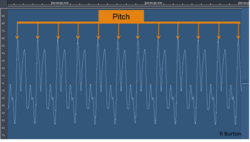
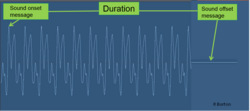
音の高さ(ピッチ)は、波の繰り返されるパターンを解析することで認識されます。また、音の始まりと終わりを検知することで、その音がどれくらいの時間続いていたかという持続時間が判断されます。
音量と音色
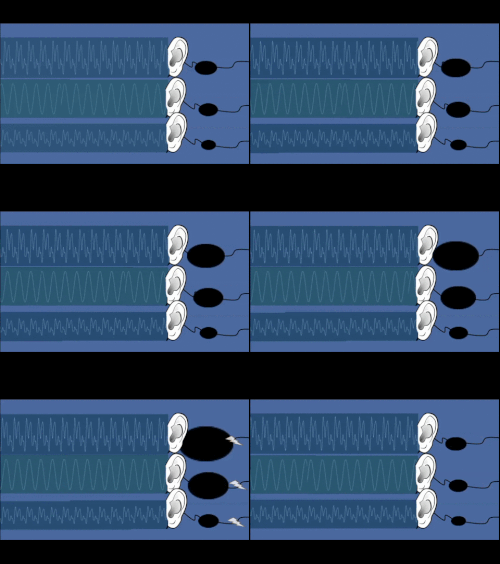
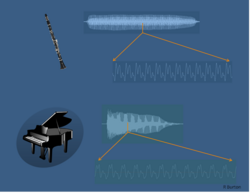
音の大きさ(ラウドネス)は、短時間(約200ミリ秒)のエネルギー統合によって決まります。また、同じ周波数であっても、波形が時間とともにどう変化するかによって、ピアノやバイオリンのような「音色(ティンブル)」の違いとして認識されます。
音のテクスチャと空間把握
複数の音源がどのように相互作用しているか、あるいは単一の音か、多声的な構成かといった認知的な分離を「音のテクスチャ」と呼びます。これに加えて、音源がどこにあるかという空間的な位置情報も同時に処理されています。
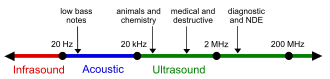
可聴域外の音:超音波と低周波音
人間の耳には聞こえない周波数帯域の音も存在します。
- 超音波 (Ultrasound): 20kHzを超える高周波音。物理的性質は可聴音と同じですが、人間には聞こえません。医療診断や工業用検査などに利用されています。
- 低周波音 (Infrasound): 20Hz未満の低周波音。人間にはピッチとしてではなく、断続的なパルスや振動として感じられることがあります。ゾウやクジラなどの大型動物が通信に利用しているほか、火山噴火の検知にも使われます。
Frequently Asked Questions
宇宙空間で音が聞こえないのはなぜですか?
音は媒体(空気などの物質)の振動として伝わる機械波であるため、媒体がほとんど存在しない真空の宇宙空間では、振動を伝える手段がなく、音が伝播できないからです。
音速はどのような条件で変化しますか?
主に媒体の温度、密度、圧力によって変化します。例えば、空気中では温度が上がると音速が速くなります。また、空気よりも水、水よりも鋼鉄のように、密度が高く弾性の強い媒体ほど音速は速くなります。
「音圧」と「音量」の違いは何ですか?
音圧は物理的な圧力の変動を測定した客観的な数値ですが、音量(ラウドネス)は人間が主観的に感じる大きさのことです。音量は、周波数や音の持続時間によっても変化するため、物理的な音圧が同じでも聞こえ方が異なる場合があります。
超音波と普通の音に物理的な違いはありますか?
物理的な性質に違いはありません。どちらも媒体を伝わる機械的な圧力波です。唯一の違いは周波数の高さであり、それが人間の聴覚システムの限界を超えているため、「聞こえない」だけです。
References
- In acoustics, the vibrating membrane of a drum functions as an acoustic membrane in the general sense (i.e. a membrane whose vibration produces or transmits sound). This is distinct from the engineered acoustic‑metamaterial membranes described in the article .
- Other major standards organisations, including , , , and the system, primarily define acoustical quantities (such as , , and ) or specify terminology related to oscillatory behaviour, but do not provide a general conceptual definition of sound as a propagating mechanical disturbance. ISO 80000‑8 defines quantities and units, ISO 18405 defines underwater‑acoustics terminology, IEC 60050‑801 defines sound in terms of particle motion in an elastic medium, DIN 1320 defines terminology for acoustics and acoustical quantities, and the SI Brochure defines only "audible sound" as a frequency range.
- In physics and acoustics literature, a distinction is made between local vibration (a time‑dependent disturbance at a point) and a wave (a disturbance that propagates through space over time). The disturbance moves through the medium, while the particles of the medium oscillate about an equilibrium position. Several authors note that defining sound as an "oscillation" can be interpreted in ways that obscure the essential role of propagation, and may contribute to conceptual conflation between oscillations and waves. Although sound waves are generated by mechanical vibrations (e.g., a loudspeaker diaphragm) and can induce vibrations in objects (e.g., a microphone diaphragm), the wave itself is the propagating disturbance in the medium, not the local vibration that produces or results from it. Some authors emphasise this distinction to avoid misidentifying sound with the vibrations that cause or result from it.
- Terms such as "oscillation" and "oscillatory" are often associated with periodicity and cyclical change in physics contexts. Oscillation is commonly defined as a repetitive variation about some central value, even though sound waves may be non‑periodic, transient, or broadband, such as noise and short pulses.
- More precisely, the particles of the medium are disturbed locally as the wave passes but experience no net transport; only the disturbance and its energy propagate.
- In solids, the strong binding between particles makes it expectable that only energy is transferred by the wave rather than matter. In fluids, particles are less constrained, but the same principle holds: the medium is disturbed locally without net transport.
- Viscous attenuation is small for ordinary audio frequencies over short distances, but increases rapidly at higher frequencies or over long propagation paths.
- The same theoretical effect is also discussed in the context of phonons; see .
- A non‑homogeneous medium is one in which the local speed of sound varies with position due to changes in temperature, density, or composition.
- Fourier analysis relies on the principle of superposition and therefore applies only to linear wave propagation. In nonlinear acoustics, where wave speed depends on amplitude, such decompositions no longer hold exactly.
📸 フォトギャラリー