水に入れたストローが折れ曲がって見えたり、雨上がりに美しい虹が架かったりするのはなぜでしょうか。これらの現象の背後にあるのが屈折という物理現象です。屈折とは、波が異なる媒体(物質)の間を移動する際に、その進行方向が変わることを指します。最も身近なのは光の屈折ですが、実は音波や水面を伝わる波など、あらゆる種類の波に共通して見られる性質です。
Key Facts
- 屈折の正体: 媒体が変わることで波の速度が変化し、進行方向が曲がること。
- 光の減速: 真空以外の物質(ガラスや水など)の中では、電子との相互作用により光の速度が低下する。
- スネルの法則: 入射角と屈折角の比率が、それぞれの媒体の屈折率の比に等しいという法則。
- 分散: 光の波長(色)によって屈折率が異なるため、光が分かれる現象(虹の原因)。
- 多様な波への適用: 光だけでなく、音波や水波でも速度差があれば屈折が起こる。
光が曲がる物理的なメカニズム
なぜ速度が変化するのか
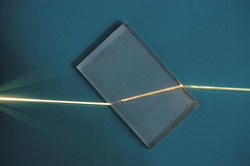
光は真空中で最大速度(c)で進みますが、空気、水、ガラスなどの物質中に入ると速度が低下します。これは単に光が遮られたり吸収されたりしているわけではありません。光という電磁波が物質中の電子を振動させ、その電子が再び電磁波を放出することで、元の光と干渉し合い、結果として全体の進行速度が遅くなるためです。
方向が変わる理由
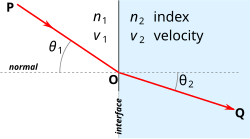
光が斜めに異なる媒体へ進入すると、波面の一部が先に速度を変えるため、左右で速度差が生じます。この非対称な速度変化によって、波全体がピボット(回転)するように方向を変えるのです。速度が遅い媒体に入る場合は法線(境界線に垂直な線)側に寄り、逆に速度が速い媒体へ出る場合は法線から遠ざかる方向に曲がります。

屈折を定義する「スネルの法則」
光の屈折量は、スネルの法則という数式で正確に記述されます。これは、入射角の正弦(sin)と屈折角の正弦の比が、2つの媒体の屈折率の比(または位相速度の比)に等しいことを示しています。波が境界線に対して完全に垂直に入射した場合は、速度は変わりますが方向は変わりません。
日常生活に見られる屈折の事例
水面での視覚的錯覚
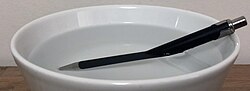
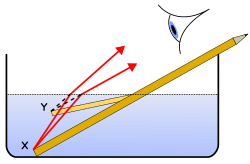
水(屈折率 約1.33)と空気(屈折率 約1.0)の境界では、光が大きく曲がります。そのため、水中にある物体から出た光が空気中で屈折し、私たちの目には物体が実際よりも浅い位置にあるように見えます。これを見かけの深さと呼びます。この現象により、水中の魚を狙う釣り人や、水上へ向かって水を飛ばすテッポウウオは、視覚的な位置ではなく補正した位置を狙う必要があります。
光の分散と虹の形成
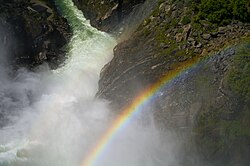
物質の屈折率は、光の波長(周波数)によってわずかに異なります。白い太陽光がプリズムや雨粒を通過すると、色ごとに屈折する角度が変わるため、光がスペクトル状に分かれます。これが分散と呼ばれる現象であり、空に虹が現れる仕組みです。
大気による影響と蜃気楼
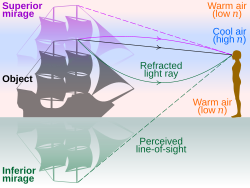
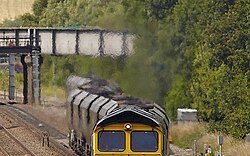
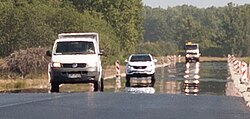
空気の屈折率は温度や密度によって変化します。高度が上がると気圧が下がり屈折率も低下するため、遠くの星の光は地球に向かってわずかに曲げられます。また、地表付近で激しい温度差があると、光が複雑に屈折し、路面に水があるように見える蜃気楼や、空気がゆらゆらと揺れる陽炎(かげろう)が発生します。
医療やその他の波への応用
眼科における屈折検査
人間の目はレンズによる屈折を利用してピントを合わせています。眼科などの医療現場では、検眼器(フォロプター)を用いて目の屈折異常を測定し、最適な矯正レンズを処方する「屈折検査」が行われます。また、屈折異常を直接治療する屈折矯正手術も一般的です。
水波と音波の屈折
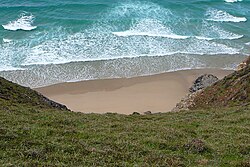
屈折は光だけの特権ではありません。水波は水深が浅くなると速度が落ちるため、海岸線に近づくにつれて波面が岸に対してほぼ平行になるように屈折します。また、水中音響学では、水温や塩分濃度、圧力による音速の変化が音線を曲げることが知られており、これは都市の道路騒音対策などの設計にも応用されています。
屈折現象のまとめ
| 項目 | 光の屈折 | 水波の屈折 | 音波の屈折 |
|---|---|---|---|
| 速度変化の要因 | 媒体の屈折率(電子との相互作用) | 水深の変化 | 温度・塩分・圧力の変化 |
| 代表的な現象 | 虹、蜃気楼、レンズ | 海岸線での波の方向変化 | 水中音波の曲がり |
| 支配的な法則 | スネルの法則 | 波の速度勾配 | 音速勾配 |
Frequently Asked Questions
なぜ光は物質中に入ると遅くなるのですか?
光が物質中の電子を振動させ、その電子が放出する電磁波が元の光と干渉し合うためです。この相互作用の結果、波のパケットが伝わる速度が実質的に低下します。
虹ができる仕組みを簡単に教えてください。
太陽光が雨粒に入るときに屈折し、さらに内部で反射して外に出るときに再び屈折します。このとき、色(波長)によって屈折する角度が異なる「分散」が起こるため、光が色分けされて虹に見えます。
蜃気楼はなぜ起こるのですか?
地面付近の空気の温度が極端に高い場合、空気の密度が変わり屈折率が変化します。これにより、本来なら直進するはずの光が上向きに曲げられ、空の景色が地面に映り込んだり、水があるように見えたりします。
水中で魚を狙うときに注意すべき点は何ですか?
光の屈折により、水中の物体は実際よりも浅い(高い)位置にあるように見えます。そのため、見たままの位置を狙うと外れてしまい、実際よりも低い位置を狙う必要があります。
音波にも屈折があるというのは本当ですか?
はい。音波も媒体の温度や密度によって速度が変わるため、速度勾配がある場所では進行方向が曲がります。これは水中だけでなく、大気中でも起こる現象です。
References
- The Editors of Encyclopaedia Britannica. "Refraction". Encyclopaedia Britannica. Retrieved 2018-10-16.
- R. Paschotta, article on chromatic dispersion Archived 2015-06-29 at the in the Encyclopedia of Laser Physics and Technology Archived 2015-08-13 at the , accessed on 2014-09-08
- Carl R. Nave, page on Dispersion Archived 2014-09-24 at the in HyperPhysics Archived 2007-10-28 at the , Department of Physics and Astronomy, , accessed on 2014-09-08
- "Rainbow". education.nationalgeographic.org. Retrieved 2025-06-28.
- Born and Wolf (1959). . New York, NY: Pergamon Press INC. p. 37.
- Why does light slow down in water? -
- Hecht, Eugene (2002). Optics. Addison-Wesley. p. 101. .
- "Refraction". RP Photonics Encyclopedia. RP Photonics Consulting GmbH, Dr. Rüdiger Paschotta. 21 April 2013. :10.61835/vke. Retrieved 2018-10-23.
It results from the boundary conditions which the incoming and the transmitted wave need to fulfill at the boundary between the two media. Essentially, the tangential components of the wave vectors need to be identical, as otherwise the phase difference between the waves at the boundary would be position-dependent, and the wavefronts could not be continuous. As the magnitude of the wave vector depends on the refractive index of the medium, the said condition can in general only be fulfilled with different propagation directions.
- Dill, Lawrence M. (1977). "Refraction and the spitting behavior of the archerfish (Toxotes chatareus)". Behavioral Ecology and Sociobiology. 2 (2): 169–184. :1977BEcoS...2..169D. :10.1007/BF00361900. 4599128. 14111919.
- "The effect of heat haze on image quality". Nikon. 2016-07-10. Retrieved 2018-11-04.
📸 フォトギャラリー