私たちが夜空を見上げたとき、そこには無限に広がる空間があるように感じられます。しかし、物理学的に「観測可能」な範囲には明確な境界が存在します。観測可能な宇宙とは、宇宙の始まりから現在までに、光などの電磁波が地球に到達できた領域のことです。この領域は地球を中心とした巨大な球体として定義されます。
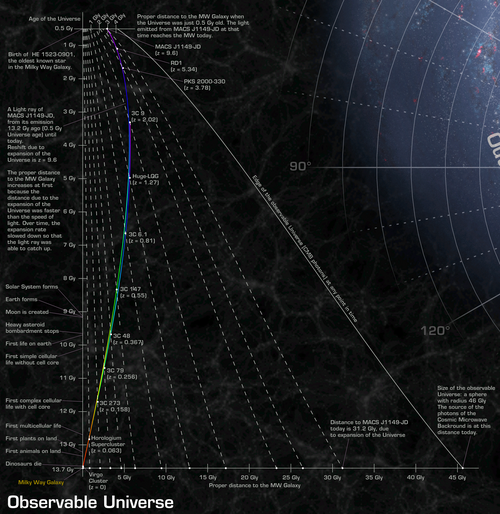
宇宙は絶えず膨張しており、その速度は加速しています。そのため、光が旅をする間に空間自体が広がった結果、観測可能な宇宙の半径は、宇宙の年齢(約138億年)よりもはるかに大きな約465億光年(14.26ギガパーセク)に達しています。
Key Facts
- 直径:約930億光年(8.8 × 1026メートル)
- 年齢:137.87 ± 0.020億年
- 構成要素:ダークエネルギー(68.3%)、ダークマター(26.8%)、通常物質(4.9%)
- 平均温度:約2.725ケルビン
- 物質量:通常物質の総質量は約1.5 × 1053 kg
宇宙のサイズと「共動距離」の概念
宇宙の大きさを考える際、単純な光の到達時間だけでは不十分です。ここで重要になるのが共動距離(comoving distance)という概念です。これは、宇宙の膨張を考慮して、現在の尺度で測定した距離を指します。
例えば、宇宙最古の光である宇宙マイクロ波背景放射(CMBR)を放った物質は、放出時点では地球からわずか4,200万光年ほどの距離にありました。しかし、その後138億年かけて宇宙が膨張したため、現在それらの物質は地球から約460億光年離れた場所に位置していると計算されます。
全宇宙と観測可能な宇宙の違い
私たちが観測できる範囲は、全宇宙のごく一部に過ぎないと考えられています。アラン・グースらが提唱した宇宙インフレーション理論(宇宙誕生直後に急激な加速膨張が起きたとする説)に基づけば、全宇宙のサイズは観測可能な範囲の少なくとも3 × 10²³倍以上の規模である可能性が示唆されています。
宇宙を構成する物質とエネルギー
宇宙の全エネルギー密度を計算すると、私たちが知っている「原子」でできた通常物質(バリオン物質)は、全体のわずか4.9%に過ぎません。残りの大部分は、光を発せず重力のみで影響を及ぼすダークマター(暗黒物質)と、宇宙の膨張を加速させている謎のエネルギーであるダークエネルギーで占められています。
通常物質の総質量から計算すると、観測可能な宇宙に存在する水素原子の総数は約1080個に達すると推定されており、これはエディントン数として知られています。
| 項目 | 数値・詳細 |
|---|---|
| 半径(共動距離) | 約465億光年 |
| 全体積 | 約4.22 × 10¹² 立方光年 |
| エネルギー密度 | 約8.5 × 10⁻²⁷ kg/m³(1立方メートルあたり陽子約5個分) |
| 最遠方天体 | 銀河 MoM-z14(赤方偏移 z=14.44) |
大規模構造と観測の限界
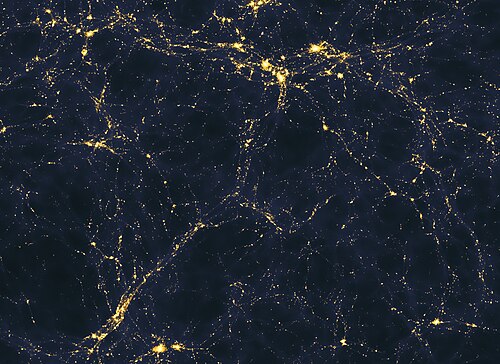
宇宙を広大なスケールで捉えると、銀河はランダムに配置されているのではなく、フィラメント状の構造や巨大な空洞(ヴォイド)を持つ大規模構造を形成しています。私たちの天の川銀河は、処女座超銀河団という小さな集団の一部に過ぎません。
![Hubble Ultra-Deep Field image of a region of the observable universe (equivalent sky area size shown in bottom left corner), near the constellation Fornax. Each spot is a galaxy, consisting of billions of stars. The light from the smallest, most redshifted galaxies originated around 12.6 billion years ago,[31] close to the age of the universe.](/images/31/09/31098998bdd5aaf7981d37bb4f3ef91d6cf3c9de3c8d7d1528eb6a5bc479d2cd.jpg)
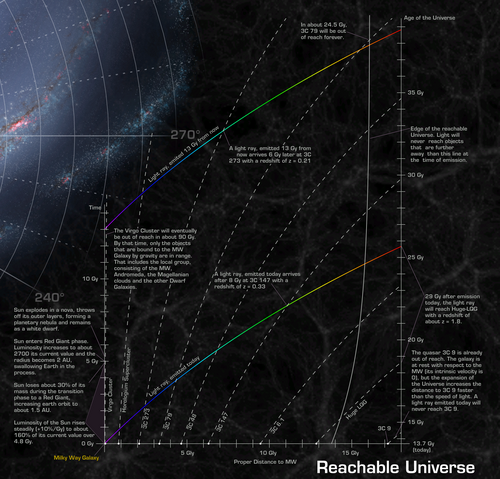
しかし、宇宙の加速膨張により、将来的に多くの銀河は私たちの視界から消えていきます。ある一定の距離(共動距離で約620億光年)を超えて放出された光は、永遠に地球に届くことはありません。また、遠方の天体ほど光が引き伸ばされて赤くなる赤方偏移が強まり、最終的には観測不能なほど暗く、赤い光へと変化していきます。
Frequently Asked Questions
宇宙の年齢が138億年なのに、なぜ半径が465億光年もあるのですか?
光が地球に向かって旅をしている間にも、宇宙自体が膨張し続けているためです。光が移動した距離に、その間の空間の広がりを加算して計算するため、現在の距離(共動距離)は宇宙の年齢よりも大きな値になります。
ダークエネルギーとは具体的に何ですか?
宇宙全体の約68.3%を占めるとされる未知のエネルギーです。重力とは逆に、空間を押し広げる斥力として働き、宇宙の膨張速度を加速させていると考えられています。
私たちは宇宙の端に行くことができますか?
いいえ、不可能です。宇宙の膨張速度が光速を超える領域が存在するため、現在の物理法則では、ある一定の距離(到達可能な宇宙の境界)を超えた場所へ到達することはできません。
観測可能な宇宙の外側には何があるのですか?
確実なことは分かっていませんが、インフレーション理論によれば、観測可能な範囲と同様の銀河や星々が、想像を絶する規模でさらに広がっていると考えられています。
References
- prevents nearby objects in the same local region from moving faster than the speed of light with respect to each other, but there is no such constraint for distant objects when the space between them is expanding; see for a discussion.
- The comoving distance of the future visibility limit is calculated on p. 8 of Gott et al.'s A Map of the Universe to be 4.50 times the , given as 4.220 billion parsecs (13.76 billion light-years), whereas the current comoving radius of the observable universe is calculated on p. 7 to be 3.38 times the Hubble radius. The number of galaxies in a sphere of a given comoving radius is proportional to the cube of the radius, so as shown on p. 8 the ratio between the number of galaxies observable in the future visibility limit to the number of galaxies observable today would be (4.50/3.38)3 = 2.36.
- This does not mean "unbounded" in the mathematical sense; a finite universe would have an upper bound on the distance between two points. Rather, it means that there is no boundary past which there is nothing. See .
- Although listed in by the cited source, this number is so vast that its digits would remain virtually unchanged for all intents and purposes regardless of which conventional units it is listed in, whether it to be or , as the differences would disappear into the error.
📸 フォトギャラリー