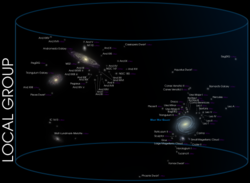
私たちが暮らす地球が含まれる局所銀河群(Local Group)は、宇宙の広大なスケールにおいて、ごく近傍に位置する銀河の集まりです。このグループは、巨大な2つの銀河を中心とした「ダンベル型」の構造を持っており、宇宙における私たちの「近所」を形作っています。
この銀河群の重心は、天の川銀河とアンドロメダ銀河の中間に位置していますが、質量分布の影響でアンドロメダ銀河側にわずかに寄っています。現在、これら2つの巨大銀河は互いに引き寄せられており、秒速約123kmという猛烈な速度で接近し続けています。
Key Facts
- 構成数:134以上の銀河が存在する。
- 主要メンバー:天の川銀河、アンドロメダ銀河、さんかく座銀河の3つの主要な渦巻銀河。
- 構造:天の川銀河系とアンドロメダ銀河系の2つのサブグループからなるダンベル状の形態。
- 規模:長軸は約1,670万光年に及び、結合質量は約2.47 × 10¹² 太陽質量と推定される。
- 親構造:さらに大きな構造である「局所シート(Local Sheet)」の一部である。
局所銀河群を構成する主要な銀河
局所銀河群には多様な形態の銀河が含まれていますが、特に影響力の強い3つの渦巻銀河が中心的な役割を果たしています。
天の川銀河(Milky Way)
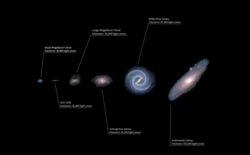
地球が属する棒渦巻銀河です。直径は約87,400光年で、グループ内で2番目に大きなサイズを誇ります。多くの衛星銀河を従えており、その重力圏に多くの矮小銀河を保持しています。

アンドロメダ銀河(M31)
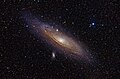
局所銀河群で最大の銀河であり、直径は約152,000光年に達します。星の数も約1兆個と極めて多く、天の川銀河よりも質量が大きいと考えられています。M32やM110といった多くの衛星銀河を伴っています。
さんかく座銀河(M33)
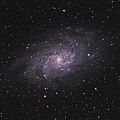
3番目に大きな渦巻銀河であり、唯一の非棒渦巻銀河です。アンドロメダ銀河の衛星である可能性が指摘されており、数十億年前の接近によってアンドロメダ銀河の星形成が活性化したという説があります。
多様な矮小銀河と衛星システム
主要な3銀河の周囲には、非常に多くの矮小銀河(Dwarf Galaxy)が点在しています。これらは大きく分けて、ガスを豊富に持つ「不規則銀河」と、ガスが少なく古い星で構成される「矮小楕円銀河」や「矮小球状銀河」に分類されます。
特に天の川銀河の周囲には、大マゼラン雲(LMC)や小マゼラン雲(SMC)といった著名な衛星銀河が存在します。また、最近の観測では、極めて暗く星の数が少ない「超淡い矮小銀河(Ultra-faint dwarf galaxies)」が次々と発見されており、銀河群の構成メンバーは更新され続けています。
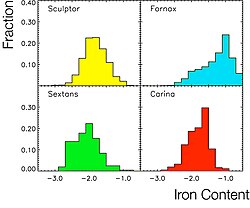
これらの矮小銀河の分布や化学組成(金属量)を分析することで、天の川銀河がどのように成長し、周囲の小さな銀河を吸収してきたかという進化の歴史を解き明かすことができます。
宇宙における位置とダイナミクス
局所銀河群は、地球から約500万光年圏内の近傍宇宙に位置しています。この領域では、銀河同士の相互作用が激しく、ガスが引き剥がされて形成される「マゼラン流(Magellanic Stream)」のような構造も見られます。
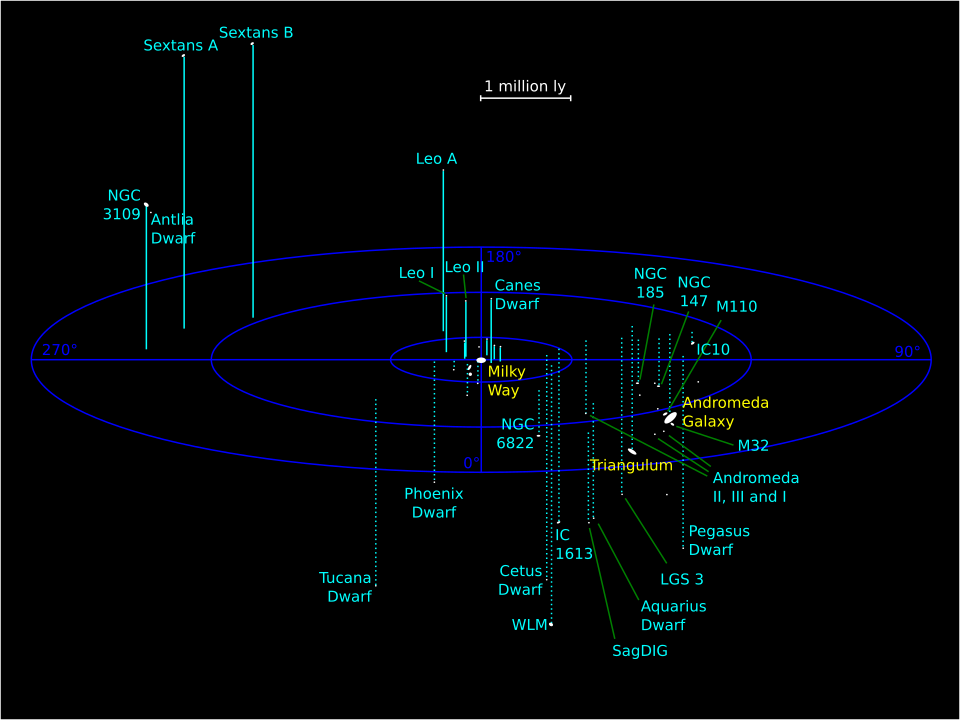
長期的には、天の川銀河とアンドロメダ銀河は最終的に衝突し、一つの巨大な楕円銀河へと統合される運命にあります。このダイナミックな動きは、局所銀河群全体の構造を決定づける最大の要因となっています。
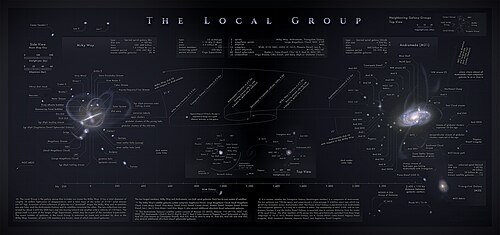
主要銀河の比較まとめ
| 銀河名 | 形態 | 直径 (D25) | 推定質量 (太陽質量) | 特徴 |
|---|---|---|---|---|
| アンドロメダ銀河 | 渦巻銀河 (SAb) | 約152,000光年 | (1.5 ± 0.5) × 1012 | グループ最大、星の数が最多 |
| 天の川銀河 | 棒渦巻銀河 (SBbc) | 約87,400光年 | (1.54 ± 0.1) × 1012 | 地球が属する、質量的に最大候補 |
| さんかく座銀河 | 渦巻銀河 (SAcd) | 約61,100光年 | 5 × 10¹¹ | 3番目に大きく、非棒渦巻銀河 |
| 大マゼラン雲 | マゼラン型渦巻 | 約32,200光年 | 1 × 10¹¹ | 天の川銀河の主要な衛星銀河 |
Frequently Asked Questions
局所銀河群とは具体的にどのような集まりですか?
天の川銀河やアンドロメダ銀河を含む、宇宙の近傍に位置する銀河のグループです。134以上の銀河で構成されており、主に2つの大きな銀河系が互いに引き寄せ合う構造をしています。
天の川銀河とアンドロメダ銀河は将来どうなりますか?
両者は現在、秒速約123kmで接近しており、将来的には衝突・合体して一つの大きな銀河になると予測されています。
「矮小銀河」とは何ですか?
主要な銀河に比べてサイズが非常に小さく、星の数も少ない銀河のことです。局所銀河群には多くの矮小銀河が含まれており、その多くは巨大銀河の重力に捕らわれた衛星銀河として存在しています。
さんかく座銀河はどのような立ち位置の銀河ですか?
局所銀河群で3番目に大きな渦巻銀河です。アンドロメダ銀河の衛星である可能性が高く、過去にアンドロメダ銀河と接近したことで、相手の星形成を刺激したと考えられています。
局所銀河群の重心はどこにありますか?
天の川銀河から約150万光年離れた、天の川銀河とアンドロメダ銀河の中間に位置しています。ただし、アンドロメダ銀河の方が質量が大きいため、重心はややアンドロメダ側に寄っています。
References
- Makarov, Danila; Makarov, Dmitry; Makarova, Lidia; Libeskind, Noam (2025). "The frozen outskirts: A cold Hubble flow and the mass of the Local Group". Astronomy & Astrophysics. 698: A178. :2505.06642. :2025A&A...698A.178M. :10.1051/0004-6361/202554778.
- Theuns, Tom. "Galaxy population". . .
- McCall, Marshall L. (29 April 2013). "A Council of Giants". Monthly Notices of the Royal Astronomical Society. 440 (1) (published 10 March 2014): 405–426. :1403.3667. :2014MNRAS.440..405M. :10.1093/mnras/stu199.
- Banik, Indranil; Zhao, Hongsheng (2018). "A plane of high-velocity galaxies across the Local Group". Monthly Notices of the Royal Astronomical Society. 473 (3): 4033–4054. :1701.06559. :10.1093/mnras/stx2596.
- Elahi, Pascal J.; Power, Chris; Lagos, Claudia del P.; Poulton, Rhys; Robotham, Aaron S G. (2018). "Using velocity dispersion to estimate halo mass: Is the Local Group in tension with ΛCDM?". Monthly Notices of the Royal Astronomical Society. 477: 616–623. :1712.01989. :10.1093/mnras/sty590.
- Maloney, Philip R.; Bland-Hawthorn, J. (1999). "Warm Gas and Ionizing Photons in the Local Group". The Astrophysical Journal. 522 (2): L81–L84. :astro-ph/9907197. :1999ApJ...522L..81M. :10.1086/312223.
- {{{label}}}
- Karachentsev, I. D.; Kashibadze, O. G. (2006). "Masses of the local group and of the M81 group estimated from distortions in the local velocity field". Astrophysics. 49 (1): 3–18. :2006Ap.....49....3K. :10.1007/s10511-006-0002-6. 120973010.
- The mass of the Local Group is essentially accounted for by the mass of the Milky Way and the Andromeda Galaxy. Estimates for the mass of each galaxy are compatible with 1012 M☉, and Peñarrubia et al. (2014) estimate (2.3±0.7)×1012 M☉ for the Local Group, but Karachentsev and Kashibadze (2006) estimate the somewhat lower value of (1.29±0.14)×1012 M☉.
- Boylan-Kolchin, Michael; Weisz, Daniel R.; Bullock, James S.; Cooper, Michael C. (2016). "The Local Group: The ultimate deep field". Monthly Notices of the Royal Astronomical Society: Letters. 462: L51–L55. :1603.02679. :10.1093/mnrasl/slw121.
📸 フォトギャラリー