化学の世界には、伝統的な「オクテット則(最外殻電子を8個で満たそうとする傾向)」に反するように見える不思議な分子が存在します。これらは超原子価分子(Hypervalent molecules)と呼ばれ、中心となる主族元素が価電子殻に8個を超える電子を保持しているように見えるのが特徴です。代表的な例として、五塩化リン(PCl5)や六フッ化硫黄(SF6)などが挙げられます。
Key Facts
- 定義: 第15〜18族の主族元素が、オクテット則で規定される最低価数以外の状態で存在する分子。
- 代表例: PCl5, SF6, ClF3, XeF4などのハロゲン化物や希ガス化合物。
- 結合理論の変遷: かつてはd軌道の関与(spd混成)が信じられていたが、現在は3中心4電子結合や分子軌道論による説明が主流。
- 反応性の特徴: 4配位の類似体と比較して、5配位や6配位の超原子価状態にある分子は一般に親核置換反応などの反応性が著しく高い。
超原子価の定義と分類
1969年にジェレミー・I・ムシャーによって形式的に定義された超原子価分子は、中心原子が持つ価電子数が、その族の最低価数(15族なら3、16族なら2など)を超えている状態を指します。これらを分類するための便利な表記法として「N-X-L表記」があります。ここでNは価電子数、Xは中心原子の元素記号、Lは配位子の数を表します。
例えば、二フッ化キセノン(XeF2)は「10-Xe-2」、五塩化リン(PCl5)は「10-P-5」、六フッ化硫黄(SF6)は「12-S-6」と表記されます。このような化合物は、有機合成に有用な超原子価ヨウ素化合物や、極めて安定な希ガス化合物など、多岐にわたるクラスに分類されます。
結合メカニズムを巡る論争と理論
超原子価分子の結合様式については、化学史の中で激しい議論が交わされてきました。初期の理論では、中心原子の空いているd軌道がs軌道やp軌道と混成し、電子を収容する「spd混成軌道」を形成すると考えられていました。これにより、PCl5の三角双錐形やSF6の正八面体構造が説明されていました。
しかし、現代の量子化学計算(ab initio計算)により、第3周期元素の3d軌道はエネルギー的に高く、結合への寄与は極めて小さいことが判明しました。現在では、d軌道への依存ではなく、3中心4電子(3c-4e)結合というモデルが有力視されています。これは、1つのp軌道が2つの配位子と直線的に重なり、3つの分子軌道(結合性、非結合性、反結合性)を形成し、そこに4つの電子が配置される仕組みです。
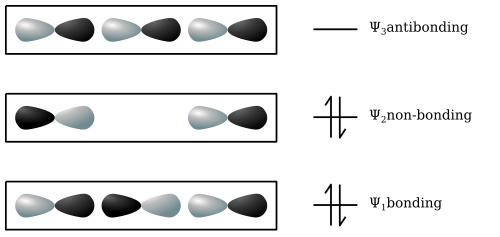
このモデルでは、電子が非局在化するため、中心原子は形式的にオクテット則を維持したまま、多くの配位子と結合することが可能になります。また、最新の研究では、結合の大部分(約80%以上)がイオン的な性質によって説明される一方で、わずかながらspd混成のような超原子価構造がエネルギー的な安定化に寄与していることも示唆されています。
「超原子価」か「超配位」か:定義の再検討
近年では、「超原子価(Hypervalent)」という言葉自体への批判もあります。ロナルド・ギレスピーらは、電子局在関数などの分析に基づき、通常の分子と超原子価分子の結合に根本的な違いはないと主張し、「超配位(Hypercoordinate)」という用語への置き換えを提案しました。これは、結合の性質ではなく、単に配位数が多いことを指す言葉です。
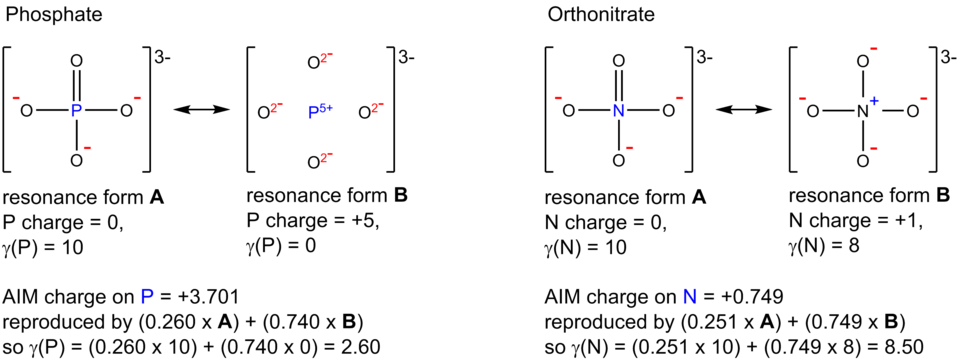
また、原子電荷マップを用いた新しい定義(価電子等価物 $\gamma$)では、実際に共有されている電子数が8を超えるかどうかで判定します。この基準では、従来のPCl5などはイオン性が強いため「超配位だが超原子価ではない」とされ、逆にオゾン(O3)などが「真の超原子価分子」として再分類されます。
構造的特徴と化学的反応性
超原子価分子は、その幾何学的構造が反応性に大きな影響を与えます。特にケイ素(Si)やリン(P)の化合物において、配位数が増加すると親核試薬に対する反応速度が劇的に向上することが知られています。
例えば、4配位のクロロシランに比べて、5配位のケイ素種は親核攻撃を受けやすく、加水分解速度が飛躍的に速まります。これは、超原子価中間体を経由することで遷移状態のエネルギーが下がるためと考えられています。また、リン化合物においても、5配位構造を持つ種は特有の反応機構(アルコール分解など)を示します。
![Relative bond strengths in hexacoordinated phosphorus compounds. In A, the N–P bond is 1.980 Å long and the C–P is 1.833 Å long, and in B, the N–P bond increases to 2.013 Å as the C–P bond decreases to 1.814 Å.[30]](/images/ec/d5/ecd5b94a097d46cfdb42179ce7a5bcacefd703d5e6cc948ab7270d1c6d18cc82.png)
![Relative bond strengths in pentacoordinated silicon compounds. In A, the Si-O bond length is 1.749Å and the Si-I bond length is 3.734Å; in B, the Si-O bond lengthens to 1.800Å and the Si-Br bond shortens to 3.122Å, and in C, the Si-O bond is the longest at 1.954Å and the Si-Cl bond the shortest at 2.307A.[30]](/images/52/59/52590f2291b99187b19a98e2e9895cd1f55671ff0e48453840a456744f8b3ea5.png)
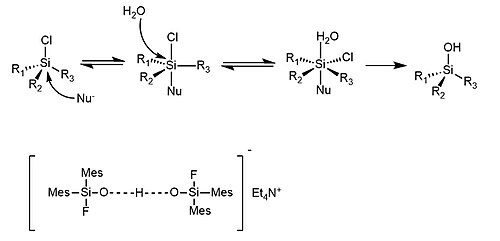
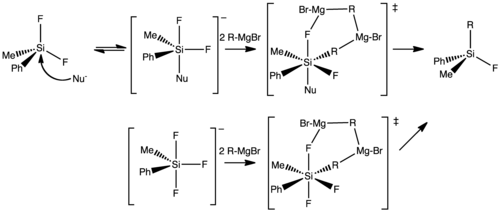
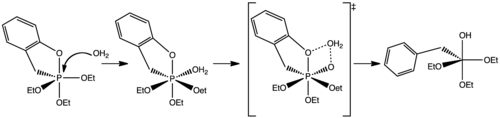
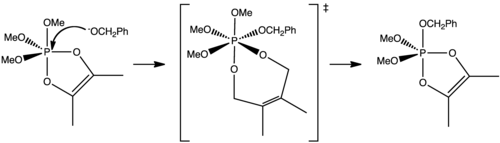
こうした反応性の向上は、計算化学的なアプローチによっても裏付けられており、5配位種が持つ特有の電子状態が親核試薬の接近を容易にしていることが示されています。

まとめ:超原子価化合物の特性一覧
| 比較項目 | d軌道混成モデル(古典的) | 3中心4電子結合モデル(現代的) | イオン的モデル / 超配位 |
|---|---|---|---|
| 中心原子の電子数 | 8個を超える(拡張オクテット) | 実質的に8個を維持 | 配位子への電荷移動で8個以下に |
| 関与する軌道 | s, p, d 軌道の混成 | p軌道と配位子軌道の重なり | 主にs, p 軌道(イオン結合的) |
| 主な説明対象 | SF6, PCl5 の幾何構造 | XeF2, I3- などの直線構造 | 電気陰性度の高い配位子を持つ種 |
| 現在の評価 | 教育的ツールとして利用 | 量子化学的に妥当性が高い | 熱力学的計算と整合性が高い |
Frequently Asked Questions
超原子価分子とは具体的にどのようなものですか?
中心にある主族元素が、通常の化学結合のルール(オクテット則)で想定される数よりも多くの電子を周囲に持っているように見える分子のことです。例えば、リンが5つの塩素原子と結合している五塩化リンなどがこれに当たります。
なぜd軌道を使った説明は否定されるようになったのですか?
高度な量子化学計算の結果、第3周期元素のd軌道はエネルギー的に非常に高く、実際に結合を作るために使われるには不適切であることが分かったためです。現在は、d軌道を使わずに電子を分散させる「3中心4電子結合」などの理論で説明されます。
「超原子価」と「超配位」の違いは何ですか?
「超原子価」は電子の数(8個超)に注目した概念ですが、「超配位」は単に中心原子に結合している原子の数(配位数)が多いことを指します。結合の正体がイオン的なものである場合、電子数は8個以下に抑えられているため、「超配位だが超原子価ではない」という解釈がなされます。
超原子価になると反応性はどのように変わりますか?
一般的に、配位数が増えて超原子価(または超配位)状態になると、親核試薬による攻撃を受けやすくなり、反応速度が著しく向上します。これは、遷移状態の安定化や電子密度の変化によるものです。
水素で構成される超原子価分子は存在しますか?
ほとんどの超原子価分子はフッ素などの電気陰性度の高い原子を必要としますが、計算化学の分野では「超原子価水素化物」の研究が進んでいます。特にヨウ素の水素化物(IH3やIH5)などは、安定して観測できる可能性があると示唆されています。
References
- Musher, J.I. (1969). "The Chemistry of Hypervalent Molecules". 8: 54–68. :10.1002/anie.196900541.
- Perkins, C. W.; ; ; Lau, W.; Alegria, A; (1980). "An Electrically Neutral σ-Sulfuranyl Radical from the Homolysis of a Perester with Neighboring Sulfenyl Sulfur: 9-S-3 species". J. Am. Chem. Soc. 102 (26): 7753–7759. :1980JAChS.102.7753P. :10.1021/ja00546a019.
- Jensen, W. (2006). "The Origin of the Term "Hypervalent"". 83 (12): 1751. :2006JChEd..83.1751J. :10.1021/ed083p1751. | Link
- Kin-ya Akiba (1999). Chemistry of Hypervalent Compounds. New York: Wiley VCH. .
- Magnusson, E. (1990). "Hypercoordinate molecules of second-row elements: d functions or d orbitals?". J. Am. Chem. Soc. 112 (22): 7940–7951. :1990JAChS.112.7940M. :10.1021/ja00178a014.
- Braïda, Benoît; Hiberty, Philippe C. (2013-04-07). "The essential role of charge-shift bonding in hypervalent prototype XeF2" (PDF). Nature Chemistry. 5 (5): 417–422. :2013NatCh...5..417B. :10.1038/nchem.1619. 1755-4330. 23609093.
- H., Cockett, A. (2013). The Chemistry of the Monatomic Gases : Pergamon Texts in Inorganic Chemistry. Smith, K. C., Bartlett, Neil. Saint Louis: Elsevier Science. . 953379200.
{{}}: CS1 maint: multiple names: authors list () - Lein, Matthias; Frenking, Gernot (2005-01-01). "The nature of the chemical bond in the light of an energy decomposition analysis". Theory and Applications of Computational Chemistry: 291–372. :10.1016/B978-044451719-7/50056-1. .
{{}}: CS1 maint: periodical has ISBN () - Brecher, Jonathan (2008). "Graphical representation standards for chemical structure diagrams (IUPAC Recommendations 2008)". Pure and Applied Chemistry. 80 (2): 277–410. :10.1351/pac200880020277. 0033-4545.
- Reed, Alan E.; Schleyer, Paul v. R. (November 1988). "The anomeric effect with central atoms other than carbon. 2. Strong interactions between nonbonded substituents in mono- and polyfluorinated first- and second-row amines, FnAHmNH2". Inorganic Chemistry. 27 (22): 3969–3987. :10.1021/ic00295a018. 0020-1669.
📸 フォトギャラリー