写真における「感度」とは、光に対するフィルムやイメージセンサーの反応しやすさを数値化したものです。かつては、光に敏感な乳剤(エマルジョン)を使用すれば、より短い時間で画像を記録できたため、露出時間を短縮できるという意味で「スピード(速度)」と呼ばれていました。この概念は現代のデジタルカメラにも引き継がれ、ISO感度として定義されています。
感度の選択は、最終的な画像の質感に決定的な影響を与えます。高感度設定では短いシャッタースピードで撮影が可能になりますが、フィルムでは粒子が粗くなり、デジタルでは電気的なノイズが増加します。対して低感度設定では、より多くの光を必要とするため露出時間は長くなりますが、きめ細やかな描写と高いディテールを維持することが可能です。
Key Facts
- ISO感度は、1974年に導入された国際標準規格であり、現在の世界共通基準である。
- 算術スケール(ASA)は数値が2倍になると感度も2倍になる。
- 対数スケール(DIN)は数値が3°上がると感度が2倍になる。
- 画質への影響:高感度は「粒子感・ノイズ」が増え、低感度は「高精細」になる傾向がある。
- デジタル時代の進化:現代のセンサーはISO 100,000を超える超高感度を実現している。
感度測定システムの変遷と歴史
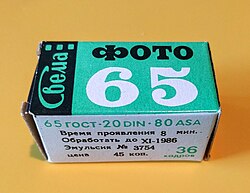
現在のISO規格が普及する前は、地域によって異なる測定基準が用いられていました。米国ではASA(アメリカ標準協会)、欧州ではDIN(ドイツ規格協会)が主流でした。また、旧ソ連では1951年からGOSTという独自の算術スケールが採用されていました。
これらの古いシステムは、測定方法や数値の定義が異なっていたため、互換性を持たせるための変換表が必要でした。例えば、1950年代の資料では、現在の基準とは異なる変換値が記載されていた例もあり、規格の統一がいかに重要であったかが分かります。
![Historic film speed conversion table, 1952[69]](/images/ce/bc/cebcd7277a72ec153896d69db8164440aa432399e7cc52c17e1e025842a6a61b.jpg)
初期の露出計と計測
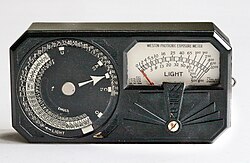
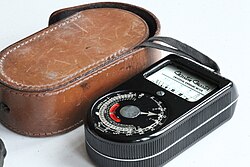
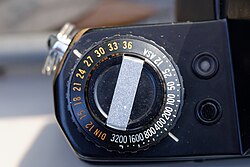
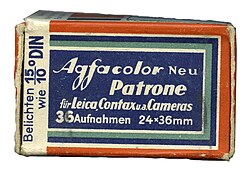
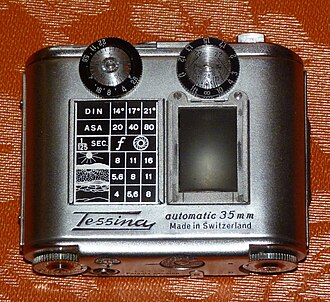
1930年代から40年代にかけて、Westonなどのメーカーが露出計を開発し、写真家は現場で正確な感度設定を行えるようになりました。当時のカメラや露出計には、ASAとDINの両方の表記が併記されていることが一般的でした。
現代の標準規格:ISOシステム
1974年に導入されたISOシステムは、従来のASA(算術的)とDIN(対数的)の両方の概念を統合したものです。カラーネガフィルムにはISO 5800、白黒ネガにはISO 6、カラーリバーサルフィルムにはISO 2240といった個別の標準規格が定められています。
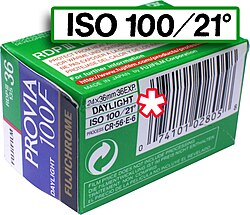
一般的に「ISO 100」と表記される場合、それは算術的なASA値を指していますが、正式には「ISO 100/21°」のように、算術値と対数値を併記します。対数スケールでは、数値に3を加えるごとに感度が1ストップ(2倍)上昇します。
感度変換の計算式
算術的な感度(S)と対数的な感度(S°)の間には、以下の数学的関係があります。
- 対数感度の算出:S° = 10 log S + 1
- 算術感度の算出:S = 10^((S° - 1) / 10)
フィルムからデジタルセンサーへ
デジタルカメラにおけるISOは、イメージセンサー(CCDやCMOS)で捉えた電気信号を増幅させることで感度を上げています。フィルムの物理的な粒子とは異なりますが、信号を増幅させることで「デジタルノイズ」が発生するという点では、高感度化に伴う画質低下という共通の課題を抱えています。
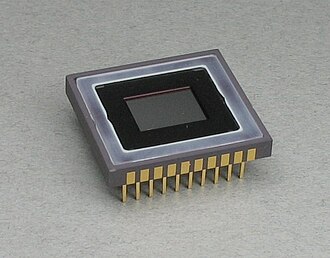
現代のデジタルカメラ、特にプロ向けのフルサイズ機では、ISO 100,000やそれ以上の極めて高い感度設定が可能となっており、暗所での撮影能力が飛躍的に向上しました。一方で、フィルム時代にはISO 3200などの高感度フィルムは非常に粒子が粗く、独特の質感を持っていました。
露出ガイドとカメラの対応範囲
1950年代のカメラには簡易的な露出ガイドが付属していましたが、現代のカメラはDXコードによる自動認識や、広範な手動設定を備えています。一部のハイエンド機では、露出補正を組み合わせることで、規格外の極低感度から超高感度まで対応しています。
感度と露出のまとめ
| 規格名 | 主な地域/時代 | 計算方式 | 感度2倍時の変化 |
|---|---|---|---|
| ASA | 米国 / 旧標準 | 算術的 | 数値が2倍になる |
| DIN | 欧州 / 旧標準 | 対数的 | 数値が3°増加する |
| GOST | 旧ソ連 | 算術的 | 数値が2倍になる |
| ISO | 世界共通 / 現行 | 統合形式 | 算術値2倍 / 対数値+3° |
Frequently Asked Questions
ISO感度を上げるとなぜ画質が落ちるのですか?
フィルムの場合、高感度にするために光に反応する粒子を大きくする必要があり、それが「粒子感」として現れます。デジタルカメラの場合は、センサーが捉えた微弱な電気信号を増幅させるため、同時に不要な電気的ノイズまで増幅されてしまうからです。
ASAとISOの違いは何ですか?
実質的な意味はほぼ同じです。ASAは米国標準協会の規格でしたが、それが国際標準化され、現在のISO規格に統合されました。そのため、現代の文脈で「ISO 100」と言うことは、かつての「ASA 100」とほぼ同義です。
DINという表記を見かけましたが、これは何ですか?
ドイツ規格協会(DIN)による対数的な感度表記です。例えばISO 100はDIN 21°に相当します。数値が3上がるごとに感度が2倍になる仕組みになっており、主に古いヨーロッパのフィルムやカメラで見られます。
デジタルカメラのISO設定はフィルムと同じ仕組みですか?
いいえ、仕組みは異なります。フィルムは化学的な感度(乳剤の性質)で決まりますが、デジタルカメラはセンサーで得た信号を電子的に増幅させています。ただし、露出計算における「光の量と感度の関係」という概念は共通しているため、同じISOという単位が使われています。
低感度で撮影するメリットは何ですか?
低感度(ISO 100など)で撮影すると、フィルムでは粒子が非常に細かくなり、デジタルではノイズが最小限に抑えられます。その結果、色の階調が豊かになり、非常に精細でクリアな画像を得ることができます。
References
- Allbright, G S (1991), "Emulsion Speed Rating Systems", The Journal of Photographic Science, 39 (2): 95–99, :10.1080/00223638.1991.11737126
- Jacobson, Ralph E (1978), The Manual of Photography (Seventh Edition), Focal Press, p. 410
- DIN 4512:1934-01. Photographische Sensitometrie, Bestimmung der optischen Dichte (in German). (DNA). 1934.
In the introduction to the standard, 's system is described as the first practical system used to measure emulsion speeds, but as being unreliable. In regard to Scheiner's system, it states: "Auch hier erwies sich nach einiger Zeit, daß das Meßverfahren trotz der von vorgenommenen Abänderungen den Anforderungen der Praxis nicht vollständig Rechnung zu tragen vermag, so daß jeder Hersteller […] nach seinem eigenen System die Empfindlichkeit in ermitteln muß, häufig in sehr primitiver Weise durch […] Vergleich mit Erzeugnissen anderer Hersteller. Die so ermittelten Gebrauchs-Scheinergrade haben mit dem ursprünglich […] ausgearbeiteten Meßverfahren nach Scheiner sachlich nichts mehr zu tun. […] Als Folge hiervon ist allmählich eine Inflation in Empfindlichkeitsgraden eingetreten, für die das Scheiner'sche Verfahren nichts mehr als den Namen hergibt."
- Progress medal. ., and web-page listing people, who have received this award since 1878: "Progress medal". Archived from the original on 2012-08-22. Retrieved 2013-04-19.
Instituted in 1878, this medal is awarded in recognition of any invention, research, publication or other contribution which has resulted in an important advance in the scientific or technological development of photography or imaging in the widest sense. This award also carries with it an Honorary Fellowship of The Society. […] 1882 […] 1884 […] 1898 and […] 1910 […] 1912 […] 1948 […]
- Jones, Bernhard Edward, ed. (1911). Cassell's cyclopaedia of photography. London, UK: . (Reprinted as ; Sobieszek, Robert A. (1974). introduction. Encyclopaedia of photography – With a New Picture Portfolio. By Jones, Bernhard Edward. New York, USA: Arno Press Inc. pp. 472–473. .: 'Soon after the introduction of the gelatine dry plate, it was usual to express the speed of the emulsion as "x times", which meant that it was x times the speed of a wet collodion plate. This speed was no fixed quantity, and the expression consequently meant but little. introduced a sensitometer, consisting of a series of numbered squares with increasing quantities of opaque pigment. The plate to be tested was placed in contact with this, and an exposure made to light emanating from a tablet of luminous paint, excited by burning magnesium ribbon. After development and fixation the last number visible was taken as the speed of the plate. The chief objections to this method were that practically no two numbered tablets agreed, that the pigment possessed selective spectral absorption, and that the luminosity of the tablet varied considerably with the lapse of time between its excitation and the exposure of the plate. […] has introduced a modified Warnerke tablet containing a series of twenty-five graduated densities, a series of coloured squares, and a strip of neutral grey, all five being of approximately equal luminosity, and a series of four squares passing a definite portion of the spectrum; finally, there is a square of a line design, over which is superposed a half-tone negative. This "plate tester", […] is used with a standard candle as the source of light, and is useful for rough tests of both plates and printing papers.')
- (1905). The Book of Photography: Practical, Theoretical and Applied.
THE CHAPMAN JONES PLATE TESTER. A convenient means of testing the colour rendering and other properties of a sensitive plate, or for ascertaining the effect of various colour screens, is afforded by the plate tester devised by Mr. in 1900. This consists of a number of graduated squares by which the sensitiveness and range of gradation of the plate examined may be determined; a series of squares of different colours and mixtures of colours of equal visual intensity, which will indicate the colour sensitiveness; and a strip of uncoloured space for comparison purposes. It is simply necessary to expose the plate being tested, in contact with the screen, to the light of a standard candle. A suitable frame and stand are supplied for the purpose; any other light may, however, be used if desired. The plate is then developed, when an examination of the negative will yield the desired information. The idea of the coloured squares is based on that of the Colour Sensitometer, where three or four squares of coloured and one of uncoloured glass are brought to an equal visual intensity by backing where necessary with squares of exposed celluloid film developed to suitable density.
- Lindsay, Arthur (1961). Sowerby, MacRae (ed.). Dictionary of Photography: A Reference Book for Amateur and Professional Photographers (19th ed.). London, UK: pp. 582–589.
- (2007). Characteristic curve (PDF). Moscow: (ВГИК). p. 24. Retrieved 2012-11-09.
- Riat, Martin (Spring 2006). Graphische Techniken – Eine Einführung in die verschiedenen Techniken und ihre Geschichte (PDF) (E-Book) (in German) (3rd German ed.)., based on a Spanish book: Riat, Martin (September 1983). Tecniques Grafiques: Una Introduccio a Les Diferents Tecniques I a La Seva Historia (in Spanish) (1st ed.). Aubert. .
- Sheppard, Samuel Edward (February 1932). Harris, Sylvan (ed.). "Resumé of the Proceedings of the Dresden International Photographic Congress". . XVIII (2). (SMPE): 232–242.
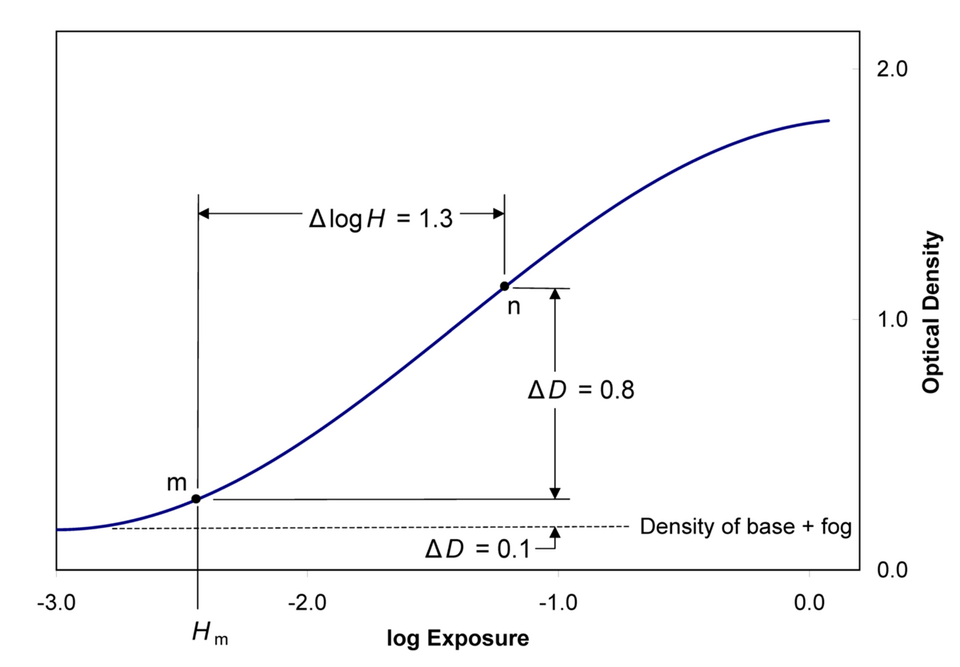
[…] The 8th International Congress of Photography was held at Dresden, Germany, from [3 to 8] August […] 1931, inclusive. […] In regard to sensitometric standardization, several important developments occurred. First, the other national committees on sensitometric standardization accepted the light source and filter proposed by the American Committee at Paris, 1925, and accepted by the British in 1928. In the meantime, no definite agreement had been reached, nor indeed had very definite proposals been made on the subjects of sensitometers or exposure meters, development, density measurement, and methods of expressing sensitometric results, although much discussion and controversy on this subject had taken place. At the present Congress, a body of recommendations for sensitometric standards was put forward by the Deutschen Normenausschusses [für] Phototechnik, which endeavored to cover the latter questions and bring the subject of sensitometric standardization into the industrial field. It was stated by the German committee that this action had been forced on them by difficulties arising from indiscriminate and uncontrolled placing of speed numbers on photographic sensitive goods, a situation which was summarized at the Congress by the term "-inflation". The gist of these recommendations was as follows: (a) Acceptance of the light source and daylight filter as proposed by the American commission. (b) As exposure meter, a density step-wedge combined with a drop shutter accurate to 1/20 second. (c) Brush development in a tray with a prescribed solution of metol-hydroquinone according to a so-called "optimal" development. (d) Expression of the sensitivity by that illumination at which a density of 0.1 in excess of fog is reached. (e) Density measurement shall be carried out in diffused light according to details to be discussed later. These proposals aroused a very lively discussion. The American and the British delegations criticized the proposals both as a whole and in detail. As a whole they considered that the time was not ripe for application of sensitometric standards to industrial usage. In matters of detail they criticized the proposed employment of a step-wedge, and the particular sensitivity number proposed. The latter approaches very roughly the idea of an exposure for minimum gradient, but even such a number is not adequate for certain photographic uses of certain materials. The upshot of the discussion was that the German proposals in somewhat modified form are to be submitted simply as proposals of the German committee for sensitometric standardization to the various national committees for definite expression of opinion within six months of the expiration of the Congress. Further, in case of general approval of these recommendations by the other national committees, that a small International Committee on Sensitometric Standardization shall, within a further period of six months, work out a body of sensitometric practices for commercial usage.
📸 フォトギャラリー