宇宙が誕生した直後、極限の高温・高圧状態の中で、現在の宇宙を構成する基本的な軽い原子核が作り出されました。このプロセスをビッグバン元素合成(BBN: Big Bang Nucleosynthesis)、または原始核合成と呼びます。宇宙誕生からわずか20分ほどの間に行われたこの化学反応は、現代の標準宇宙論を支える重要な柱の一つとなっています。
Key Facts
- 発生時期:宇宙誕生後、約数秒から20分までの短期間に発生。
- 生成元素:主に水素(H)、ヘリウム(He)、リチウム(Li)などの軽元素が合成された。
- 質量比:宇宙の質量の約75%が水素、約25%がヘリウム4で構成されると予測される。
- 決定要因:バリオン(陽子や中性子)と光子の比率(η)が元素の生成量に大きく影響する。
- 科学的意義:観測される軽元素の量と理論値の一致が、ビッグバン理論の強力な証拠となっている。
元素合成の物理的メカニズム
宇宙の温度が1〜2 MeV(メガ電子ボルト)以上の極めて高い状態では、陽子と中性子は弱い相互作用によって互いに変換され合っていました。しかし、宇宙が膨張し温度が低下すると、この平衡状態が崩れます。その結果、中性子は陽子へと崩壊し始め、中性子と陽子の比率は約1対7まで減少しました。これが、その後の核合成の出発点となります。
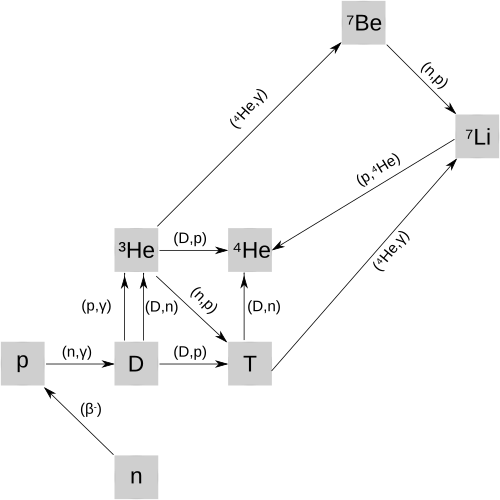
まず、陽子と中性子が結合して重水素(デューテリウム)が形成されます。その後、重水素がさらに融合してトリチウム、ヘリウム3、そして非常に安定した結合エネルギーを持つヘリウム4へと進化しました。ヘリウム4は非常に強固な構造を持つため、一度形成されると分解されにくく、結果として宇宙の物質の大部分が水素とヘリウム4で占められることになりました。
![The abundances of light element nuclei during Big Bang nucleosynthesis, as a function of time since the Big Bang in seconds (lower axis) or the Standard Model plasma temperature in MeV.[10] The y-axis shows the abundance as a number density of each individual species divided by the number density of baryons.](/images/0e/58/0e583c8cc8f0d355e06c22d73b677ec55cf130eb36ed27617da36f52549b044a.png)
核反応の連鎖とボトルネック
元素合成の過程では、特定の質量を持つ原子核が存在しない「質量ギャップ(質量数5および8の不安定性)」という壁に突き当たります。このため、ヘリウム4より重い元素を合成するには非常に高いエネルギーや特殊な条件が必要であり、ビッグバン直後の短時間では、酸素20などのごくわずかな重元素が生成されるにとどまりました。
元素比率を決定する重要なパラメータ
BBNによる元素の生成量は、バリオン対光子比(η)という数値に強く依存します。これは宇宙におけるバリオン(陽子や中性子)の密度を反映しており、宇宙のエントロピーを制御します。エントロピーが高いと核融合の開始が遅れ、逆に低いと合成期間が長くなるため、最終的な元素の比率が変動します。
特に重水素は、このバリオン密度に対して非常に敏感に反応します。例えば、ηの値が10分の1になると、重水素の量は約50倍に増加するという特性があります。このため、重水素の観測量は宇宙の初期密度を推定する重要な指標となります。
![The evolution of different light element abundances for different values of the baryon-to-photon ratio η.[17] Note the final abundances (values at the latest times) can vary dramatically depending on the value of this parameter.](/images/73/c3/73c36d4644ad68b5b5d6aca0ed1042072c8fc48ef9229b2289db65b56b1629a3.gif)
理論の発展と観測による検証
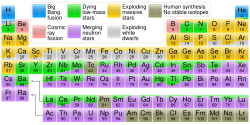
この理論は、1940年代にジョージ・ガモフらによって提唱されました。当初は質量ギャップの問題で困難に直面しましたが、後に恒星内部での元素合成(ステラ・ヌクレオシンセシス)の理論が確立されたことで、水素とヘリウムがビッグバン由来であり、それ以上の重元素は星の中で作られたという役割分担が明確になりました。
1965年の宇宙マイクロ波背景放射(CMB)の発見は、ビッグバン理論に決定的な根拠を与えました。その後、金属量の少ない(=星による汚染が少ない)ガス雲や矮小銀河を観測することで、原始的な元素比率の測定が進みました。その結果、ヘリウム4や重水素の観測値はBBNの予測と極めて高い精度で一致することが確認されています。
リチウム問題という謎
一方で、リチウム7に関しては、理論的な予測値よりも観測値が2〜4倍ほど低いという不一致が見られます。これは「宇宙論的リチウム問題」と呼ばれ、観測手法の課題なのか、あるいは未知の物理現象が関わっているのか、現在も研究が続いています。
まとめ:BBNが示す宇宙の姿
| 項目 | 詳細内容 |
|---|---|
| 主要生成元素 | 水素、ヘリウム(4, 3)、重水素、リチウム |
| 主要質量比 | 水素 約75% / ヘリウム4 約25% |
| 時間的枠組み | 宇宙誕生後 数秒 〜 約20分 |
| 重要パラメータ | バリオン対光子比(η) |
| 検証手段 | 金属欠乏星、クエーサー前方のガス雲、CMBの解析 |
Frequently Asked Questions
なぜ20分で元素合成が終わったのですか?
宇宙が膨張し続けることで、温度と密度が急速に低下したためです。核融合反応には高いエネルギーが必要ですが、20分後には温度が下がりすぎて、それ以上の核融合を維持できなくなったため、元素比率が固定されました。
重い元素(金や鉄など)はなぜBBNで作られなかったのですか?
質量数5と8の安定した原子核が存在しないという「質量ギャップ」があったためです。これを乗り越えて炭素などの重い元素を作るには、星の内部のような高密度状態でヘリウム核が3つ同時に衝突する(トリプルアルファ反応)などの特殊なプロセスが必要であり、BBNの短時間では不十分でした。
バリオン対光子比がなぜ重要なのですか?
この比率は宇宙の物質密度を決定するためです。密度が高いほど核反応が起きやすくなり、重水素などの軽い元素がより効率的にヘリウム4へと変換されます。そのため、最終的に残った重水素の量を調べることで、初期宇宙の密度を逆算できます。
BBNの理論は現在の宇宙論でどのように利用されていますか?
BBNから導き出されたバリオン密度が、数10万年後の出来事である宇宙マイクロ波背景放射(CMB)から得られた値と一致するかを確認することで、標準宇宙論(Λ-CDMモデル)の正しさを検証する整合性テストとして利用されています。
References
- Patrignani, C.; et al. (Particle Data Group) (2016). "Big-Bang nucleosynthesis" (PDF). Chin. Phys. C. 40: 100001. Archived (PDF) from the original on 2016-12-01.
- Schramm, David N.; Turner, Michael S. (1998-01-01). "Big-bang nucleosynthesis enters the precision era". Reviews of Modern Physics. 70 (1): 303–318. :astro-ph/9706069. :1998RvMP...70..303S. :10.1103/RevModPhys.70.303.
- Kragh, Helge (2007). Conceptions of cosmos: from myths to the accelerating universe: a history of cosmology. Oxford; New York: Oxford University Press. .
- ; ; (1 April 1948). "The Origin of Chemical Elements". . 73 (7): 803–804. :1948PhRv...73..803A. :10.1103/PhysRev.73.803. 18877094.
- Peebles, P. J. E. (1966). "Primeval Helium Abundance and the Primeval Fireball". Physical Review Letters. 16 (10): 410–413. :1966PhRvL..16..410P. :10.1103/PhysRevLett.16.410.
- Wagoner, Fowler and Hoyle "ON THE SYNTHESIS OF ELEMENTS AT VERY HIGH TEMPERATURES", Robert V. Wagoner, William A. Fowler, and F. Hoyle, The Astrophysical Journal, Vol. 148, April 1967.
- (1996). The Big Bang and Other Explosions in Nuclear and Particle Astrophysics. Singapore: World Scientific. p. 175. .
- Hashimoto, Masa-aki; Nakamura, Riou; Thushari, E. P. Berni Ann; Arai, Kenzo (2018). Big-Bang Nucleosynthesis: Thermonuclear History in the Early Universe. SpringerBriefs in Physics Ser. Singapore: Springer. :10.1007/978-981-13-2935-7. . 2191-5423.
- Smith, Kawano, and Malaney. "EXPERIMENTAL, COMPUTATIONAL, AND OBSERVATIONAL ANALYSIS OF PRIMORDIAL NUCLEOSYNTHESIS", Michael S. Smith, Lawrence H. Kawano and Robert A. Malaney, The Astrophysical Journal Supplement Series, 85:219-247, 1993 April.
- Pitrou, Cyril; Coc, Alain; Uzan, Jean-Phillipe; Vangioni, Elisabeth (2018-09-03). "Precision big bang nucleosynthesis with improved Helium-4 predictions". Physics Reports. 754 (1): 1–66. :1801.08023. :2018PhR...754....1P. :10.1016/j.physrep.2018.04.005.
📸 フォトギャラリー