Various atoms and molecules from A New System of Chemical Philosophy (John Dalton, 1808)
← ホームへ戻る

原子の構造と歴史物質の最小単位が解き明かす宇宙の仕組み

🗓 2026年8月11日

私たちの身の回りにあるあらゆる物質は、原子と呼ばれる極めて小さな粒子から構成されています。化学元素の最小単位である原子は、目に見えないほど小さいながらも、その内部には宇宙の根本的な法則が凝縮されています。本記事では、原子の概念がどのように誕生し、現代の科学においてどのように定義されているのかを詳しく解説します。

Key Facts

  • 構成要素: 中心にある原子核(陽子と中性子)と、その周囲を分布する電子で構成される。
  • サイズ: 直径は約62pm(ヘリウム)から520pm(セシウム)まであり、光の波長より遥かに小さい。
  • 質量: 1.67 × 10⁻²⁷ kg から 4.52 × 10⁻²⁵ kg の範囲に分布する。
  • 原子番号: 原子核に含まれる陽子の数が、その元素の正体を決定する。
  • 観測: 光学顕微鏡では見えないが、走査型トンネル顕微鏡(STM)などの特殊な装置で個々の原子を観察できる。

原子論の変遷:哲学から科学へ

原子の概念は、単なる哲学的な推測から始まり、厳密な実験科学へと進化しました。19世紀初頭、ジョン・ダルトンは「倍比の法則」を提唱し、元素が特定の整数比で結合することを明らかにしました。例えば、酸化スズには2種類の化合物が存在し、スズに対する酸素の比率が1:2となることから、原子が個別の単位として存在することが示唆されました。
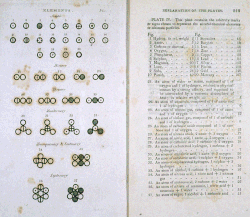
Various atoms and molecules from A New System of Chemical Philosophy (John Dalton, 1808)

その後、科学者たちは原子の内部構造を次々と解明していきます。J.J.トムソンによる電子の発見に続き、アーネスト・ラザフォードはアルファ粒子散乱実験を行い、原子の中心に正電荷が集中した極めて小さな「原子核」が存在することを突き止めました。
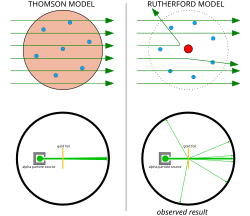
The Rutherford scattering experiments: The extreme scattering of some alpha particles suggested the existence of a nucleus of concentrated charge.

さらにニールス・ボーアは、電子が特定のエネルギー準位を持つ軌道を回っているというモデルを提示しました。電子が軌道間を瞬時に移動する「量子跳躍」という概念は、当時の科学に大きな衝撃を与えましたが、現在の知見ではこの単純な軌道モデルは塗り替えられています。
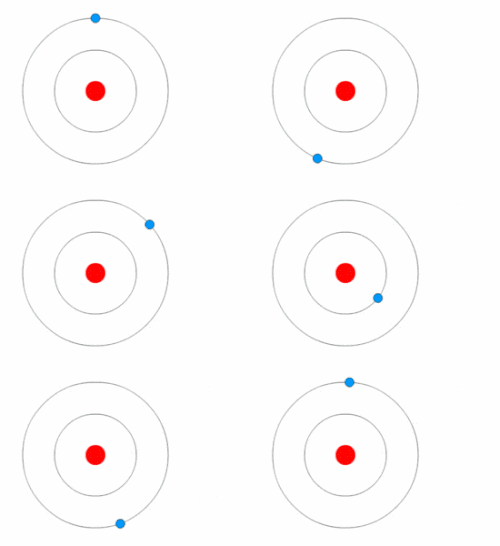
The Bohr model of the atom, with an electron making instantaneous "quantum leaps" from one orbit to another with gain or loss of energy. This model of electrons in orbits is obsolete.

現代的な原子モデルと内部構造

現代の物理学では、電子は決まった軌道を回っているのではなく、存在確率の高い領域として定義される電子雲(原子軌道)を形成していると考えられています。これは量子力学的なアプローチによるもので、電子の正確な位置を特定するのではなく、分布として捉えるモデルです。
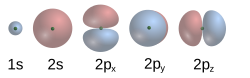
The modern model of atomic orbitals draws zones where an electron is most likely to be found at any moment.

原子核の構成と性質

原子の中心にある原子核は、正の電荷を持つ陽子と、電荷を持たない中性子で構成されています。陽子の数は「原子番号」と呼ばれ、これにより元素の種類が決まります。陽子と中性子は強い相互作用によって結合しており、この結合を切り離すために必要なエネルギーが「核結合エネルギー」です。
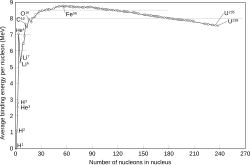
The binding energy needed for a nucleon to escape the nucleus, for various isotopes

エネルギー準位とスペクトル

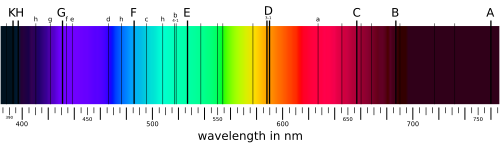
電子は特定のエネルギー状態(エネルギー準位)にのみ存在できます。電子がより高いエネルギー状態へ遷移する際に光を吸収し、低い状態へ戻る際に光を放出します。この現象により、元素ごとに固有の吸収線や放出線が現れるため、スペクトル分析によって物質の同定が可能になります。

These electron's energy levels (not to scale) are sufficient for ground states of atoms up to cadmium (5s2 4d10) inclusively. The top of the diagram is lower than an unbound electron state.
An example of absorption lines in a spectrum

原子軌道の形状

電子が存在する領域である軌道は、エネルギーレベルに応じて多様な3次元形状を持ちます。これらは単純な球形だけでなく、ダンベル型やより複雑な形状をしており、化学結合の性質を決定づける重要な要因となります。
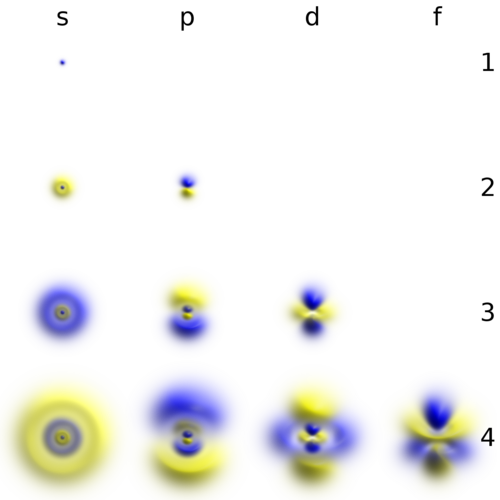
3D views of some hydrogen-like atomic orbitals showing probability density and phase (g orbitals and higher are not shown)

原子の規模感と物理的特性

原子の小ささは想像を絶します。例えば、人間の髪の毛1本の太さには、炭素原子が約100万個並ぶ計算になります。また、1滴の水には約200万兆個(2 × 10²¹)の酸素原子が含まれています。もしリンゴを地球ほどの大きさに拡大したとしたら、その中の原子は元のリンゴほどの大きさになります。

このような極小の世界を可視化できるのが走査型トンネル顕微鏡です。これにより、金などの金属表面で原子がどのように配列しているかを直接的に観察することが可能となりました。
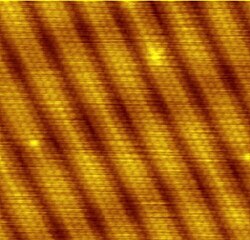
Scanning tunneling microscope surface reconstruction image showing the individual atoms making up this gold (100) surface. The surface atoms deviate from the bulk crystal structure and arrange in columns several atoms wide with pits between them.
原子の基本特性まとめ
特性 詳細・範囲 備考
直径 62 pm 〜 520 pm He(最小)〜 Cs(最大)
質量範囲 1.67 × 10⁻²⁷ 〜 4.52 × 10⁻²⁵ kg 元素により異なる
電荷 中性 または イオン電荷 電子数と陽子数のバランスで決定
構成粒子 陽子、中性子、電子 核と電子雲に分かれる

宇宙における原子の起源と進化

宇宙の全エネルギー密度のうち、バリオン物質(通常の物質)が占める割合は約4%に過ぎません。宇宙初期には水素やヘリウムなどの軽い元素が主でしたが、星の内部で起こる核融合反応によって、より重い元素が生成されてきました。

例えば、2つの陽子が結合して重水素核が形成される過程では、陽電子と電子ニュートリノが放出されます。さらに巨大な星の中では、アルファプロセスや中性子捕獲(sプロセス、rプロセス)といった複雑な反応を経て、鉄より重い元素が作られ、超新星爆発や中性子星の合体によって宇宙空間に散布されます。
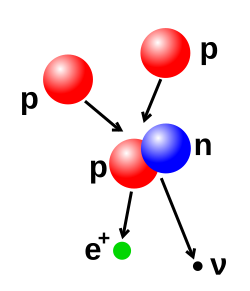
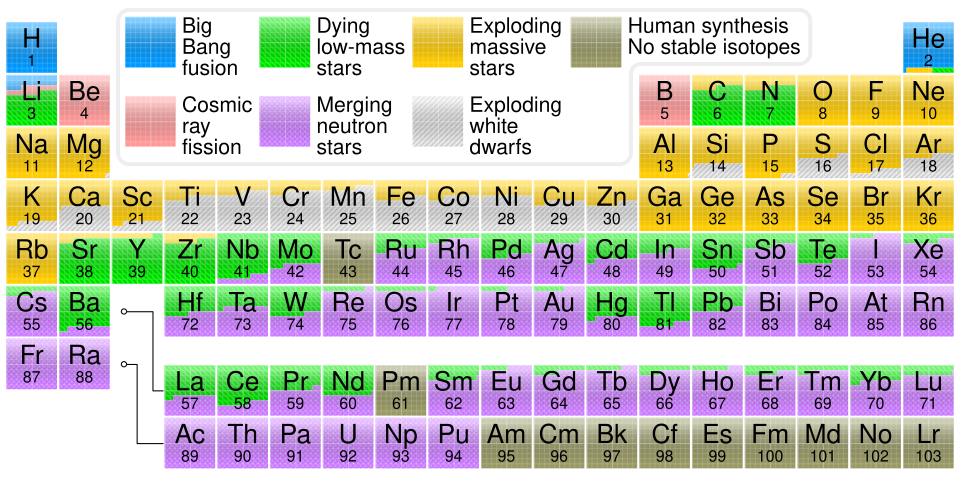
Illustration of a nuclear fusion process that forms a deuterium nucleus, consisting of a proton and a neutron, from two protons. A positron (e+)—an antimatter electron—is emitted along with an electron neutrino.
Periodic table showing the origin of each element. Elements from carbon up to sulfur may be made in small stars by the alpha process. Elements beyond iron are made in large stars with slow neutron capture (s-process). Elements heavier than iron may be made in neutron star mergers or supernovae after the r-process.

放射性と安定性

すべての原子核が安定しているわけではありません。陽子と中性子の比率が不安定な同位体は、放射性崩壊を起こして別の元素へと変化します。この崩壊にかかる時間は「半減期」として定義され、元素によって極めて短いものから、宇宙の年齢に匹敵するほど長いものまで存在します。
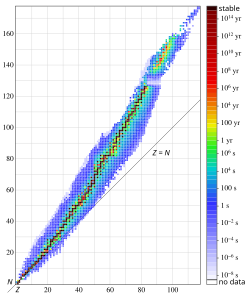
This diagram shows the half-life (T1⁄2) of various isotopes with Z protons and N neutrons.

特殊な状態:ボース=アインシュタイン凝縮

極低温の状態では、複数の原子が単一の量子状態に落ち込み、あたかも一つの巨大な原子(スーパーアトム)のように振る舞う「ボース=アインシュタイン凝縮」という現象が起こります。これは物質の新しい状態として知られています。
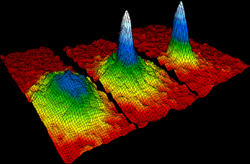
Graphic illustrating the formation of a Bose–Einstein condensate

量子力学的視点からの補足

古典力学では、粒子がある領域に留まるには十分なエネルギー(ポテンシャル障壁)が必要であると考えます。しかし、量子力学の世界では、粒子が障壁を通り抜ける「トンネル効果」などの現象が発生します。これは現代の半導体技術やSTMの動作原理の基礎となっています。
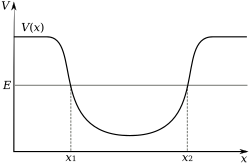
A potential well, showing, according to classical mechanics, the minimum energy V(x) needed to reach each position x. Classically, a particle with energy E is constrained to a range of positions between x1 and x2.

Frequently Asked Questions

原子と分子は何が違うのですか?

原子は化学元素の最小単位であり、単独で存在できる最小の粒子です。一方、分子は2つ以上の原子が化学結合によって結びついた集団のことを指します。例えば、酸素原子(O)が2つ結合すると酸素分子(O2)になります。

なぜ原子の大きさは元素によって異なるのですか?

原子の大きさは、中心にある陽子の数(核電荷)と、電子が分布するエネルギー準位(電子殻)によって決まります。核の正電荷が強くなると電子をより強く引き寄せますが、電子殻が増えると全体的な半径は大きくなる傾向があります。

「同位体」とは何のことですか?

同じ元素(陽子の数が同じ)でありながら、中性子の数が異なる原子のことを同位体(アイソトープ)と呼びます。化学的な性質はほぼ同じですが、質量が異なるため、物理的な性質や放射能の有無に違いが出ます。

原子核の中では何が起きているのですか?

原子核の中では、陽子同士の電気的な反発力(クーロン力)を上回る非常に強力な「強い相互作用」が働いており、陽子と中性子を密に結合させています。このバランスが崩れると、放射性崩壊や核分裂、核融合といった現象が起こります。

電子は本当に「雲」のように存在しているのですか?

はい。現代の量子力学では、電子を特定の点としてではなく、ある確率でそこに存在する「確率密度分布」として捉えます。そのため、視覚的に表現すると雲のような広がりを持つため、「電子雲」と呼ばれています。

References

  1. For more recent updates see 's Interactive Chart of Nuclides Archived 25 July 2020 at the .
  2. A carat is 200 milligrams.

📸 フォトギャラリー

Various atoms and molecules from A New System of Chemical Philosophy (John Dalton, 1808)
The Rutherford scattering experiments: The extreme scattering of some alpha particles suggested the existence of a nucleus of concentrated charge.
The Bohr model of the atom, with an electron making instantaneous "quantum leaps" from one orbit to another with gain or loss of energy. This model of electrons in orbits is obsolete.
The modern model of atomic orbitals draws zones where an electron is most likely to be found at any moment.
The binding energy needed for a nucleon to escape the nucleus, for various isotopes
Illustration of a nuclear fusion process that forms a deuterium nucleus, consisting of a proton and a neutron, from two protons. A positron (e+)—an antimatter electron—is emitted along with an electron neutrino.
A potential well, showing, according to classical mechanics, the minimum energy V(x) needed to reach each position x. Classically, a particle with energy E is constrained to a range of positions between x1 and x2.
3D views of some hydrogen-like atomic orbitals showing probability density and phase (g orbitals and higher are not shown)
This diagram shows the half-life (T1⁄2) of various isotopes with Z protons and N neutrons.
These electron's energy levels (not to scale) are sufficient for ground states of atoms up to cadmium (5s2 4d10) inclusively. The top of the diagram is lower than an unbound electron state.
An example of absorption lines in a spectrum
Graphic illustrating the formation of a Bose–Einstein condensate
Scanning tunneling microscope surface reconstruction image showing the individual atoms making up this gold (100) surface. The surface atoms deviate from the bulk crystal structure and arrange in columns several atoms wide with pits between them.
Periodic table showing the origin of each element. Elements from carbon up to sulfur may be made in small stars by the alpha process. Elements beyond iron are made in large stars with slow neutron capture (s-process). Elements heavier than iron may be made in neutron star mergers or supernovae after the r-process.