私たちの身の回りには、回転する物体が不思議な安定性を見せたり、回転速度が急激に変化したりする現象が多く存在します。例えば、高速で回転する独楽(こま)が倒れずに直立し続けるのは、物理学における角運動量という概念で説明できます。角運動量は、直線的な運動における「運動量」の回転版とも言える量であり、天体の運行からミクロな素粒子の挙動まで、宇宙のあらゆるスケールで重要な役割を果たしています。
Key Facts
- 定義: 角運動量は、物体の質量、回転半径、および速度の積に関連する物理量である。
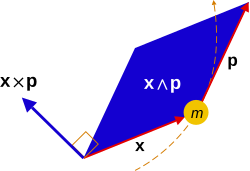
- 基本式: 古典力学では $L = I\omega$(慣性モーメント × 角速度)または $L = r \times p$(位置ベクトル × 線形運動量)で表される。
- 保存則: 外部からトルク(回転力)が加わらない限り、系の全角運動量は一定に保たれる。
- 単位: SI単位系では $\text{kg\cdot m}^2\text{/s}$ または $\text{J\cdot s}$ が用いられる。
- 量子化: 量子力学の世界では、角運動量は連続的な値ではなく、特定の不連続な値(量子化)をとる。
角運動量の基礎概念
角運動量とは、物体が回転運動を持っている度合いを示す量です。直線運動における運動量が「質量 $\times$ 速度」で定義されるのと同様に、回転運動では「回転しにくさ(慣性モーメント)」と「回転の速さ(角速度)」の積として捉えることができます。
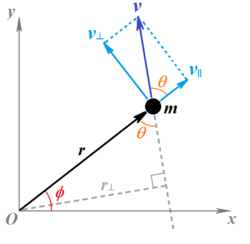
粒子一つの場合、原点からの距離(半径ベクトル $r$)と速度のうち、半径方向に対して垂直な成分($v_{\perp}$)が角運動量の大きさを決定します。つまり、回転中心から遠い場所で速く動いている物体ほど、大きな角運動量を持ちます。
慣性モーメントの影響
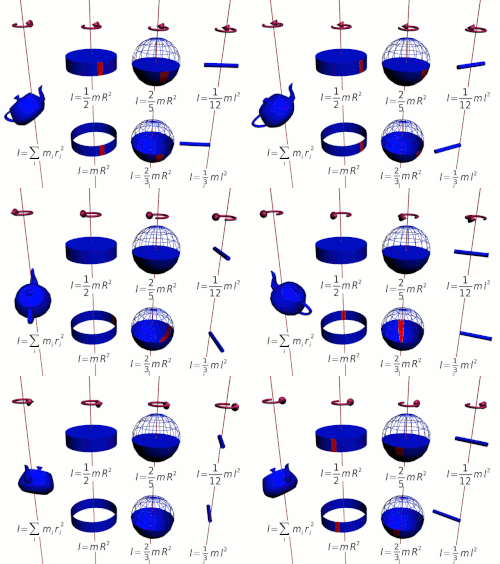
回転運動において、質量に相当するのが慣性モーメント($I$)です。これは単なる質量の大きさだけでなく、質量が回転軸からどのように分布しているかによって決まります。同じ質量であっても、質量が軸から離れて分布しているほど慣性モーメントは大きくなり、回転状態を変化させるのに大きな力が必要になります。
トルクと角運動量の変化
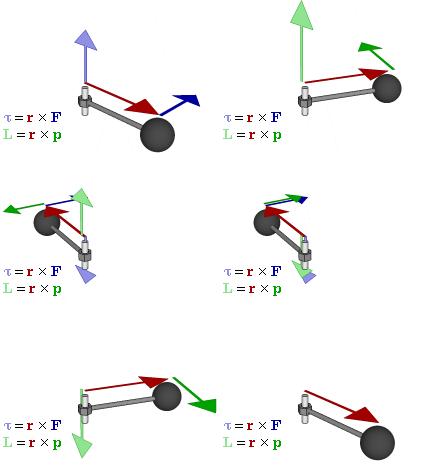
物体の回転状態を変化させるには、トルク($\tau$)と呼ばれる回転させる力が不可欠です。直線運動において力が運動量を変化させるように、トルクは角運動量を時間的に変化させます。この関係は、ニュートンの運動第2法則の回転版として理解できます。
興味深い点として、トルクが加わった際に必ずしも角加速度と平行に変化するとは限りません。これは、物体の形状変化によって慣性モーメント自体が時間的に変動し得るためです。
角運動量保存の法則とその応用
外部から正味のトルクが作用しない系では、全角運動量は一定に保たれます。これを角運動量保存の法則と呼びます。この法則の最も分かりやすい例が、フィギュアスケートのスピンです。選手が腕や脚を体に引き寄せると、慣性モーメントが減少します。角運動量を一定に保つため、その分だけ回転速度(角速度)が自動的に上昇し、高速回転が可能になります。

また、この原理は天文学的なスケールでも機能しています。地球と月の間では潮汐力によるトルクが発生しており、地球の自転角運動量が月に転移しています。その結果、地球の自転速度はわずかに低下し(一日の長さが伸びる)、月は地球から徐々に遠ざかる軌道へと押し上げられています。
歳差運動のメカニズム
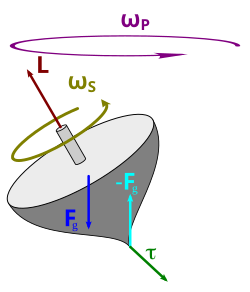
回転している物体に、回転軸と異なる方向から力が加わると、軸自体が円を描くようにゆっくりと回転する歳差運動が発生します。これは、加わったトルクによって角運動量ベクトルが変化し、元の回転方向を維持しようとする性質と外力が組み合わさることで起こります。
高度な物理学的視点
多粒子系と剛体
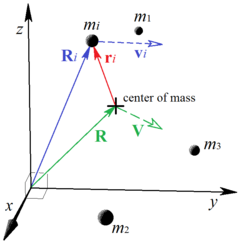
複数の粒子からなる系全体の角運動量は、重心周りの回転による角運動量と、重心自体の移動による軌道角運動量の和として表現されます。これにより、複雑な形状をした剛体の回転も数学的に記述することが可能です。
量子力学における角運動量
ミクロな世界では、角運動量は古典力学とは全く異なる挙動を示します。角運動量は量子化されており、$\hbar$(プランク定数を $2\pi$ で割った値)の整数倍や半整数倍の値しか取ることができません。これは、円環上の定常波が整数個の波長しか持てないという物理的制約に似ています。

また、量子力学では粒子が持つ固有の角運動量であるスピンという概念が登場します。これは古典的な「回転」とは本質的に異なる性質ですが、数学的には角運動量の形式で扱われ、全角運動量は軌道角運動量とスピンの合成として定義されます。
![Angular momenta of a classical object.Left: "spin" angular momentum S is really orbital angular momentum of the object at every point.Right: extrinsic orbital angular momentum L about an axis.Top: the moment of inertia tensor I and angular velocity ω (L is not always parallel to ω).[36]Bottom: momentum p and its radial position r from the axis. The total angular momentum (spin plus orbital) is J. For a quantum particle the interpretations are different; particle spin does not have the above interpretation.](/images/4d/f2/4df2496af342759ebebb3317f162d4ee26387ec59cbe52f09b4e7d1c2f4353f3.webp)
歴史的背景と理論の発展
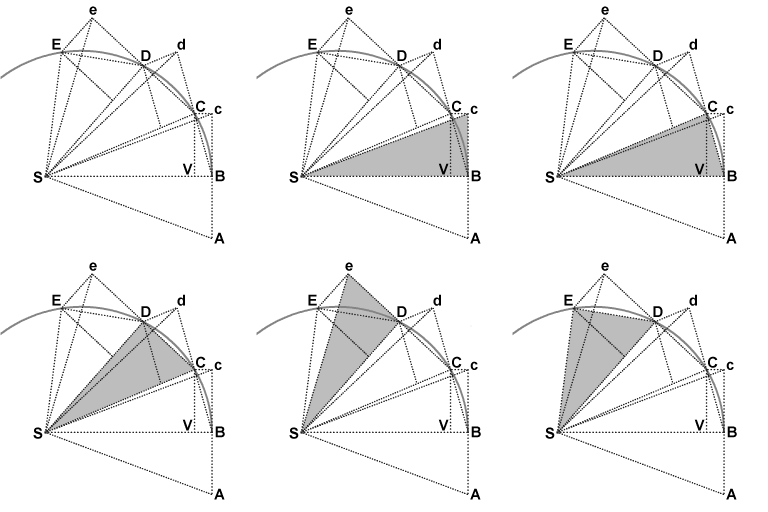
角運動量の概念は、アイザック・ニュートンが『プリンキピア』の中で「面積速度一定の法則」として示したことに端を発します。ニュートンは幾何学的な手法を用いて、惑星の公転において角運動量が保存されていることを実質的に証明していました。
その後、ラグランジュやハミルトンによる解析力学の発展により、角運動量は「回転対称性」という空間の性質から導かれる保存量として再定義されました。現代物理学では、作用関数の回転不変性が角運動量の保存を意味することが数学的に示されています。
角運動量のまとめ
| 項目 | 直線運動(線形) | 回転運動(角) |
|---|---|---|
| 基本量 | 運動量 ($p = mv$) | 角運動量 ($L = I\omega$) |
| 抵抗要素 | 質量 ($m$) | 慣性モーメント ($I$) |
| 変化させる要因 | 力 ($F$) | トルク ($\tau$) |
| 保存条件 | 外力がゼロ | 外トルクがゼロ |
| 量子化 | (一般に連続的) | 離散的な値をとる |
Frequently Asked Questions
角運動量とトルクはどう関係していますか?
トルクは角運動量を時間的に変化させる原因となる量です。直線運動において「力」が「運動量」を変化させるのと同様に、物体にトルクが加わると、その物体の角運動量はトルクの方向に変化します。
なぜフィギュアスケーターは腕を縮めると速く回るのですか?
これは角運動量保存の法則によるものです。腕を縮めることで質量分布が中心に寄り、慣性モーメント(回転しにくさ)が減少します。外部からトルクが加わっていないため、減少した慣性モーメントを補うように角速度(回転スピード)が増加します。
量子力学における「スピン」とは物理的に回転しているということですか?
いいえ、量子力学におけるスピンは、古典的な物体が回転していることとは異なります。スピンは粒子が持つ固有の内部自由度であり、数学的に角運動量と同じ性質を持つためそう呼ばれていますが、実際に球体が回転しているわけではありません。
慣性モーメントは質量が同じなら常に同じ値になりますか?
いいえ、異なります。慣性モーメントは質量の大きさに加えて、「質量が回転軸からどれだけ離れているか」に依存します。同じ質量の物体でも、質量が外側に広がっているほど慣性モーメントは大きくなります。
角運動量の保存は宇宙のどこで起きていますか?
至る所で起きています。例えば、恒星が誕生する際に巨大なガス雲が収縮して高速回転する円盤になる現象や、惑星が一定の方向を向いて公転し続けることなどは、すべて角運動量保存の法則によって説明されます。
References
- "Soaring Science: The Aerodynamics of Flying a Frisbee". Scientific American. August 9, 2012. Retrieved January 4, 2022.
- "Tropical Cyclone Structure". National Weather Service. Retrieved January 4, 2022.
- Moore, Thomas (2016). Six Ideas That Shaped Physics, Unit C: Conservation Laws Constrain Interactions (Third ed.). McGraw-Hill Education. p. 91. .
- Department of Physics and Astronomy, Georgia State University. "Moment of Inertia: Thin Disk". HyperPhysics. Retrieved 17 March 2023.
- Wilson, E. B. (1915). "Linear Momentum, Kinetic Energy and Angular Momentum". The American Mathematical Monthly. XXII. Ginn and Co., Boston, in cooperation with University of Chicago, et al.: 190.
- Worthington, Arthur M. (1906). Dynamics of Rotation. Longmans, Green and Co., London. p. 21 – via Google books.
- Taylor, John R. (2005). Classical Mechanics. University Science Books, Mill Valley, CA. p. 90. .
- Dadourian, H. M. (1913). Analytical Mechanics for Students of Physics and Engineering. D. Van Nostrand Company, New York. p. 266 – via Google books.
- Watson, W. (1912). General Physics. Longmans, Green and Co., New York. p. 33 – via Google books.
- Barker, George F. (1893). Physics: Advanced Course (4th ed.). Henry Holt and Company, New York. p. 66 – via Google Books.
📸 フォトギャラリー