太陽系の外縁部に位置する天王星は、その淡い青緑色の外観と、他の惑星には見られない極端な自転軸の傾きで知られる不思議な惑星です。かつては単なるガス惑星と考えられていましたが、現在は「氷巨星(アイスジャイアント)」という独自のカテゴリーに分類されています。この静寂に包まれた世界には、ダイヤモンドの雨が降る可能性や、複雑な磁場など、科学者の好奇心を刺激する謎が数多く隠されています。
天王星の基本データ
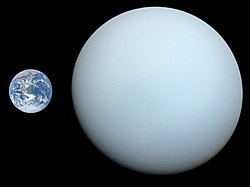
天王星は地球の約14.5倍の質量を持ち、体積では地球の63倍以上に達する巨大な惑星です。しかし、その密度は1.27g/cm³と低く、主に水素、ヘリウム、そしてメタンなどの氷のような物質で構成されています。
| 項目 | 数値・詳細 |
|---|---|
| 平均半径 | 約25,362 km |
| 公転周期 | 約84.02年 |
| 自転周期 | 約17時間14分(逆行) |
| 自転軸傾斜角 | 約82.23度 |
| 平均密度 | 1.27 g/cm³ |
| 主な構成成分 | 水素、ヘリウム、メタン |
地球とのサイズを比較すると、その圧倒的なスケールが分かります。
Key Facts:ここがポイント
- 横倒しの自転: 自転軸が公転面に対してほぼ垂直に寝ているため、極端な季節変動が起こります。
- 氷巨星の正体: 内部は岩石の核を、水、アンモニア、メタンの氷の層が取り囲んでいます。
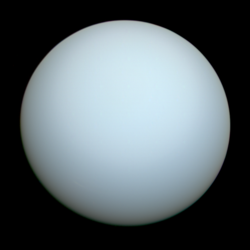
- 淡い青色の理由: 大気中のメタンが赤い光を吸収し、青い光を反射するためです。
- 唯一の訪問者: これまで人類が送った探査機で、天王星に接近したのは1986年のボイジャー2号のみです。
発見の歴史と名称の由来
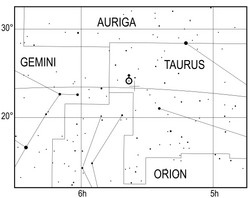
天王星は、1781年3月13日にイギリスの天文学者ウィリアム・ハーシェルによって発見されました。これは、古代から知られていた惑星以外で、人類が初めて望遠鏡を用いて発見した惑星となりました。
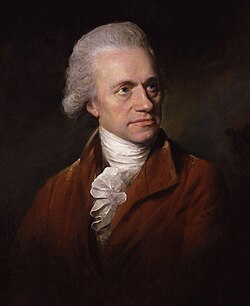
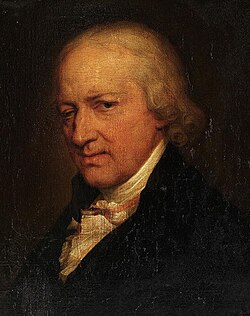
発見当初は名称が定まりませんでしたが、後に天文学者のヨハン・エリク・ボーデらの提案により、ギリシャ神話の天空神「ウラノス」にちなんで「Uranus(天王星)」と名付けられました。
特異な軌道と自転のメカニズム
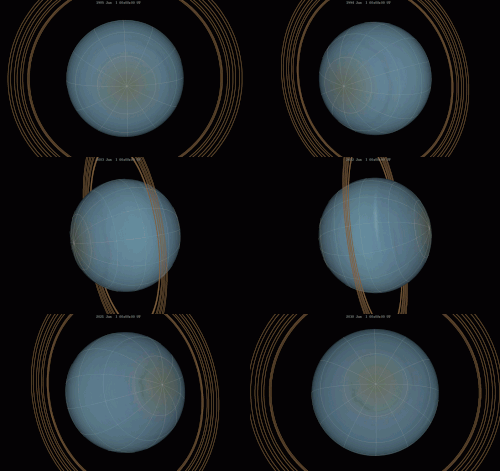
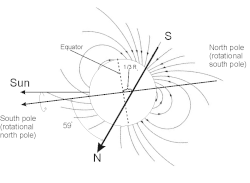
天王星の最大の特徴は、その自転軸が約82度も傾いていることです。これにより、惑星が文字通り「横倒し」の状態で太陽の周りを回っています。このため、北極と南極が交互に太陽を真っ向から向くという、極めて激しい季節の変化が生じます。
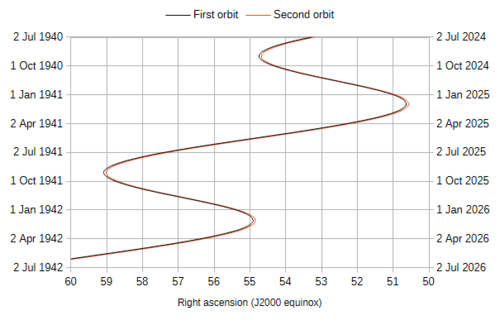
また、地球から見た天王星の動きは非常に緩やかで、太陽を一周するのに約84年という長い時間を要します。
内部構造と大気のダイナミクス
天王星の内部は、中心にある岩石質の核の上に、高温高圧の「氷」の層(水、アンモニア、メタンの混合物)が存在すると考えられています。この領域では、炭素が圧縮されてダイヤモンドとなり、それが雨のように降り注いでいるという説があります。
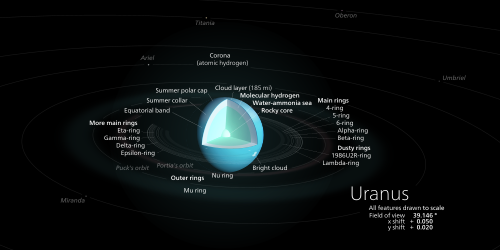
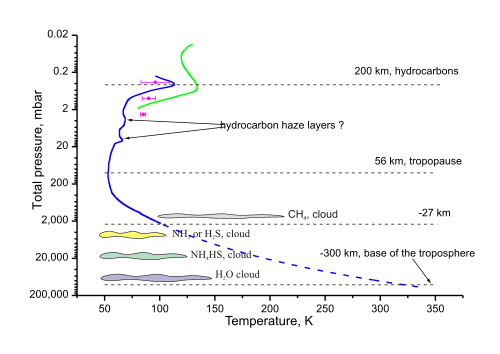
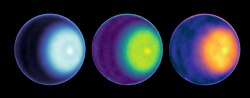
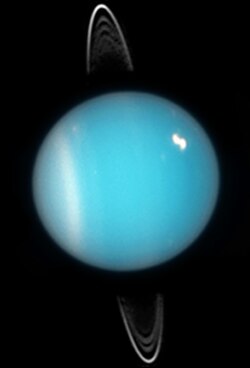
大気は主に水素とヘリウムで構成されていますが、上層にあるメタンが特徴的な色を作り出しています。ハッブル宇宙望遠鏡やジェイムズ・ウェッブ宇宙望遠鏡による観測では、ダイナミックな雲の動きや、北極付近のサイクロンなどが捉えられています。
![Uranus's upper atmosphere imaged by HST during the Outer Planet Atmosphere Legacy (OPAL) observing program.[100]](/images/29/6b/296be0892127a4e8d6a83161b364d6fb8ce19ac889c250f5511582149df6dda6.jpg)
![A near infrared time lapse of the upper atmosphere of Uranus,[112] taken by the James Webb Space Telescope. Blue represents the planet's lower atmosphere, while red represents higher altitudes.](/images/6b/b4/6bb4e2562888a2a1995772a61c128150c4a40d529b88d5c90aec18730876838e.gif)
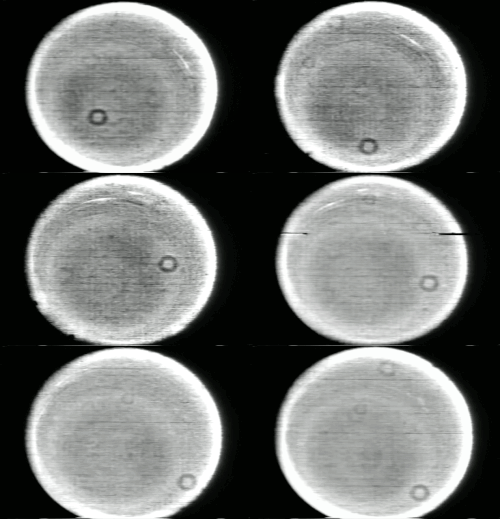
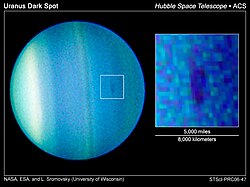
かつては「退屈な惑星」と言われたこともありましたが、実際には暗い雲の発生や、季節に伴う大気活動の変化が確認されています。
磁場と環、そして衛星たち
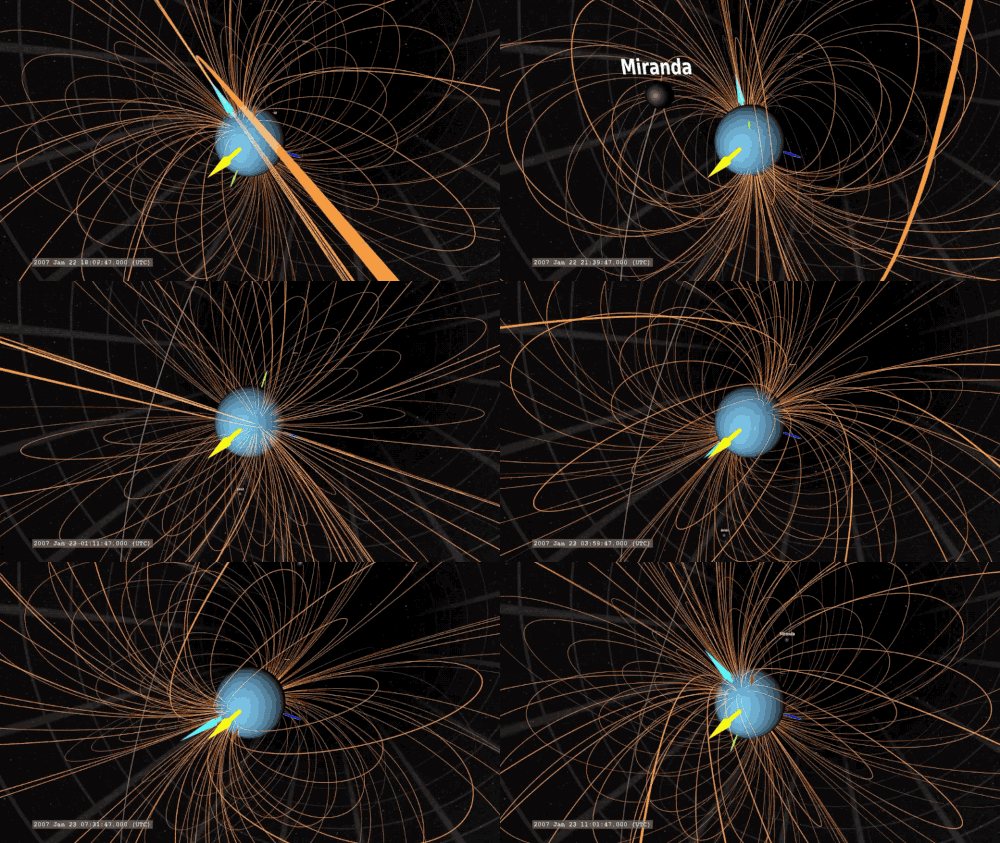
天王星の磁場は非常に複雑で、惑星の回転軸から大きくずれた位置に磁心があり、さらに傾いています。この非対称な磁気圏が、特異なオーロラ現象を引き起こしています。
![Aurorae on Uranus taken by the Space Telescope Imaging Spectrograph (STIS) installed on Hubble.[146]](/images/f0/0d/f00db4f76b168dc57713ad11639e47c3a8b084dd05e92c414743ad86adad4c11.jpg)
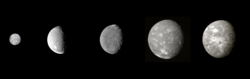
また、土星ほど顕著ではありませんが、天王星にも複数の環(リング)が存在します。これらの環は暗く、氷や塵で構成されています。さらに、29個の衛星が確認されており、そのうちの主要な5つの衛星(ミランダ、アリエル、ウンブリエル、ティタニア、オベロン)は、それぞれに個性的な地質学的特徴を持っています。
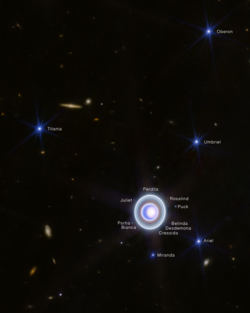
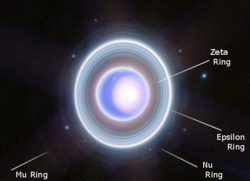
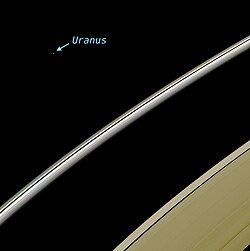
遠く離れた土星付近からカッシーニ探査機が捉えた天王星の姿は、宇宙の広大さを物語っています。
太陽系全体の中で見ると、天王星は海王星と共に、太陽から遠く離れた冷たい領域を支配する氷巨星としての役割を担っています。

Frequently Asked Questions
なぜ天王星は青く見えるのですか?
大気に含まれるメタンガスが、太陽光のうち赤い波長の光を吸収し、青い波長の光を反射するためです。これにより、私たちの目には淡い青緑色に見えます。
天王星が「横倒し」になったのはなぜですか?
正確な理由はまだ解明されていませんが、形成初期に地球サイズの巨大な天体が衝突し、惑星の軸を大きく傾けたという説が有力視されています。
天王星にダイヤモンドの雨が降っているというのは本当ですか?
科学的なシミュレーションに基づいた理論です。内部の極めて高い圧力と温度によって、メタンに含まれる炭素が結晶化し、ダイヤモンドとなって中心部へ降り積もっていると考えられています。
天王星にはどのような衛星がありますか?
現在29個の衛星が知られています。特にティタニアやオベロンなどの主要衛星は大きく、氷に覆われた表面を持っており、天王星の形成過程を知る重要な手がかりとなります。
天王星を直接訪れた探査機はありますか?
はい。1986年にNASAのボイジャー2号が唯一、天王星に最接近し、詳細なデータを収集しました。それ以降、近接して観測した探査機はありません。
References
- Based on Irwin, Patrick G J; Dobinson, Jack; James, Arjuna; Teanby, Nicholas A; Simon, Amy A; Fletcher, Leigh N; Roman, Michael T; Orton, Glenn S; Wong, Michael H; Toledo, Daniel; Pérez-Hoyos, Santiago; Beck, Julie (23 December 2023). "Modelling the seasonal cycle of Uranus's colour and magnitude, and comparison with Neptune". Monthly Notices of the Royal Astronomical Society. 527 (4): 11521–11538. :10.1093/mnras/stad3761. :20.500.11850/657542. 0035-8711.
- These are the mean elements from VSOP87, together with derived quantities.
- Refers to the level of 1 bar atmospheric pressure.
- Calculated using data from Seidelmann, 2007.[11]
- Based on the volume within the level of 1 bar atmospheric pressure.
- Calculation of He, H2 and CH4 molar fractions is based on a 2.3% mixing ratio of methane to hydrogen and the 15/85 He/H2 proportions measured at the tropopause.
- Cf. (not supported by all fonts)
- Cf. (not supported by all fonts)
- To match the description on the page , 82.23° and not 97.77° is used throughout this page. See the following explanation.
- Mixing ratio is defined as the number of molecules of a compound per a molecule of hydrogen.
📸 フォトギャラリー