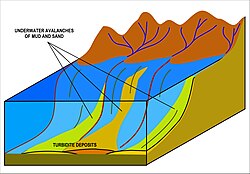
地球の深海や深い湖の底には、タービダイトと呼ばれる特殊な堆積岩が存在します。これは、水と堆積物が混ざり合った高密度の流れである「混濁流(こんだくりゅう)」によって運ばれた物質が積み重なってできたものです。通常の河川とは異なる独自の運搬メカニズムを持つため、深海という極限環境においても粗い砂や礫が堆積するという不思議な現象を引き起こします。
Key Facts
- 形成要因: 水と堆積物の混合による「密度流」によって、通常の水流では運べない粗い粒子が深海まで運ばれる。
- 堆積構造: 下層に粗い粒子、上層に細かい粒子が積み重なる「上方細粒化」が特徴。
- 主要モデル: 低密度流による「ブーマ・シーケンス」と、高密度流による「ロウ・シーケンス」がある。
- 経済的価値: 石油・天然ガスの貯留層や、金鉱床のホスト岩となることが多い。
- 地質学的指標: 古代のプレート境界(収束型境界)や地震活動の履歴を解明する手がかりとなる。
タービダイトを形成する「密度流」の仕組み
一般的な河川では、水の流れが粒子を押し流す「牽引流(けんいんりゅう)」によって物質が運ばれます。この場合、粒子が大きく重いほど、それを運ぶには非常に速い流速が必要です。しかし、タービダイトを形成する密度流は原理が異なります。
堆積物が液状化し、水と混ざり合って「スラリー状」になると、流体全体の密度が上昇します。この高密度な流れは、周囲の海水よりも重いため、たとえ流速が遅くても岩石の破片などの重い粒子を巻き込んで斜面を流れ落ちることができます。このような現象は深海だけでなく、火山の泥流(ラハール)や土砂崩れ、火砕流などでも見られます。
堆積のパターン:ブーマ・シーケンスとロウ・シーケンス
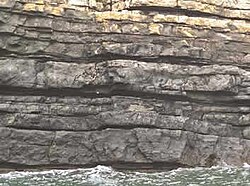
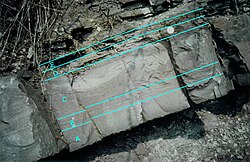
タービダイトの最大の特徴は、垂直方向の層構造にあります。1962年にアーノルド・H・ブーマによって定義されたブーマ・シーケンスは、低密度の混濁流によって形成される典型的な堆積順序を指します。
このサイクルは、まず底部の浸食面から始まり、礫や粗い砂の層が堆積し、次第に中粒砂、平行層理の砂岩、波状のリップル構造を持つ砂岩、そして最上部のシルト岩や頁岩(けつがん)へと移行します。これは、流れの勢いが次第に弱まるにつれて、重い粒子から順に沈殿したことを示しています。
一方で、堆積物の濃度が非常に高い「高密度混濁流」の場合は、粒子同士の衝突による分散圧が働くため、ブーマ・シーケンスとは異なる構造が形成されます。これはロウ・シーケンスと呼ばれ、ブーマのモデルを補完する分類として利用されています。
海底扇状地の形成とモデル化
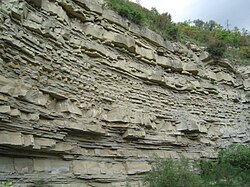
大量のタービダイトが蓄積すると、深海に海底扇状地と呼ばれる巨大な堆積構造が形成されます。これらは上部、中部、下部のファン・シーケンスに分けられ、それぞれ砂体の形状や分布特性が異なります。
現代の地質学では、「ソース・トゥ・シンク(S2S)」という概念を用い、堆積物の供給源から輸送経路、最終的な堆積場所までを統合的にモデル化しています。これには海面変動や地殻変動などの外部要因(allogenic)と、海底地形や斜面勾配などの内部要因(autogenic)の両方が影響します。現在、約26種類のファンモデルが存在し、3D地震探査やコアデータを用いて解析されています。
地質学的および経済的な重要性
タービダイトの存在は、その場所がかつてプレートの収束境界付近にあり、急峻な大陸棚斜面が存在したことを証明します。また、湖やフィヨルドで見つかるタービダイトを放射性炭素年代測定などで分析することで、過去の地震発生頻度や地滑りの履歴を高い解像度で復元することが可能です。
経済面では、タービダイト層は重要な資源の宝庫です。例えばオーストラリアのビクトリア州では、カンブリア紀からオルドビス紀のタービダイト層から大量の金が採掘されています。また、岩石化したタービダイト堆積物は、石油や天然ガスの優れた貯留層となるため、エネルギー産業においてその形状や内部構造の予測は極めて重要な課題となっています。
| 項目 | 低密度混濁流 (Bouma) | 高密度混濁流 (Lowe) |
|---|---|---|
| 堆積構造 | 明確な上方細粒化(5段階のシーケンス) | 粒子衝突による異なる構造(ロウ・シーケンス) |
| 運搬メカニズム | 懸濁荷重主体の密度流 | 高濃度スラリーによる密度流 |
| 主な堆積環境 | 深海盆、海底扇状地の下部など | 大陸棚縁辺、チャネル内部など |
| 経済的価値 | 石油・天然ガスの貯留層、金鉱床のホスト岩 |
Frequently Asked Questions
タービダイトは深海でしか形成されませんか?
いいえ。深海で最も顕著に見られますが、深い湖やフィヨルドなど、急斜面と深い盆地が存在する環境であれば同様の密度流による堆積が起こります。
ブーマ・シーケンスが不完全なことはありますか?
はい、よくあります。後続の混濁流が上の層を浸食して削り取ってしまう場合や、堆積場所が扇状地の端であるために薄い層しか残らなかった場合など、すべての段階が揃わないことは一般的です。
なぜタービダイトから金が採掘されるのですか?
タービダイトを形成する頁岩などの層が、その後の地質学的プロセスにおいて熱水溶液の通路となり、特定の構造(サドルリーフなど)に金が濃集しやすいためです。
密度流と普通の水流の決定的な違いは何ですか?
最大の違いは「流体の密度」です。普通の水流は水の速度(運動エネルギー)で粒子を運びますが、密度流は水と堆積物が混ざった「重い液体」として移動するため、低速でも大きな粒子を運ぶことができます。
タービダイトを調べると過去の地震がわかるのはなぜですか?
地震による強い揺れが海底斜面の崩壊を引き起こし、それが混濁流となって堆積するためです。堆積層の間に挟まれた有機物を年代測定することで、いつ大規模な崩壊(=地震)が起きたかを推定できます。
References
- Bouma, Arnold H. (1962) Sedimentology of some Flysch deposits: A graphic approach to facies interpretation, Elsevier, Amsterdam, 168 p
- Lowe, D.R. (1982), Sediment gravity flows: II. Depositional models with special reference to the deposits of high-density turbidity currents, Journal of Sedimentology, Society of Economic Paleontologists and Mineralogists, v. 52, p. 279-297.
- Fairbridge, Rhodes W. (ed.) (1966) The Encyclopedia of Oceanography, Encyclopedia of earth sciences series 1, Van Nostrand Reinhold Company, New York, p. 945–946.
- Mutti, E. & Ricci Lucci, F. (1975) Turbidite facies and facies associations. In: Examples of turbidite facies and associations from selected formations of the northern Apennines. IX Int. Congress of Sedimentology, Field Trip A-11, p. 21–36.
- Normark, W.R. (1978) "Fan valleys, channels, and depositional lobes on modern submarine fans : Characters for recognition of sandy turbidite environments", American Association of Petroleum Geologists Bulletin, 62 (6), p. 912–931.
- Walker, R.G. (1978) "Deep-water sandstone facies and ancient submarine fans: model for exploration for stratigraphic traps", American Association of Petroleum Geologists Bulletin, 62 (6), p. 932–966.
- Reading, H.G., Richards, M., (1994). Turbidite systems in deepwater basin margins classified by grain size and feeder system. AAPG Bulletin 78, p.794.
- Stow, D.A.V., Mayall, M., (2000). Deep-water sedimentary systems: new models for the 21st century. Marine and Petroleum Geology 17 (2), p.125-135.
- A. Prélat, J.A. Covault, D.M. Hodgson, A. Fildani, S.S. Flint, (2010) Intrinsic controls on the range of volumes, morphologies, and dimensions of submarine lobes, Sedimentary Geology, Volume 232, Issues 1–2, p.66-76.
- G. Shanmugam, Submarine fans: A critical retrospective (1950–2015), (2016) Journal of Palaeogeography, Volume 5, Issue 2, p. 110-184. describing turbidite source to sink systems.
📸 フォトギャラリー