古典力学における最も基本的かつ象徴的なモデルの一つが単振り子です。固定点から吊るされた質点が重力の下で往復運動するこの系は、単純な調和振動から複雑な非線形挙動まで、物理学の重要な概念を多く含んでいます。本記事では、その運動方程式の導出から、振幅が大きくなった場合の厳密な周期計算までを詳しく解説します。
Key Facts
- 基本原理:重力による復元力が質点を中心へと引き戻すことで周期的な運動が発生します。
- 微小振動近似:振幅が十分に小さい場合(約6°以下)、周期は振幅に依存せず、振り子の長さと重力加速度のみで決定されます。
- 非線形性:振幅が大きくなると、単純な正弦波から外れ、周期が長くなる特性があります。
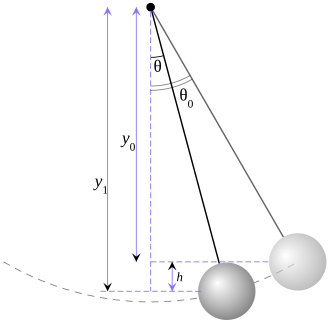
- エネルギー保存:摩擦を無視すれば、最高点での位置エネルギーと最低点での運動エネルギーが等しくなります。
運動の数学的記述
単振り子の挙動を記述するには、まずその運動方程式を導き出す必要があります。質点の速度や加速度を角度 $\theta$ で表現すると、接線方向の加速度は弧の長さを用いて定義されます。
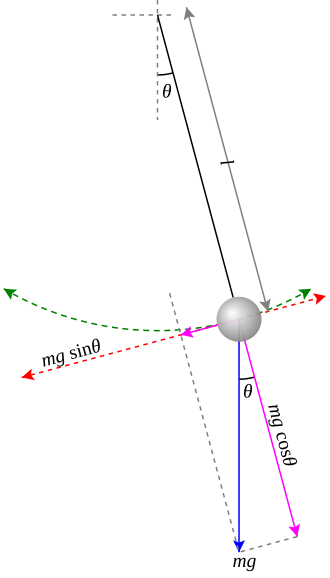
力学的アプローチでは、重力の接線成分が復元力として働き、以下の微分方程式が得られます: $\frac{d^{2}\theta}{dt^{2}} + \frac{g}{\ell}\sin\theta = 0$ ここで、$g$ は重力加速度、$\ell$ は振り子の長さを指します。
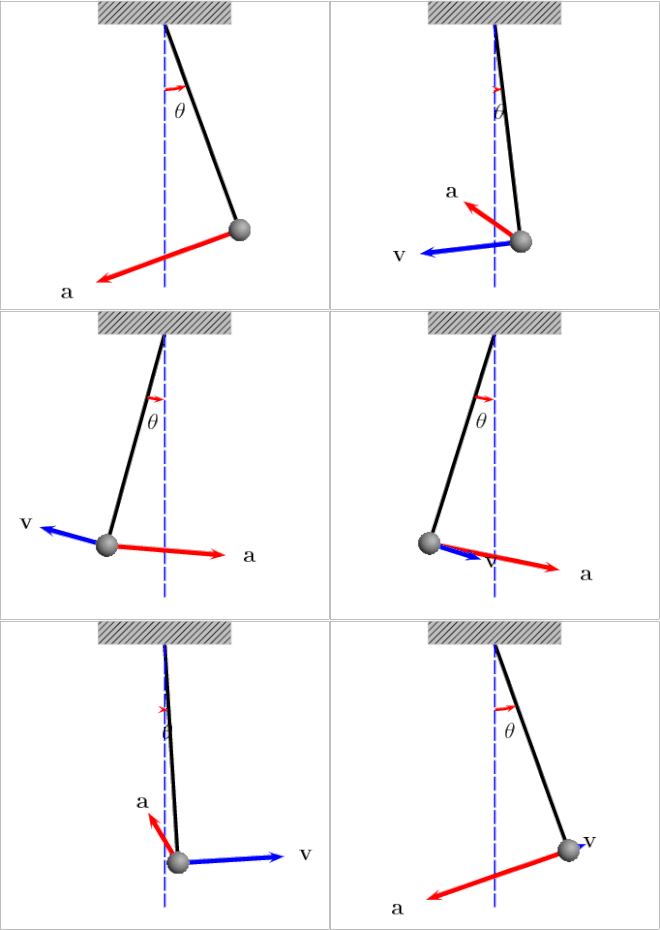
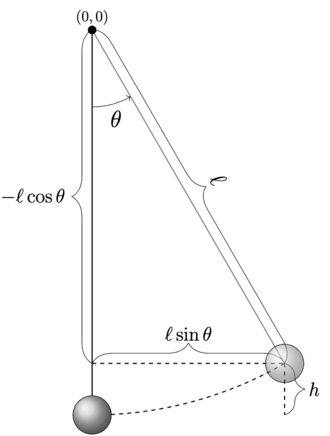
また、この系は角運動量の時間変化(トルク)や、エネルギー保存則を用いた積分形式でも記述可能です。特に、高さの変化 $h$ と速度 $v$ の関係 $v = \sqrt{2gh}$ を利用することで、位置に基づいた速度を求める「運動の第一積分」を導き出すことができます。
ラグランジュ形式によるアプローチ
解析力学の手法を用いる場合、系の運動エネルギー $E_k$ とポテンシャルエネルギー $E_p$ の差であるラグランジアン $\mathcal{L}$ を定義します。この $\mathcal{L}$ をオイラー=ラグランジュ方程式に代入することで、前述の運動方程式を効率的に導出することが可能です。
微小振動近似と周期の簡略化
前述の微分方程式に含まれる $\sin\theta$ は非線形であるため、初等関数による単純な解を得ることは困難です。しかし、振幅 $\theta$ が十分に小さい($\theta \ll 1$ ラジアン)と仮定すると、$\sin\theta \approx \theta$ という近似が成り立ちます。
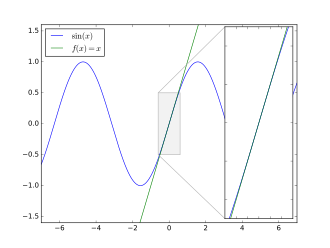
この近似を適用すると、方程式は調和振動子の形式となり、周期 $T_0$ は次のように簡潔に表されます: $T_0 = 2\pi\sqrt{\frac{\ell}{g}}$
実用的な目安として、長さ $\ell$(メートル)と周期 $T_0$(秒)の間には $\ell \approx T_0^2/4$ および $T_0 \approx 2\sqrt{\ell}$ という近似関係が成り立ちます。
大振幅における厳密な周期解析
振幅が大きくなると、微小振動近似による誤差が無視できなくなります。厳密な周期 $T$ を求めるには、エネルギー保存則から得られる積分を計算し、第一種完全楕円積分 $K(k)$ を用いて表現する必要があります。
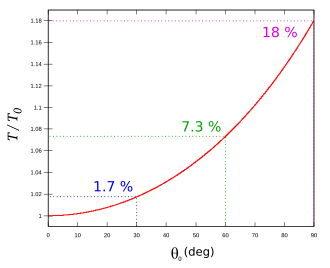
周期の厳密解は、ルジャンドル多項式を用いた級数展開や、マクローリン展開によるべき級数として表現でき、振幅 $\theta_0$ が大きくなるほど周期が伸びることが数学的に示されます。
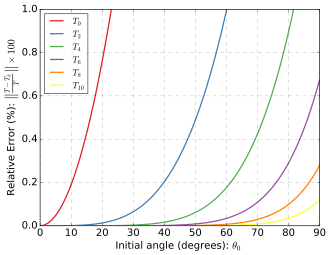
また、算術幾何平均を用いた近似手法もあり、例えば $T_1 = T_0 \sec^2(\theta_0/4)$ という式は、角度が96.11度までであっても相対誤差1%未満という高い精度を維持します。
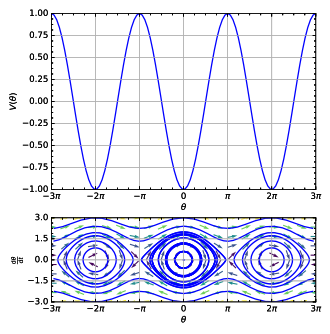
応用的な振り子モデル
物理振り子(剛体振り子)
質点が一点に集中していない剛体の振り子の場合、回転軸まわりの慣性モーメント $I_O$ と重心までの距離 $r_{\oplus}$ が重要になります。例えば、一端を固定した均質な棒の振り子は、長さの2/3の単振り子と同等の周期で振動します。
減衰・強制振動と連成系
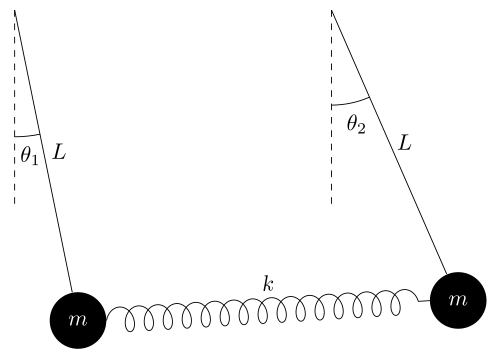
現実の系では空気抵抗などの減衰項や、外部からの周期的な強制力が加わります。また、2つの振り子をバネで繋いだ連成振り子では、2つの異なる固有振動数(同位相モードと逆位相モード)を持つ複雑な干渉運動が観察されます。
| 項目 | 微小振動近似 ($\theta \ll 1$) | 大振幅(非線形) |
|---|---|---|
| 復元力の近似 | 線形 ($\sin\theta \approx \theta$) | 非線形 ($\sin\theta$) |
| 周期の依存性 | 振幅に依存しない(等時性) | 振幅が増えると周期も増加 |
| 数学的解法 | 単純な三角関数 | 楕円積分 / 級数展開 |
| 運動の性質 | 単純調和振動 | 非線形振動 |
Frequently Asked Questions
なぜ振幅が小さいと周期が変わらないのですか?
振幅が小さいとき、復元力($\sin\theta$)が変位($\theta$)にほぼ比例するためです。この「線形性」により、復元力の増加分が速度の増加分とちょうど相殺され、往復にかかる時間は一定に保たれます。
「物理振り子」と「単振り子」の違いは何ですか?
単振り子は「質量のない紐に質点がついたモデル」ですが、物理振り子は「質量分布を持つ剛体」を扱います。物理振り子の周期は、重心の位置と慣性モーメントによって決定されます。
振幅が非常に大きい場合、周期はどうなりますか?
振幅が大きくなるほど、$\sin\theta$ の値が $\theta$ よりも小さくなるため、復元力が相対的に弱まります。その結果、最高点付近での速度が低下し、一周にかかる時間(周期)は長くなります。
連成振り子ではどのような現象が起きますか?
2つの振り子が相互にエネルギーをやり取りするため、一方の振幅が最大になるともう一方が最小になるという「うなり」のような現象や、2つの異なる振動モードの重ね合わせが見られます。
References
- defined by Christiaan Huygens: Huygens, Christian (1673). "Horologium Oscillatorium" (PDF). 17centurymaths. 17thcenturymaths.com. Retrieved 2009-03-01., Part 4, Definition 3, translated July 2007 by Ian Bruce
- Nave, Carl R. (2006). "Simple pendulum". Hyperphysics. Georgia State Univ. Retrieved 2008-12-10.
- Xue, Linwei (2007). "Pendulum Systems". Seeing and Touching Structural Concepts. Civil Engineering Dept., Univ. of Manchester, UK. Retrieved 2008-12-10.
- Weisstein, Eric W. (2007). "Simple Pendulum". Eric Weisstein's world of science. Wolfram Research. Retrieved 2009-03-09.
- Nelson, Robert; Olsson, M. G. (February 1986). "The pendulum — Rich physics from a simple system". American Journal of Physics. 54 (2): 112–121. :1986AmJPh..54..112N. :10.1119/1.14703. 121907349.
- Carvalhaes, Claudio G.; Suppes, Patrick (December 2008), "Approximations for the period of the simple pendulum based on the arithmetic-geometric mean" (PDF), , 76 (12͒): 1150–1154, :2008AmJPh..76.1150C, :10.1119/1.2968864, 0002-9505, retrieved 2013-12-14
- ; (1987). Pi and the AGM. New York: Wiley. pp. 1–15. . 0877728.
- Van Baak, Tom (November 2013). "A New and Wonderful Pendulum Period Equation" (PDF). Horological Science Newsletter. 2013 (5): 22–30.
- Lima, F. M. S. (2008-09-10). "Simple 'log formulae' for pendulum motion valid for any amplitude". European Journal of Physics. 29 (5): 1091–1098. :10.1088/0143-0807/29/5/021. 0143-0807. 121743087 – via IoP journals.
- Lima, F. M. S.; Arun, P. (October 2006). "An accurate formula for the period of a simple pendulum oscillating beyond the small angle regime". American Journal of Physics. 74 (10): 892–895. :physics/0510206. :2006AmJPh..74..892L. :10.1119/1.2215616. 0002-9505. 36304104.
📸 フォトギャラリー