工業製品の設計において、部品のサイズや定格値をどのように決定すべきかは重要な課題です。あらゆる数値を個別に設定すると、部品の種類が膨大になり、製造コストや在庫管理の効率が悪化します。この問題を解決するために考案されたのが、ルナール数(Renard series)と呼ばれる優先数の体系です。
ルナール数は、特定の範囲を幾何級数的に分割することで、最小限のバリエーションで最大限のカバー範囲を確保する数学的なアプローチです。これにより、任意の数値を最も近い規格値に置き換えた際の相対誤差を最小限に抑えることが可能になります。
Key Facts
- 起源: 1877年頃にフランス軍のエンジニア、シャルル・ルナール大佐によって提案された。
- 数学的根拠: 1から10までの間隔を等比数列(幾何級数)で分割するシステム。
- 国際規格: 1949年にISO(国際標準化機構)に採用され、現在はISO 3として標準化されている。
- 主な用途: 電気ヒューズの定格電流や、コンデンサの定格電圧(100V, 160V, 250Vなど)に利用されている。
- 特徴: 10倍ごとに数値が繰り返されるため、SI単位系(メートル法)と非常に親和性が高い。
ルナール数の基本構造と計算原理
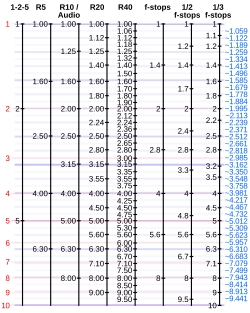
ルナール数の核心は、1から10までの区間を5、10、20、または40のステップで分割することにあります。隣接する数値間の比率はほぼ一定であり、具体的には10のn乗根(nは分割数)に基づいています。
例えば、最もシンプルなR5シリーズでは、10の5乗根(約1.58)が公比となります。これにより、1.00, 1.60, 2.50, 4.00, 6.30という5つの基本数値が導き出されます。より精密な区分が必要な場合は、R10(10の10乗根 ≒ 1.26)、R20(10の20乗根 ≒ 1.12)、R40(10の40乗根 ≒ 1.06)といったシリーズが使い分けられます。
これらの数値は、実用性を高めるために適宜四捨五入され、扱いやすい数値に調整されています。
実務における適用例
ルナール数を導入することで、設計者は根拠のある数値選択が可能になります。以下に具体的な適用シナリオを挙げます。
- 部品配置の最適化: 例えば、ある装置のネジの間隔を32mmから55mmの間で設定する場合、R5シリーズに含まれる「4.00」に基づき、40mmという規格値を採用することで標準化を図れます。
- 製品ラインナップの策定: 15mmから300mmの範囲で釘のサイズを展開する場合、R5シリーズを適用すれば、16, 25, 40, 63, 100, 160, 250mmという効率的なラインナップを構築できます。
- 容量の規格化: 伝統的なワイン樽の容量(ガロン単位)をメートル法に変換して規格化する場合も、ルナール数を用いることで、63, 100, 160, 250, 400, 630, 1000リットルといった合理的でバランスの良い区分に整理できます。
シリーズのバリエーションと精度
用途に応じて、精度の異なる複数のシリーズが定義されています。基本となる「最小丸め(Least rounded)」のほか、より整数に近い値を用いる「中丸め(Medium rounded)」や「最大丸め(Most rounded)」が存在します。これは、過剰な精度が不要な場合や、ギアの歯数のように整数値が必須な場合に利用されます。
また、特定のシリーズからn番目ごとに数値を抽出するサブセット(例:R″10/3)を作成することで、さらに間隔を広げた規格群を定義することも可能です。
| シリーズ | 分割数 | 近似公比 | 基本数値例(1〜10) |
|---|---|---|---|
| R5 | 5 | 1.58 | 1.0, 1.6, 2.5, 4.0, 6.3 |
| R10 | 10 | 1.26 | 1.0, 1.25, 1.6, 2.0, 2.5, 3.15, 4.0, 5.0, 6.3, 8.0, 10 |
| R20 | 20 | 1.12 | (より細かい刻みで1.0から10.0まで展開) |
| R40 | 40 | 1.06 | (さらに高精度な刻みで展開) |
単位系との整合性
ルナール数は10倍ごとにサイクルが繰り返されるため、10進法ベースのSI単位系と完璧に適合します。ミリメートルで設計してもメートルで設計しても、選択される比率は変わりません。一方で、インチやフィート(12進法)や、コンピュータサイエンスで用いられる2進数(2, 8, 16進法)に適用する場合は、10の根ではなく、12の根や2の根に基づいた別の基数を用いる必要があります。
Frequently Asked Questions
ルナール数を使う最大のメリットは何ですか?
最大のメリットは、製品ラインナップの数を最小限に抑えつつ、あらゆる要求仕様に対して「許容できる誤差範囲内」で最適な規格値を提供できることです。これにより、製造コストの削減と互換性の向上が実現します。
R5やR10などの数字は何を意味していますか?
数字は、1から10までの1サイクルをいくつに分割しているかを示しています。例えばR5は5分割、R10は10分割を意味し、数字が大きくなるほど数値の間隔が狭くなり、より精密な選択が可能になります。
なぜ単純な等差数列(1, 2, 3...)ではなく等比数列を使うのですか?
等差数列では、数値が大きくなるにつれて相対的な誤差(パーセンテージ)が小さくなりすぎ、効率が悪くなります。等比数列(幾何級数)を用いることで、どの数値範囲においても一定の相対誤差に抑えることができるため、設計上の合理性が高まります。
ISO 3とはどのような規格ですか?
ISO 3は、これらの優先数(Preferred Numbers)のシリーズを定義した国際規格です。世界共通の数値体系を用いることで、異なる国やメーカー間での部品の共通化や標準化を促進しています。
ルナール数はどのような製品に利用されていますか?
電子部品の定格(コンデンサの電圧やヒューズの電流値)をはじめ、機械部品の寸法、配管のサイズ、あるいは容器の容量など、幅広い工業製品の規格策定に利用されています。
References
- ISO 3:1973-04 - Preferred Numbers - Series of Preferred Numbers. (ISO). April 1973. Retrieved 2016-12-18. (Replaced: ISO Recommendation R3-1954 - Preferred Numbers - Series of Preferred Numbers. July 1954. (July 1953))
- Kienzle, Otto Helmut [in German] (2013-10-04) [1950]. Written at Hannover, Germany. Normungszahlen [Preferred numbers]. Wissenschaftliche Normung (in German). Vol. 2 (reprint of 1st ed.). Berlin / Göttingen / Heidelberg, Germany: . . Retrieved 2017-11-01. (340 pages)
- Paulin, Eugen (2007-09-01). Logarithmen, Normzahlen, Dezibel, Neper, Phon - natürlich verwandt! [Logarithms, preferred numbers, decibel, neper, phon - naturally related!] (PDF) (in German). Archived (PDF) from the original on 2016-12-18. Retrieved 2016-12-18.
- "preferred numbers". Sizes, Inc. 2014-06-10 [2000]. Archived from the original on 2017-11-01. Retrieved 2017-11-01.
- Engineers, American Society of Mechanical (1924). Mechanical Engineering: The Journal of the American Society of Mechanical Engineers. American Society of Mechanical Engineers.
- ISO 17:1973-04 - Guide to the use of preferred numbers and of series of preferred numbers. (ISO). April 1973. Archived from the original on 2017-11-02. Retrieved 2017-11-02.
[…] Preferred numbers were first utilized in France at the end of the nineteenth century. From 1877 to 1879, Captain Charles Renard, an officer in the engineer corps, made a rational study of the elements necessary in the construction of […] aircraft. He computed the specifications […] according to a grading system […]. Recognizing the advantage to be derived from the geometrical progression, he adopted […] a grading system […] that would yield a tenth multiple of the value […] after every fifth step of the series […] Renard's theory was to substitute […] more rounded but […] practical values […] as a power of 10, positive, nil or negative. He thus obtained […] 10 16 25 40 63 100 […] continued in both directions […] by the symbol R5 […] the R10, R20, R40 series were formed, each adopted ratio being the square root of the preceding one […] The first standardization drafts were drawn up on these bases in Germany by the Normenausschuss der Deutschen Industrie on 13 April 1920, and in France by the Commission permanente de standardisation in document X of 19 December 1921. […] the commission of standardization in the Netherlands proposed their unification […] reached in 1931 […] in June 1932, the International Federation of the National Standardizing Associations organized an international meeting in Milan, where the ISA Technical Committee 32, Preferred numbers, was set up and its Secretariat assigned to France. On 19 September 1934, the ISA Technical Committee 32 held a meeting in Stockholm; sixteen nations were represented: Austria, Belgium, Czechoslovakia, Denmark, Finland, France, Germany, Hungary, Italy, Netherlands, Norway, Poland, Spain, Sweden, Switzerland, U.S.S.R. With the exception of the Spanish, Hungarian and Italian […] the other delegations accepted the draft […] Japan communicated […] its approval […] the international recommendation was laid down in ISA Bulletin 11 (December 1935). […] After the Second World War, the work was resumed by ISO. The Technical Committee ISO/TC 19, Preferred numbers, was set up and France again held the Secretariat. This Committee at its first meeting […] in Paris in July 1949 […] recommended […] preferred numbers defined by […] ISA Bulletin 11, […] R5, R10, R20, R40. This meeting was attended by […] 19 […] nations: Austria, Belgium, Czechoslovakia, Denmark, Finland, France, Hungary, India, Israel, Italy, Netherlands, Norway, Poland, Portugal, Sweden, Switzerland, United Kingdom, U.S.A., U.S.S.R. During […] subsequent meetings in New York in 1952 and […] the Hague in 1953, […] attended also by Germany, […] series R80 was added […] The draft thus amended became ISO Recommendation R3. […]
(Replaced: ISO Recommendation R17-1956 - Preferred Numbers - Guide to the Use of Preferred Numbers and of Series of Preferred Numbers. 1956. (1955) and ISO R17/A1-1966 - Amendment 1 to ISO Recommendation R17-1955. 1966.) - De Simone, Daniel V. (July 1971). U.S. Metric Study Interim Report - Engineering Standards (PDF). Washington, USA: (NBS). NBS Special Publication 345-11 (Code: XNBSA). Archived (PDF) from the original on 2017-11-03. Retrieved 2017-11-03.
{{}}:|website=ignored ()