A solvent (white) is added to a compound (orange). The slurry is heated to give a solution (orange). The solution is allowed to cool, ideally yielding crystals (orange), leaving impurities in solution (pale-orange).
← ホームへ戻る
再結晶精製結晶化溶媒アンチソルベント

再結晶による化合物の精製原理から高度な結晶成長法まで

🗓 2026年8月11日

化学合成や物質抽出において、得られた試料から不純物を取り除き、高純度な物質を得ることは極めて重要です。その代表的な手法が再結晶です。これは、不純物を含む試料を適切な溶媒に溶解させ、その後、条件を変化させることで目的物質のみを固体結晶として析出させる精製技術です。結晶が持つ高度に秩序化された周期的な分子構造を利用し、自己組織化プロセスを通じて不純物を排除します。

Key Facts

  • 精製の原理:目的分子は結晶表面に堆積して成長に寄与するが、不純物分子は構造的に適合せず溶媒中に留まる。
  • 溶解度の利用:温度変化や溶媒組成の変化によって溶解度を制御し、結晶を析出させる。
  • X線解析への応用:単結晶を得るためには、急激な析出を避け、緩やかな環境変化を与えることが不可欠である。
  • 結晶の維持:結晶格子内の溶媒(結晶水など)が失われると構造が崩壊し、粉末状になるため密閉保存が必要。

再結晶の基礎メカニズム

再結晶の核心は、目的物質と不純物の間にある「分子間相互作用の差」にあります。溶液中で目的物質の分子が既存の結晶表面に接触すると、その秩序ある構造に組み込まれ、結晶は成長します。一方で、不純物分子は結晶の規則的な配列に適合しないため、表面に定着できず溶媒中に溶解したままとなります。

最も一般的な手法は温度管理です。多くの物質は温度が上がると溶解度が増加する(吸熱溶解)ため、溶媒の沸点付近で飽和溶液を作成し、その後ゆっくりと冷却します。これにより溶液が過飽和状態となり、確率的な核生成を経てマクロなサイズの結晶へと成長します。

再結晶の主要アプローチまとめ
手法 メカニズム 主な用途
温度降下法 温度低下による溶解度の減少 一般的な純度向上
アンチソルベント法 溶解度の低い溶媒の添加 温度に不安定な物質の精製
溶媒蒸発法 溶媒量の減少による飽和状態の創出 X線解析用単結晶の育成
拡散法 異なる溶媒間の緩やかな混合 高品質な単結晶の育成

多様な再結晶の手法

温度制御と不溶物の除去

単純な冷却法では、加熱して溶解させた後、徐々に温度を下げることで結晶を得ます。もし試料に溶媒に溶けない不純物が混在している場合は、加熱飽和状態でろ過を行い、不溶物を除去してから冷却工程に移ります。
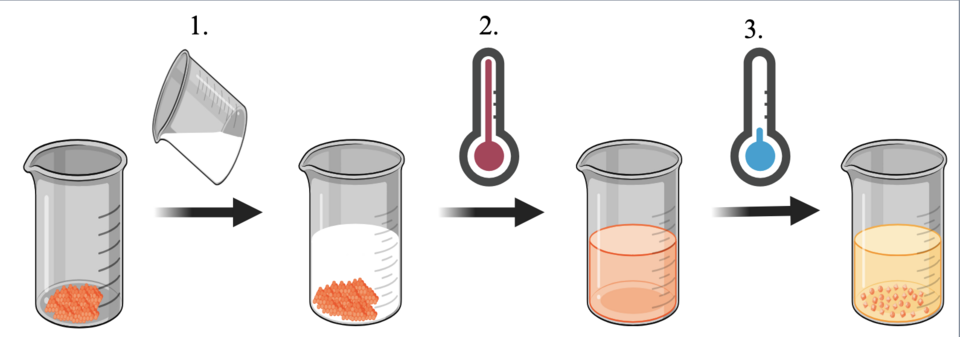
A solvent (white) is added to a compound (orange). The slurry is heated to give a solution (orange). The solution is allowed to cool, ideally yielding crystals (orange), leaving impurities in solution (pale-orange).
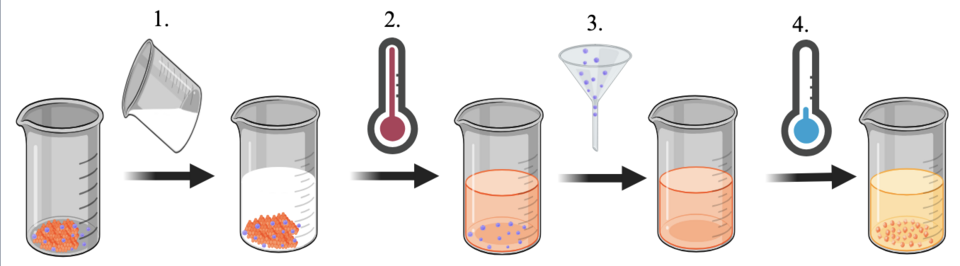
A solvent is added (white) to a mixture of a compound (orange) and insoluble substance (purple) → Solvent is heated to give a saturated compound solution (orange) and an insoluble substance (purple) → Saturated compound solution (orange) is filtered to remove the insoluble substance (purple) → Saturated compound solution (orange) is allowed to cool over time yielding crystals (orange) as separate from an impure solution (pale-orange).

アンチソルベント(貧溶媒)の利用

目的物質が非常に溶けやすい溶媒(良溶媒)に溶解させた後、混和性はあるが目的物質の溶解度が極めて低い別の溶媒(アンチソルベント)を添加する方法です。添加量や濃度を調整し、析出が始まるまで加えた後、静置または冷却して結晶を成長させます。この際、アンチソルベントを層状に重ねる手法も用いられます。
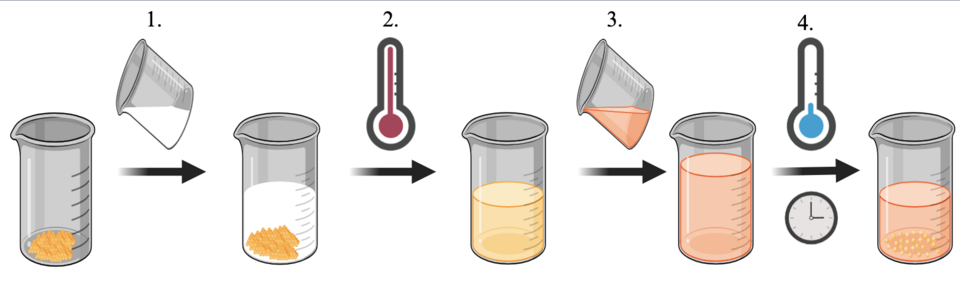
An antisolvent (orange) is added to a solution (light orange) of the targeted compound. Cooling over time can yield crystals (light orange).

単結晶育成のための高度な手法

X線結晶構造解析には、凝集していない単一の高品質な結晶が必要です。そのためには、極めて緩やかな条件変化が求められます。

  • 緩慢蒸発法:容器に小さな穴を開け、溶媒をゆっくりと揮発させることで飽和度を高めます。単一溶媒だけでなく、揮発度の異なる混合溶媒を用いることで、組成変化に伴う結晶化を誘導できます。
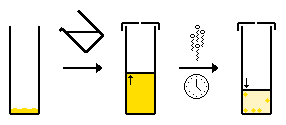
→ Solvent added (clear) to compound (orange) to give compound solution (orange) → Vessel sealed but a small hole allows solvent vapour (clear) to slowly evaporate from compound solution (orange) over time to give crystals (orange) and a saturated solution (pale-orange).
→ Solvent added (clear) to compound (orange) to give compound solution (orange) → The second solvent added (blue) to the compound solution (orange) to give mixed solvent system (green) → Vessel sealed but a small hole allows solvent vapour (clear) to slowly evaporate over time to give crystals (orange) and a saturated mixed solvent solution (blue-green).
  • 蒸気拡散法:目的物質の溶液が入った容器を、別の溶媒が入った密閉容器の中に配置します。揮発した溶媒分子が溶液中に拡散して入り込むことで、徐々に溶解度が低下し結晶が形成されます。
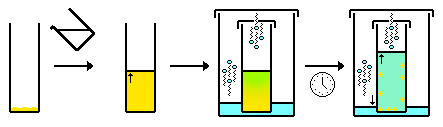
→ Solvent added (clear) to compound (orange) in the first vessel to give compound solution (orange) → The first vessel is placed in a second vessel contain second solvent (blue). The second vessel is sealed, and the first vessel is also sealed, although a small hole in the first vessel is present. This hole allows volatile solvent vapour (blue) to slowly evaporate from the second vessel and condensate (that is infuse) into the first vessel, to give a mixed solvent system (green) → Over time this gives crystals (orange) and a saturated mixed solvent system (green-blue).
  • 液液拡散法(インターフェース法):溶液の上に別の溶媒を慎重に重ね、界面で緩やかに混合させます。密度差や温度差を利用して混合速度を遅くすることで、界面付近に高品質な結晶を得やすくなります。NMRチューブなどでよく行われます。
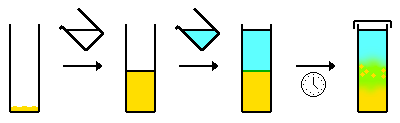
→ Solvent added (clear) to compound (orange) to give compound solution (orange) → The second solvent added (blue) carefully so that the two solvents do not mix. → The two solvents mix (diffuse) slowly over time to give crystals (orange) at the solvent interface (green)
  • 特殊装置(H型管)の利用:H字型のガラス管を用い、一方に溶液、もう一方に貧溶媒を入れます。中央の連結部分に微細なガラスシンター(多孔質ガラス)を設けることで、溶媒の混合速度を物理的に制限し、精密な結晶成長を制御します。

→ Solvent added (clear) to compound (orange) to give a compound solution (orange) → The second solvent added (blue) to the second tube chamber → The two solvents mix slowly over time, the mixing is slowed by a fine sinter separating the two solvent chambers, to give crystals (orange) at the solvent interface (green) over time

Frequently Asked Questions

なぜゆっくり冷却する必要があるのですか?

急激に冷却すると、多数の小さな結晶核が同時に発生し、不純物を巻き込みやすくなるためです。ゆっくりと冷却することで、少数の核が大きく成長し、より純度が高く大きな結晶を得ることができます。

アンチソルベントを選ぶ際の注意点は何ですか?

まず、元の溶媒と完全に混ざり合う(混和性がある)必要があります。また、目的物質がその溶媒にほとんど溶けないこと、そして不純物は溶け続けることが理想的です。

X線解析用の結晶が粉末になってしまうのはなぜですか?

結晶格子の中に溶媒分子が組み込まれている場合があり、これを「結晶溶媒」と呼びます。密閉せずに保存してこの溶媒が揮発してしまうと、内部構造が崩壊して粉末状になります。そのため、母液と共に密閉保存することが推奨されます。

溶媒の選択はどうやって決めればよいですか?

目的物質が「高温ではよく溶け、低温ではほとんど溶けない」という特性を持つ溶媒が最適です。単一の溶媒で適切に制御できない場合は、性質の異なる2種類の溶媒を組み合わせた混合溶媒系を検討します。

References

  1. "Recrystallization | Digital Lab Techniques Manual | Chemistry". MIT OpenCourseWare. Retrieved 2024-11-20.
  2. "Growing Quality Crystals". MIT Chemistry Homepage.
  3. Sommer, Roger D. "How to grow crystals for X-ray crystallography". OUTREACH IUCr Newsletter.
  4. Hightower, Timothy R.; Heeren, Jay D. (2006). "Using a Simulated Industrial Setting for the Development of an Improved Solvent System for the Recrystallization of Benzoic Acid: A Student-Centered Project". Journal of Chemical Education. 83 (11): 1663. :2006JChEd..83.1663H. :10.1021/ed083p1663.
  5. Pauli, Guido F.; Chen, Shao-Nong; Simmler, Charlotte; Lankin, David C.; Gödecke, Tanja; Jaki, Birgit U.; Friesen, J. Brent; McAlpine, James B.; Napolitano, José G. (2014-11-26). "Importance of Purity Evaluation and the Potential of Quantitative 1 H NMR as a Purity Assay: Miniperspective". Journal of Medicinal Chemistry. 57 (22): 9220–9231. :10.1021/jm500734a.  0022-2623.  4255677.  25295852.
  6. Baumann, Jacob B. (1979). "Solvent selection for recrystallization: An undergraduate organic experiment". Journal of Chemical Education. 56 (1): 64. :1979JChEd..56...64B. :10.1021/ed056p64.
  7. Bierne, David; Smith, Steven; Hoogenboom, Bernard E. (1974). "Recrystallization without tears". Journal of Chemical Education. 51 (9): 602. :1974JChEd..51..602B. :10.1021/ed051p602.
  8. Powell, Douglas R. (2016-04-12). "Review of X-Ray Crystallography". Journal of Chemical Education. 93 (4): 591–592. :10.1021/acs.jchemed.5b00893.  0021-9584.

📸 フォトギャラリー

A solvent (white) is added to a compound (orange). The slurry is heated to give a solution (orange). The solution is allowed to cool, ideally yielding crystals (orange), leaving impurities in solution (pale-orange).
An antisolvent (orange) is added to a solution (light orange) of the targeted compound. Cooling over time can yield crystals (light orange).
A solvent is added (white) to a mixture of a compound (orange) and insoluble substance (purple) → Solvent is heated to give a saturated compound solution (orange) and an insoluble substance (purple) → Saturated compound solution (orange) is filtered to remove the insoluble substance (purple) → Saturated compound solution (orange) is allowed to cool over time yielding crystals (orange) as separate from an impure solution (pale-orange).
→ Solvent added (clear) to compound (orange) to give compound solution (orange) → Vessel sealed but a small hole allows solvent vapour (clear) to slowly evaporate from compound solution (orange) over time to give crystals (orange) and a saturated solution (pale-orange).
→ Solvent added (clear) to compound (orange) to give compound solution (orange) → The second solvent added (blue) to the compound solution (orange) to give mixed solvent system (green) → Vessel sealed but a small hole allows solvent vapour (clear) to slowly evaporate over time to give crystals (orange) and a saturated mixed solvent solution (blue-green).
→ Solvent added (clear) to compound (orange) in the first vessel to give compound solution (orange) → The first vessel is placed in a second vessel contain second solvent (blue). The second vessel is sealed, and the first vessel is also sealed, although a small hole in the first vessel is present. This hole allows volatile solvent vapour (blue) to slowly evaporate from the second vessel and condensate (that is infuse) into the first vessel, to give a mixed solvent system (green) → Over time this gives crystals (orange) and a saturated mixed solvent system (green-blue).
→ Solvent added (clear) to compound (orange) to give compound solution (orange) → The second solvent added (blue) carefully so that the two solvents do not mix. → The two solvents mix (diffuse) slowly over time to give crystals (orange) at the solvent interface (green)
→ Solvent added (clear) to compound (orange) to give a compound solution (orange) → The second solvent added (blue) to the second tube chamber → The two solvents mix slowly over time, the mixing is slowed by a fine sinter separating the two solvent chambers, to give crystals (orange) at the solvent interface (green) over time