地球の歴史において、古生代の第2期にあたるオルドビス紀(約4億8685万年前から4億4310万年前まで)は、海洋生命が爆発的に多様化した極めて重要な時代です。約4375万年という長い歳月の中で、地球は劇的な海面変動や気候の変化、そして宇宙からの影響を経験しました。
主要な事実(Key Facts)
- 期間: 約4億8685万年前から4億4310万年前まで。
- 生物的特徴: 海洋生物の多様性が急増し、初期の陸上植物の胞子も出現した。
- 環境変動: 海面が現在より最大220m上昇し、その後、末期の氷河作用で急落した。
- 宇宙イベント: 中期にLコンドライト親天体の崩壊による隕石シャワーが発生した。
- 地質学的区分: 下部、中部、上部の3つのシリーズ(世)に分けられる。
地球の姿とダイナミックな環境変化
オルドビス紀の地球は、現在とは全く異なる大陸配置となっていました。時代が進むにつれて大陸は移動し、広大な海洋が形成されました。
初期の地球では、大陸の配置が海洋循環に大きな影響を与えていました。
![Paleogeographic map of the Earth in the early Ordovician, 480 million years ago[citation needed]](/images/80/25/80251928b69fb02cb9ef94d8b5e9fb5dfcf8ae3820340e1884faf3878bdb1a49.png)
中期になると、地殻変動や海面の上昇により、浅い海(浅海域)が拡大しました。これにより、多くの海洋生物が生存できるスペースが増加しました。
![Paleogeographic map of the Earth in the middle Ordovician, 470 million years ago[citation needed]](/images/98/8b/988bb81e7add2dfd0d6c3eee26d46939d899877e2071be7555f686abf47e9b42.png)
後期になると、再び大陸の配置が変化し、気候の変動が激しくなります。特に末期には大規模な氷河作用が起こり、海面が急激に低下しました。
![Paleogeographic map of the Earth in the late Ordovician, 450 million years ago[citation needed]](/images/19/62/196266a46434ababbdd93f0d846de3d0505c844fa48834edcf4372c5b90ae024.png)
海面変動と気候のサイクル
この時代の海面は非常に不安定でした。一般的に現在よりも高い水準にあり、最大で220メートルまで上昇した時期もありましたが、末期の氷河時代には141メートルまで急落しました。このような変動は、海洋生態系に絶えずストレスと適応の機会を与え続けました。
宇宙からの訪問者:オルドビス紀の隕石イベント
約4億6750万年前の中期において、Lコンドライトと呼ばれる隕石の親天体が崩壊し、地球に大量の隕石が降り注ぐ「隕石シャワー」が発生したと考えられています。最新の研究では、この破片が一時的に地球の周りにリング(環)を形成し、約4000万年間にわたって頻繁に破片が落下していた可能性が指摘されています。
このイベントは大規模な絶滅を引き起こしたわけではありませんが、地球の環境に特有の影響を与えたと考えられています。
生命の進化と多様性の爆発
オルドビス紀は、海洋生物の種数が劇的に増加した時代です。これを「オルドビス紀の生物多様化イベント」と呼びます。
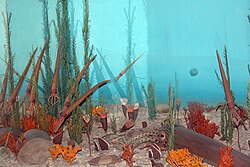
海洋の支配者たち
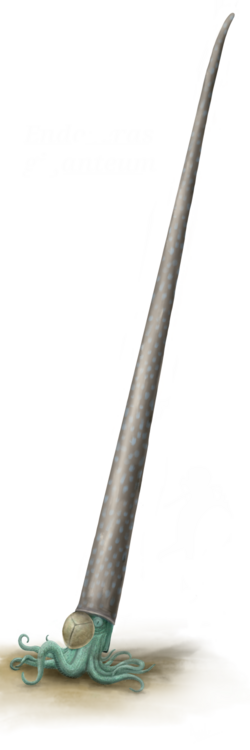
当時の海では、巨大な頭足類が頂点捕食者として君臨していました。特にエンドセラスのような種は、当時の生態系で最大級の捕食者でした。
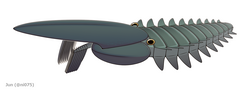
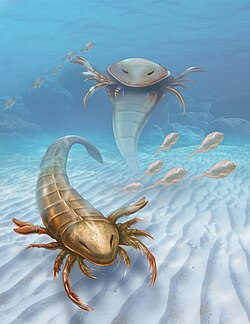
また、節足動物も繁栄し、巨大な濾過摂食者であるエギロカシスや、初期のウミサソリであるペンテコプテルスなどが生息していました。
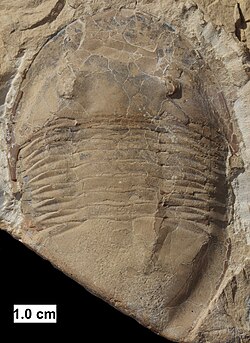
底生生物としては、三葉虫が非常に多様に進化しました。ウィスコンシン州で発見されたイソテルスなどがその代表例です。
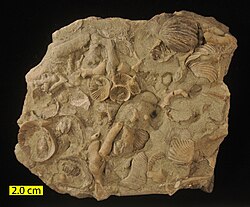
さらに、腕足動物やコケムシ、サンゴなどが複雑な礁(リーフ)を形成し、豊かな海洋生態系を構築していました。
貝類と化石の記録
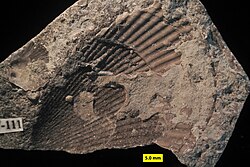
当時の二枚貝の化石からは、元のアラゴナイト(霰石)の殻が溶け出し、その跡が固まってできた型(外部鋳型)が見つかることがあります。これは当時の海底環境を知る重要な手がかりとなります。
陸上への進出
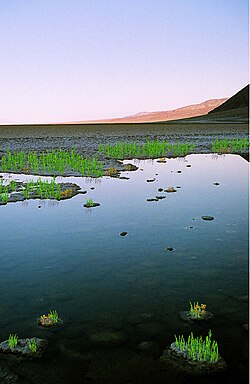
生命の活動は海の中だけではありませんでした。海岸線などの限定的なエリアでは、初期の陸上植物による植民が始まっており、その証拠となる胞子が記録されています。
また、オルドビス紀末の大量絶滅直後には、深海(数百メートル)にガラス海綿やグラフトライトなどが生息していた「安吉生物群(Anji Biota)」のような特異な生態系も存在していました。
![The Anji Biota (Wenchang Formation, Zhejiang Province, China) preserves abundant and diverse glass sponges and graptolites as well as rare examples of other marine animals (such as the eurypterid Archopterus) living at a depth of several hundred metres. It is dated to just after the Hirnantian mass extinction at the end of the Ordovician period.[96]](/images/68/3a/683acc3cb19476db02825afea992972104f8a88900fedd9a137e53596206aafb.jpg)
オルドビス紀のまとめ
オルドビス紀の地質学的・生物学的特徴を以下の表にまとめます。
| 項目 | 詳細内容 |
|---|---|
| 期間 | 約486.85 Ma 〜 443.1 Ma |
| 主要な生物 | 頭足類、三葉虫、腕足動物、初期陸上植物 |
| 海面変動 | 最大220mまで上昇し、末期に急落 |
| 特筆イベント | Lコンドライト親天体の崩壊(隕石シャワー) |
| 時代の終焉 | 氷河作用に伴う大量絶滅を経てシルル紀へ |
Frequently Asked Questions
オルドビス紀に起きた隕石イベントは絶滅の原因になりましたか?
いいえ、中期の隕石シャワーは大規模な絶滅イベントとは結びついていません。生物多様化への直接的な影響についても、近年の研究では否定的な見解が示されています。
当時の海面は現在と比べてどうでしたか?
全体的に現在よりも高く、特に中期から後期にかけては最大で220メートルも上昇していました。しかし、時代の終わりには氷河の発達により急激に低下しました。
陸上に植物は存在していましたか?
はい。限定的ではありましたが、海岸線などの環境で初期の陸上植物が出現し始めており、その胞子の化石が確認されています。
この時代の代表的な捕食者は何ですか?
エンドセラスのような巨大な頭足類が、当時の海洋生態系における主要な頂点捕食者として君臨していました。
オルドビス紀はどのように終わりましたか?
時代の末期に発生した激しい氷河作用とそれに伴う海面低下により、多くの海洋生物が絶滅する大量絶滅を経て、シルル紀へと移行しました。
References
- Wellman, C.H.; Gray, J. (2000). "The microfossil record of early land plants". . 355 (1398): 717–732. :10.1098/rstb.2000.0612. 1692785. 10905606.
- Korochantseva, Ekaterina; Trieloff, Mario; Lorenz, Cyrill; Buykin, Alexey; Ivanova, Marina; Schwarz, Winfried; Hopp, Jens; Jessberger, Elmar (2007). "L-chondrite asteroid breakup tied to Ordovician meteorite shower by multiple isochron 40 Ar- 39 Ar dating". Meteoritics & Planetary Science. 42 (1): 113–130. :2007M&PS...42..113K. :10.1111/j.1945-5100.2007.tb00221.x.
- Lindskog, A.; Costa, M. M.; Rasmussen, C.M.Ø.; Connelly, J. N.; Eriksson, M. E. (24 January 2017). "Refined Ordovician timescale reveals no link between asteroid breakup and biodiversification". Nature Communications. 8 14066. :10.1038/ncomms14066. 2041-1723. 5286199. 28117834.
It has been suggested that the Middle Ordovician meteorite bombardment played a crucial role in the Great Ordovician Biodiversification Event, but this study shows that the two phenomena were unrelated
- "International Chronostratigraphic Chart" (PDF). . December 2024. Retrieved 23 October 2025.
- ; Nowlan, Godfrey S.; Williams, S. Henry (March 2001). "Global Stratotype Section and Point for base of the Ordovician System" (PDF). . 24 (1): 19–28. :10.18814/epiiugs/2001/v24i1/005. 2586-1298. 0705-3797. 78646808. 4130038. Retrieved 10 October 2025.
- "Global Boundary Stratotype Section and Points". . Retrieved 23 October 2025.
- Haq, B. U.; Schutter, SR (2008). "A Chronology of Paleozoic Sea-Level Changes". Science. 322 (5898): 64–68. :2008Sci...322...64H. :10.1126/science.1161648. 18832639.
- "Ordovician". (Online). n.d.
- "International Chronostratigraphic Chart v.2015/01" (PDF). . January 2015. Archived (PDF) from the original on 2 April 2015. Retrieved 30 May 2015.
- Lapworth, Charles (1879). "I.—On the Tripartite Classification of the Lower Palæozoic Rocks". Geological Magazine. 6: 1–15. :1879GeoM....6....1L. :10.1017/S0016756800156560.
North Wales itself — at all events the whole of the great Bala district where Sedgwick first worked out the physical succession among the rocks of the intermediate or so-called Upper Cambrian or Lower Silurian system; and in all probability, much of the Shelve and the Caradoc area, whence Murchison first published its distinctive fossils — lay within the territory of the Ordovices; … Here, then, have we the hint for the appropriate title for the central system of the Lower Paleozoic. It should be called the Ordovician System, after this old British tribe.
📸 フォトギャラリー