物質の状態が変化する際、新しい相や構造が誕生する最初の一歩となる現象を核形成(Nucleation)と呼びます。これは、液体が凍って氷になる結晶化や、液体から気泡が発生する沸騰など、私たちの身の回りで頻繁に起きている物理現象の根幹をなすプロセスです。核形成は、物質内部で自己組織化や自己組織化が起こり、新しい熱力学的相が形成されるまでの「待ち時間」を決定づける重要なステップとなります。
例えば、大気圧下の水は0°C以下になってもすぐに凍らず、液体状態を維持することがあります。これを過冷却(Supercooling)と呼びます。この状態では核形成が非常に遅いか、あるいは全く起こらないため、氷の結晶が現れるまでに時間がかかります。しかし、さらに温度を下げると核形成が加速し、瞬時に結晶が成長します。
このような現象は、一次相転移(First-order phase transition)の典型的なメカニズムであり、連続相転移とは異なり、ある一定の障壁を乗り越えることで新しい相が形成されます。
Key Facts
- 核形成の定義: 新しい相や構造が形成されるための最初の微小な集積体の誕生プロセス。
- 2つのタイプ: 物質内部で自然に起こる「均質核形成」と、不純物や壁面などの界面で起こる「不均質核形成」がある。
- 確率的性質: 核形成はランダム(確率的)に発生するため、同一条件のシステムでも発生タイミングが異なる。
- エネルギー障壁: 新しい相の表面を作るためのエネルギーコスト(界面張力)が、核形成の速度を左右する。
- 広範な応用: 雲の形成、半導体製造、アルツハイマー病に関連するアミロイド凝集などの生物学的プロセスにも関与している。
核形成のメカニズムと理論
核形成は本質的に確率的なプロセスです。既存の相の中に、微小な新しい相の揺らぎが絶えず現れては消えていますが、ある時、偶然に十分な大きさに達した揺らぎ(臨界核)が現れると、それは縮小することなく成長し始め、システム全体を新しい相へと塗り替えていきます。
この挙動を説明するのが古典的核形成理論(CNT)です。CNTでは、微小な核をマクロな液滴のように扱い、その界面張力を用いてエネルギー障壁を算出します。ただし、実際の分子レベルの挙動(特に蒸気が液体になる過程など)では、実験値と理論値に大きな乖離が見られることもあります。
また、相分離が遅延し、ある不安定な領域に入った瞬間に自発的に構造が変化する「スピノーダル分解(Spinodal decomposition)」という現象もあり、これは核形成とは異なる相転移の経路として知られています。
均質核形成と不均質核形成の違い
核形成には、発生場所によって大きく2つの種類があります。一つは、周囲に何もない状態で起こる均質核形成(Homogeneous nucleation)、もう一つは、容器の壁面や微小な不純物の表面で起こる不均質核形成(Heterogeneous nucleation)です。
現実の世界では、不均質核形成が圧倒的に支配的です。なぜなら、表面が存在することで、新しい相を形成する際に必要な界面面積が減少するため、エネルギー障壁(自由エネルギーの壁)が低くなり、核形成が指数関数的に加速されるからです。

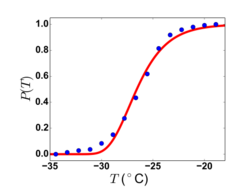
例えば、極めて純粋な水は-35°C付近まで凍らないことがありますが、不純物が含まれている水は-5°Cやそれ以上の温度で容易に凍結します。これは不純物が核形成サイトとして機能し、不均質核形成を促進するためです。
結晶化における核形成のプロセス
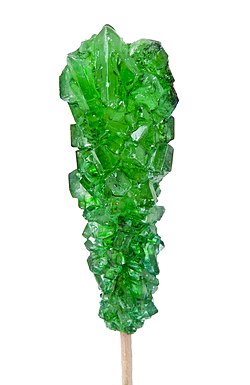
結晶の成長においては、最初に現れる核を一次核形成(Primary nucleation)と呼びます。一方で、既に存在する結晶から新たな核が誘発される現象を二次核形成(Secondary nucleation)と呼びます。例えば、溶液中の結晶にせん断力が加わると、既存の結晶から微小な破片が剥がれ落ち、それが新たな核となって結晶数を急増させることがあります。
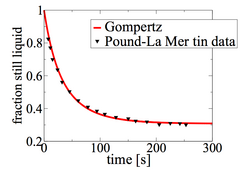
小滴のような微小な体積の中では、たった一つの核形成イベントが全体の結晶化を決定します。このような系では、核形成が起こるまでの時間を統計的に解析することで、不純物の分布や核形成速度を推定することが可能です。
実社会における核形成の具体例
流体における現象
- 雲の形成: 湿った空気が冷却され、過飽和状態になると、空気中の微粒子(雲凝結核)を起点として水滴が核形成し、雲となります。
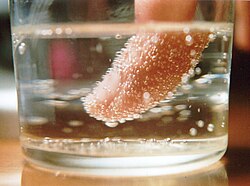
- 炭酸飲料の気泡: 栓を抜いて圧力が下がると、二酸化炭素が核形成して気泡となります。メントスをコーラに入れると激しく噴出するのは、メントスの表面が大量の核形成サイトを提供するためです。
- 沸騰: 加熱面の微小な隙間や濡れ性の低い箇所が核形成サイトとなり、気泡が発生します。
材料科学と工業利用
- 金属製造: 溶融金属を鋳型に流し込んで冷却する際、結晶核の形成プロセスを制御することで、材料の機械的特性を調整します。
- 半導体産業: ナノクラスターのサイズがバンドギャップエネルギーに影響するため、核形成の制御が極めて重要です。
- 原子力産業: 放射線によって鋼材内部にヘリウム気泡や不純物沈殿が核形成すると、材料の脆化やクリープ現象を引き起こし、原子炉の寿命に影響します。
核形成の概要まとめ
| 項目 | 均質核形成 | 不均質核形成 |
|---|---|---|
| 発生場所 | 物質の内部(界面なし) | 壁面、不純物、粒子表面 |
| エネルギー障壁 | 高い(球状の界面を形成するため) | 低い(界面面積が削減されるため) |
| 発生速度 | 遅い(極めて純粋な系で顕著) | 速い(一般的・支配的) |
| 具体例 | 超純水の極低温での凍結 | 雲の形成、炭酸の気泡、一般的な凍結 |
Frequently Asked Questions
なぜ純粋な水は0°Cになっても凍らないのですか?
氷の結晶(核)を形成するには、その表面を作るためのエネルギー(界面張力)が必要です。純粋な水ではこのエネルギー障壁を乗り越えるための「きっかけ」となる不純物がないため、均質核形成が起こるまで液体状態を維持する「過冷却」状態になります。
不均質核形成が速いのはなぜですか?
不純物や壁面などの表面を利用すると、新しい相を形成する際に必要な界面面積を減らすことができます。これにより、核形成に必要な自由エネルギーの障壁が低くなり、結果として核がより容易に、そして速く形成されるためです。
一次核形成と二次核形成の違いは何ですか?
一次核形成は、新しい相が全く存在しない状態、あるいは既存の相から遠く離れた場所でゼロから核が誕生することです。対して二次核形成は、既に存在する結晶などの影響を受けて、そこから新たな核が誘発されるプロセスを指します。
核形成は生物学的な現象にも関係していますか?
はい。例えば、アルツハイマー病に関連するアミロイド凝集体の形成は、核形成とそれに続く成長プロセスによって進行します。また、細胞内の微小管のような自己組織化システムにおいても、核形成のメカニズムが働いています。
スピノーダル分解と核形成は何が違うのですか?
核形成は、エネルギー障壁があるため、ある程度の「揺らぎ」が臨界サイズに達するまで待機時間が必要なプロセスです。一方、スピノーダル分解はシステムが完全に不安定な領域に入った際に起こり、小さな乱れが即座に自発的に成長するため、待機時間なしに相分離が進行します。
References
- H. R. Pruppacher and J. D. Klett, Microphysics of Clouds and Precipitation, Kluwer (1997).
- Sear, R.P. (2007). "Nucleation: theory and applications to protein solutions and colloidal suspensions" (PDF). Journal of Physics: Condensed Matter. 19 (3) 033101. :2007JPCM...19c3101S. 10.1.1.605.2550. :10.1088/0953-8984/19/3/033101. 4992555.
{{}}: Cite uses deprecated parameter|citeseerx=() - Sear, Richard P. (2014). "Quantitative Studies of Crystal Nucleation at Constant Supersaturation: Experimental Data and Models". CrystEngComm. 16 (29): 6506–6522. :2014CEG....16.6506S. :10.1039/C4CE00344F.
- Kreer, Markus (1993). "Classical Becker-Döring cluster equations: Rigorous results on metastability and long-time behaviour". Annalen der Physik. 505 (4): 398–417. :1993AnP...505..398K. :10.1002/andp.19935050408.
- A. Fladerer, R. Strey: "Homogeneous nucleation and droplet growth in supersaturated argon vapour: The cryogenic nucleation pulse chamber". The Journal of Chemical Physics 124(16), 164710 (2006). :10.1063/1.2186327.
- Duft, D.; Leisner (2004). "Laboratory evidence for volume-dominated nucleation of ice in supercooled water microdroplets". Atmospheric Chemistry and Physics. 4 (7): 1997. :2004ACP.....4.1997D. :10.5194/acp-4-1997-2004.
- Gillam, J.E.; MacPhee, C.E. (2013). "Modelling amyloid fibril formation kinetics: mechanisms of nucleation and growth". Journal of Physics: Condensed Matter. 25 (37) 373101. :2013JPCM...25K3101G. :10.1088/0953-8984/25/37/373101. 23941964. 3146822.
- Zhang, Tian Hui; Liu, Xiang Yang (2 February 2009). "Nucleation: What Happens at the Initial Stage?". Angewandte Chemie International Edition. 48 (7): 1308–1312. :2009ACIE...48.1308Z. :10.1002/anie.200804743. 19132645.
- Mendez-Villuendas, Eduardo; Bowles, Richard (2007). "Surface Nucleation in the Freezing of Gold Nanoparticles". Physical Review Letters. 98 (18) 185503. :cond-mat/0702605. :2007PhRvL..98r5503M. :10.1103/PhysRevLett.98.185503. 17501584. 7037979.
- Auer, S.; D. Frenkel (2004). "Numerical prediction of absolute crystallization rates in hard-sphere colloids" (PDF). The Journal of Chemical Physics. 120 (6): 3015–29. :2004JChPh.120.3015A. :10.1063/1.1638740. :1874/12074. 15268449. 15747794.
📸 フォトギャラリー