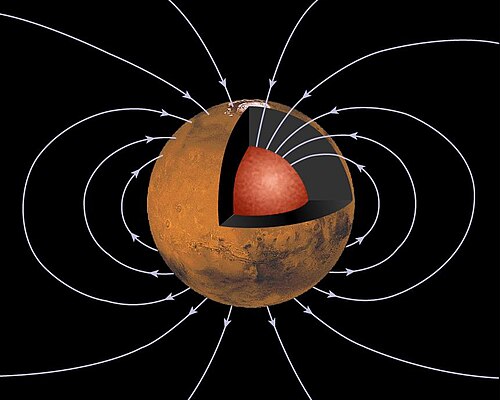
地球のような強力な全球的な磁場を持たない火星ですが、かつては内部でダイナモ(流体金属の運動によって磁場が発生する仕組み)が作動し、強力な磁気圏を有していたことが分かっています。現在の火星に残されているのは、過去の磁場の名残である「地殻磁気」のみです。本記事では、最新の探査データと隕石分析から明らかになった、火星の磁場の劇的な変遷について解説します。
Key Facts
- 古代の強力な磁場:約40億年前、火星には現在の地球に匹敵する強力な全球的磁場が存在していた。
- 南北の磁気格差:北半球の低地はほぼ無磁化しているが、南半球の地殻には強い残留磁気が残っている。
- ダイナモの停止:初期のダイナモは約40億〜39億年前に停止し、その後、一部の地域で弱い磁場が再活性化した可能性がある。
- 地表の磁気強度:衛星データよりも、着陸機(InSight)や隕石による地表レベルの測定値の方が高い磁気強度を示している。
火星ダイナモの歴史とタイムライン
火星の内部で磁場を生成していたダイナモは、惑星の歴史の中で段階的に変化しました。約42億〜43億年前には非常に強力な磁場が存在しており、これが火星初期の環境を保護していたと考えられています。
しかし、この初期ダイナモは、ヘラス、イシディス、アルギュレといった巨大盆地が形成される前(約40億〜39億年前)に停止したと推測されています。その後、ノアキス期後半からヘスペリア期にかけて、一部の火山地域(ティルレヌス山やシルティス・メジャーなど)で磁気的な痕跡が見られることから、小規模な「後期ダイナモ」が作動していたか、あるいは磁場が断続的に復活していた可能性が指摘されています。
![Timing of the Martian dynamo. Grey shading represents possible age constraints (in Ga years) for the early and late dynamo. Stars indicate new age constraints from MAVEN data. [a] Early dynamo before the formation of Hellas, Isidis, and Argyre. [b] The cessation of the early dynamo based on large basin population. [c] The age of ALH84001. [d] Late dynamo after the formation of the major basins.](/images/44/2d/442d3fb99dc9a9f47a8914e90063732378b8febfcd1575d45db98f6caf7148c7.jpg)
地殻に残された磁気の記憶
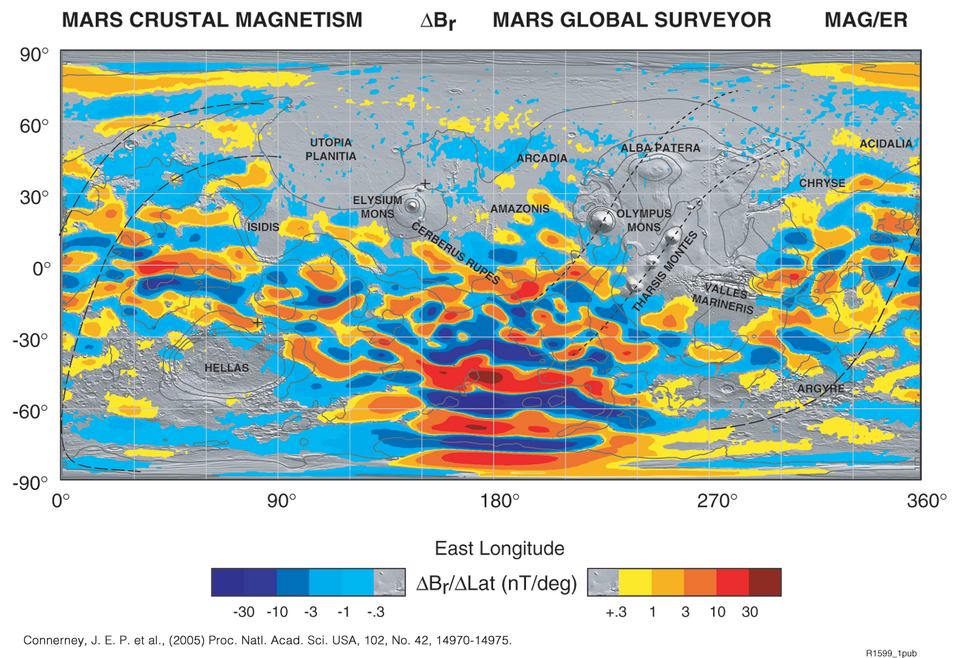
現在の火星を観測すると、磁場の分布に極端な偏りがあることが分かります。これを「磁気的な二分性」と呼びます。北半球の低地では磁気がほとんど検出されない一方で、南半球には強い残留磁気(岩石が冷却される際に当時の磁場を記録したもの)が縞状に分布しています。
この縞状のパターンについては、地球の海底拡大のようにプレートテクトニクスによる極性の反転が起きたという説や、岩脈の貫入によるものという説があります。一方で、最新のデータ解析(L1正則化などの手法)を用いると、縞模様ではなく「磁化された局所的なパッチ」として現れることが分かっており、火山活動や衝突イベントによる局所的な加熱が原因である可能性も検討されています。
多角的な観測アプローチ:衛星・着陸機・隕石
火星の磁場研究は、異なるスケールのデータを用いることで精度を高めています。
衛星による広域観測
MGS(マーズ・グローバル・サーベイヤー)やMAVENといった衛星は、高度90〜6000kmから磁場を測定しています。これにより、南半球の古い地殻(約42〜43億年前)に強い磁気が残っている一方で、北半球や巨大盆地、オリンポス山などの火山地帯には磁気的な特徴が乏しいことが判明しました。
地表での直接測定
着陸機InSightがエリシウム平原で測定した地殻磁場は約2μTであり、これは同じ地点の衛星推定値(約200nT)よりも1桁高い値でした。この強い磁気は、地表の若い溶岩流の下にある、より古いノアキス期の基盤岩に由来するものと考えられています。
隕石による古地磁気分析
地球に飛来した火星隕石は、当時の磁場を記録する貴重なタイムカプセルです。特にALH84001隕石の炭酸塩分析からは、約41〜39億年前に約50μTという非常に強い磁場があったことが示唆されました。一方、より新しいナクライト隕石(約14億年前)では約5μTと弱くなっており、時間の経過とともに磁場が減衰した過程を裏付けています。
ダイナモを動かしていたメカニズムと停止の謎
火星のダイナモを駆動していたのは、初期の高温コアにおける熱対流であったと考えられています。その後、コアの冷却に伴い、内核の結晶化による潜熱や化学的な対流(軽い元素の移動)が役割を果たした可能性があります。ただし、InSightのデータでは固体内核の存在が確定しておらず、熱対流のみで駆動していた可能性も残されています。
ダイナモがなぜ停止したのかについては、マントルの冷却速度の変化や、ノアキス期に発生した巨大衝突によってコアとマントルの境界における熱流が減少したためという説が有力です。最新のモデルでは、外核が液体状態で維持されているため、将来的に再び磁場が活性化する可能性も議論されています。
| 駆動源 | メカニズム | 必要条件・特徴 |
|---|---|---|
| 熱的要因 | 熱対流 / マグマオーシャン | 高温状態、高硫黄含有量、または導電性溶融物の存在 |
| 熱化学的要因 | 化学対流(上向き/下向き結晶化) | 低温状態、低硫黄または高硫黄(結晶化方向による)、将来的な再活性の可能性 |
| 機械的要因 | 巨大衝突イベント | コア・マントル境界の熱流を減少させ、ダイナモを停止させる要因となる |
Frequently Asked Questions
なぜ現在の火星には全球的な磁場がないのですか?
内部のコアが冷却され、ダイナモを駆動させるための十分な対流(熱的または化学的な流れ)が維持できなくなったためと考えられています。
南半球にだけ強い磁気が残っているのはなぜですか?
北半球で起きた巨大衝突(ボレアリス衝突)による熱的な消磁や、マントル対流の偏りによって片方の半球のみでダイナモが作動していた可能性などが議論されています。
火星隕石からどのようにして昔の磁場がわかるのですか?
岩石がキュリー温度以下に冷却される際、当時の周囲の磁場方向と強さを記録する「熱残留磁気(TRM)」という性質を利用して分析しています。
将来的に火星の磁場が復活することはありますか?
一部のモデルでは、液体状態の外核が依然として存在しているため、条件が整えば再びダイナモが作動し、磁場が再活性化する可能性があると予測されています。
InSightのデータは衛星データとどう違うのですか?
衛星は広範囲を俯瞰するため平均的な値になりますが、InSightは地表で直接測定するため、局所的な強い磁気源(地下の古い基盤岩など)をより正確に捉えることができます。
References
- Langlais, Benoit; Thébault, Erwan; Houliez, Aymeric; Purucker, Michael E.; Lillis, Robert J. (2019). "A New Model of the Crustal Magnetic Field of Mars Using MGS and MAVEN". Journal of Geophysical Research: Planets. 124 (6): 1542–1569. :2019JGRE..124.1542L. :10.1029/2018JE005854. 2169-9100. 8793354. 35096494.
- Johnson, Catherine L.; Mittelholz, Anna; Langlais, Benoit; Russell, Christopher T.; Ansan, Véronique; Banfield, Don; Chi, Peter J.; Fillingim, Matthew O.; Forget, Francois; Haviland, Heidi Fuqua; Golombek, Matthew (March 2020). "Crustal and time-varying magnetic fields at the InSight landing site on Mars". Nature Geoscience. 13 (3): 199–204. :2020NatGe..13..199J. :10.1038/s41561-020-0537-x. 1752-0908. 211265951.
- Acuña, M. H.; Connerney, J. E. P.; F, N.; Ness; Lin, R. P.; Mitchell, D.; Carlson, C. W.; McFadden, J.; Anderson, K. A.; Rème, H.; Mazelle, C. (1999-04-30). "Global Distribution of Crustal Magnetization Discovered by the Mars Global Surveyor MAG/ER Experiment". Science. 284 (5415): 790–793. :1999Sci...284..790A. :10.1126/science.284.5415.790. 10221908.
- Milbury, C.; Schubert, G.; Raymond, C. A.; Smrekar, S. E.; Langlais, B. (2012). "The history of Mars's dynamo as revealed by modeling magnetic anomalies near Tyrrhenus Mons and Syrtis Major". Journal of Geophysical Research: Planets. 117 (E10) 2012JE004099. :2012JGRE..11710007M. :10.1029/2012JE004099. 2156-2202.
- Weiss, Benjamin P.; Vali, Hojatollah; Baudenbacher, Franz J.; Kirschvink, Joseph L.; Stewart, Sarah T.; Shuster, David L. (2002-08-15). "Records of an ancient Martian magnetic field in ALH84001". Earth and Planetary Science Letters. 201 (3): 449–463. :2002E&PSL.201..449W. :10.1016/S0012-821X(02)00728-8. 0012-821X.
- Shaw, John; Hill, Mimi J; Openshaw, Steven J (2001-08-15). "Investigating the ancient Martian magnetic field using microwaves". Earth and Planetary Science Letters. 190 (3): 103–109. :2001E&PSL.190..103S. :10.1016/S0012-821X(01)00381-8. 0012-821X.
- Volk, Michael W. R.; Fu, Roger R.; Mittelholz, Anna; Day, James M. D. (2021). "Paleointensity and Rock Magnetism of Martian Nakhlite Meteorite Miller Range 03346: Evidence for Intense Small-Scale Crustal Magnetization on Mars". Journal of Geophysical Research: Planets. 126 (5) e2021JE006856. :2021JGRE..12606856V. :10.1029/2021JE006856. 2169-9100. 236613272.
- Cisowski, S. M (1986-06-01). "Magnetic studies on Shergotty and other SNC meteorites". Geochimica et Cosmochimica Acta. 50 (6): 1043–1048. :1986GeCoA..50.1043C. :10.1016/0016-7037(86)90386-8. 0016-7037.
- Gattacceca, Jérôme; Hewins, Roger H.; Lorand, Jean-Pierre; Rochette, Pierre; Lagroix, France; Cournède, Cécile; Uehara, Minoru; Pont, Sylvain; ; Scorzelli, Rosa B.; Hombourger, Chrystel (2013). "Opaque minerals, magnetic properties, and paleomagnetism of the Tissint Martian meteorite". Meteoritics & Planetary Science. 48 (10): 1919–1936. :2013M&PS...48.1919G. :10.1111/maps.12172. 1945-5100. 6599459.
- Antretter, Maria; Fuller, Mike; Scott, Edward; Jackson, Mike; Moskowitz, Bruce; Solheid, Peter (2003). "Paleomagnetic record of Martian meteorite ALH84001". Journal of Geophysical Research: Planets. 108 (E6): 5049. :2003JGRE..108.5049A. :10.1029/2002JE001979. 2156-2202.
📸 フォトギャラリー