地球の表面ではプレートが絶えず動いていますが、プレートの境界から遠く離れた場所で激しい火山活動が起こることがあります。ハワイやアイスランドのようなホットスポット、あるいはデカン・トラップのような巨大火成岩岩省の形成を説明するために提唱されたのが「マントルプルーム」という概念です。これは、地球深部から上昇する高温の物質の柱が、地表付近で溶融してマグマとなり、異常な火山活動を引き起こすというメカニズムです。
Key Facts
- 発生源: 地下約2,900kmにあるコア・マントル境界(CMB)で高温物質が生成されるとされる。
- 構造: 細長い「管(コンジット)」と、上端に広がるキノコ状の「頭部」からなる。
- 役割: 地球内部の膨大な熱(約44テラワット)を深部から表面へ運ぶ輸送路と考えられている。
- 証拠: 地震波トモグラフィーにより、一部のホットスポット直下に垂直な高温領域が可視化されている。
- 論争: 深部からの上昇とする「プルーム説」に対し、浅いマントルの対流で説明する「プレート説」が存在する。
マントルプルームの構造と形成メカニズム
マントルプルームは、1963年にJ.ツゾ・ウィルソンによって提唱され、その後W.ジェイソン・モーガンらによって発展しました。この理論では、コア・マントル境界で過熱された物質が核となり、浮力によってマントルを上昇します。プルームは単なる連続的な流れではなく、高温の物質の塊(バブル)が連続的に上昇するイメージに近いものです。
上昇するプルームは、下部の細い管と、上部の球状に広がった頭部を持つ「キノコ状」の形態をとります。これは、中心部の高温物質が周囲よりも速く上昇するためです。この頭部が地殻に到達すると、部分溶融が起こり、地表にホットスポットを形成します。
![Hydrodynamic simulation of a single "finger" of the Rayleigh–Taylor instability, a possible mechanism for plume formation.[19] In the third and fourth frame in the sequence, the plume forms a "mushroom cap". Note that the core is at the top of the diagram and the crust is at the bottom.](/images/47/01/47013746bd6ce4a281b1db389c82a5e46fefc7110c5dc80dff7c317ae34246fd.gif)
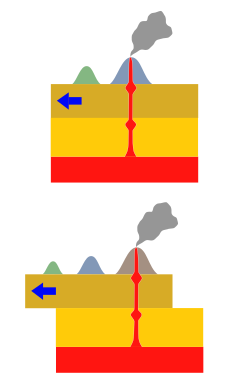
かつてはプルームが固定された位置にあると考えられており、その上をプレートが移動することで、ハワイ・エンペラー海山列のような火山島列が形成されると説明されてきました。しかし、近年の古地磁気データの解析により、プルーム自体も相対的に移動している可能性や、LLSVPs(大型低せん断速度領域)との関連性が指摘されています。
![A superplume generated by cooling processes in the mantle (LVZ = low-velocity zone)[1]](/images/8f/0a/8f0aec6fb4b400ae9b4bd686c0d9ce00d7ddb2947b3095e52b0e7ae832ca6c4f.png)
プルームの規模と周期
タンとソープの理論によれば、キノコ状プルームの頭部の直径は約2,000kmに達すると予測されています。また、下部マントルの加熱開始からプルーム形成までには約8.3億年、形成サイクルは約20億年かかるとされており、地球全体で約17個のプルームが存在すると推測されています。
地球内部の熱源と化学的特性
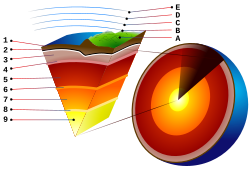
プルームの起点とされるコア・マントル境界は、地球内部で最も激しい温度差が存在する場所の一つです。外核の温度は、その直上のマントルよりも約1,000度高く、この熱伝導によってマントル底部が加熱され、浮力を得た物質が上昇し始めます。
また、ホットスポットから噴出する玄武岩(海洋島玄武岩:OIB)の化学組成を分析すると、中央海嶺の玄武岩とは異なる特徴が見られます。ここには、かつて沈み込んだプレートや大陸堆積物が深部まで運ばれ、再びプルームによって地表へ戻ってきたことを示す同位体シグネチャー(DMM, HIMU, EM1, EM2, FOZOなど)が含まれています。
![Calculated Earth's temperature vs. depth. Dashed curve: Layered mantle convection; Solid curve: Whole mantle convection.[26]](/images/a7/fe/a7fe6abd6594ce506f9a30911383184031ff150b4281e57ce6ecab9ce8f581ae.png)
物質の循環に関する対立する視点
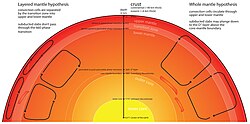
沈み込んだ物質の行方については、二つの主要な説があります。プルーム説では、物質がコア・マントル境界まで深く沈み込み、その後プルームに乗って上昇すると考えます。対してプレート説では、物質は浅いマントル内で再循環し、そこから火山活動に利用されると主張しています。
最新の観測データと理論の検証
2015年の研究では、膨大な地震データを用いたフル波形トモグラフィーにより、ピトケアン、サモア、ガラパゴスなどのホットスポット直下に、周囲より約400度高温な垂直プルームが可視化されました。これらのプルームは幅600〜800kmに及び、コア・マントル境界から深さ1,000km付近まで伸びていることが判明しました。
![An example of plume locations suggested by one recent group.[44] Figure from Foulger (2010).[36]](/images/f0/16/f016c462d9c62434e562c8c3d98b33c5310eaf46687b3fc3930b8c59684d160a.png)
この観測結果は、プルームが地球内部の熱輸送の主役である可能性を示唆しています。また、イエローストーンのようなホットスポットについても、近年の高精度な地震波データにより、下部マントルプルームの存在を支持する証拠が集まっています。
プルーム説 vs プレート説:大論争
21世紀に入り、「プルーム説」と「プレート説」の間で激しい議論(Great Plume Debate)が展開されています。批判側は、プルーム説が観測結果に合わせて後付けで修正され続けており、科学的な予測能力に欠けていると指摘しています。
プレート説では、以下のようなメカニズムでプレート境界以外での火山活動を説明しようとしています。
- 大陸の分裂やリソスフェアの薄層化
- 沈み込むプレート(スラブ)の断裂や剥離
- 浅いマントル内での小規模な対流
- 構造的な不連続面における応力の急激な変化
まとめ:地球内部構造の比較
| 比較項目 | プルーム説 (Plume Hypothesis) | プレート説 (Plate Hypothesis) |
|---|---|---|
| 主な熱源/要因 | コア・マントル境界の熱 | 浅いマントルの対流・プレートの挙動 |
| 物質の循環範囲 | 全マントル(深部まで循環) | 主に上部マントル(浅い循環) |
| ホットスポットの性質 | 深部から上昇する固定的な熱柱 | リソスフェアの亀裂や局所的な対流 |
| 主な根拠 | 地震波トモグラフィー、同位体分析 | プレート境界の力学、浅部地質構造 |
Frequently Asked Questions
マントルプルームとは具体的に何ですか?
地球の核とマントルの境界付近で加熱された岩石が、浮力によってゆっくりと地表に向かって上昇する高温の物質の柱のことです。地表に到達するとマグマとなり、火山活動を引き起こします。
ホットスポットとプルームはどう関係していますか?
プルームが地殻の直下に到達し、その熱で岩石が溶けてマグマが発生する場所が「ホットスポット」です。プレートがこの固定的な熱源の上を移動することで、火山島が列をなして形成されます。
なぜプルームの存在について論争があるのですか?
すべての火山活動をプルームだけで説明することが難しく、プレートの断裂や浅いマントルの対流といった他の要因で説明できるケースがあるためです。また、プルームの正確な形状や挙動について、モデルによって解釈が異なるためです。
地震波トモグラフィーで何がわかるのですか?
地震波の伝わり方の速度差を分析することで、地球内部の温度分布を可視化できます。高温の領域は地震波の速度が遅くなるため、これを解析することで深部から上昇するプルームの姿を捉えることができます。
プルームは本当に固定されているのでしょうか?
かつては固定されていると考えられていましたが、最新の研究では、プルームも周囲のマントルの流れに影響され、ゆっくりと移動していることが示唆されています。
References
- Based upon Figure 17 in Matyska, Ctirad; Yuen, David A. (2007). "Lower-mantle material properties and convection models of multiscale plumes". In ; Jurdy, D. M. (eds.). Plates, plumes, and planetary processes. . p. 159. 10.1.1.487.8049. :10.1130/2007.2430(08). .
{{}}: Cite uses deprecated parameter|citeseerx=() - "The question of mantle plumes". www.earthmagazine.org. Retrieved 2022-08-05.
- Wilson, J. Tuzo (8 June 1963). "Hypothesis of earth's behaviour". Nature. 198 (4884): 925–929. :1963Natur.198..925T. :10.1038/198925a0. 28014204.
- Duncan, Robert Ames; McDougall, Ian (1976). "Linear volcanism in French polynesia". Journal of Volcanology and Geothermal Research. 1 (3): 197–227. :1976JVGR....1..197D. :10.1016/0377-0273(76)90008-1. :1885/140344.
- Krishnamurti, Ruby; Howard, Louis N. (1981). "Large-scale flow generation in turbulent convection". Proceedings of the National Academy of Sciences. 78 (4): 1981–1985. :1981PNAS...78.1981K. :10.1073/pnas.78.4.1981. 319265. 16592996.
- Larson, R.L. (1991). "Latest pulse of Earth: Evidence for a mid-Cretaceous superplume". Geology. 19 (6): 547–550. :1991Geo....19..547L. :10.1130/0091-7613(1991)019<0547:LPOEEF>2.3.CO;2.
- French, Scott W.; Romanowicz, Barbara (2015). "Broad plumes rooted at the base of the Earth's mantle beneath major hotspots". Nature. 525 (7567): 95–99. :2015Natur.525...95F. :10.1038/nature14876. 0028-0836. 26333468. 205245093.
- Davies, D.R.; Goes, S.; Sambridge, M. (February 2015). "On the relationship between volcanic hotspot locations, the reconstructed eruption sites of large igneous provinces and deep mantle seismic structure". Earth and Planetary Science Letters. 411: 121–130. :2015E&PSL.411..121D. :10.1016/j.epsl.2014.11.052.
- Bono, Richard K.; Tarduno, John A.; Bunge, Hans-Peter (2019-07-29). "Hotspot motion caused the Hawaiian-Emperor Bend and LLSVPs are not fixed". Nature Communications. 10 (1): 3370. :2019NatCo..10.3370B. :10.1038/s41467-019-11314-6. 2041-1723. 6662702. 31358746.
- Stein, M. & Hofmann, A.W. (1994). "Mantle plumes and episodic continental growth". Nature. 372 (6501): 63–68. :1994Natur.372...63S. :10.1038/372063a0. 4356576.
📸 フォトギャラリー