私たちの太陽系は、静止しているわけではなく、銀河系の中を絶えず移動しています。その旅路において、現在私たちが通り抜けているのが局所星間雲(Local Interstellar Cloud: LIC)と呼ばれる巨大なガスと塵の集まりです。「ローカル・フラフ(Local Fluff)」という愛称でも知られるこの領域は、太陽系のすぐ外側に広がる宇宙の環境を形作っています。
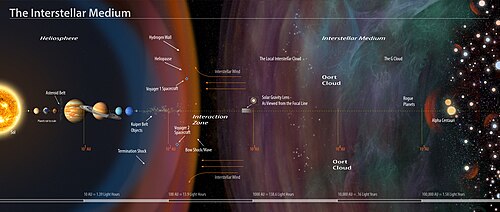
太陽系は、まず太陽風が届く範囲であるヘリオスフィア(太陽圏)に包まれていますが、その境界を越えた先に、この局所星間雲を含む「極局所星間物質(VLISM)」という領域が広がっています。私たちは今、この希薄な雲の中を航行しているのです。

Key Facts
- 正体:太陽系が現在通過している、水素密度がわずかに高い星間ガス雲。
- 規模:直径は約30光年(約9.2パーセク)に及ぶ。
- 温度:約7,000Kと高温だが、密度が極めて低いため熱容量は小さい。
- 位置関係:低密度領域である「局所バブル」の内部に位置している。
- 今後の予測:太陽系は今後1,900年以内にこの雲を完全に脱出すると推定されている。
宇宙の階層構造と局所星間雲の正体
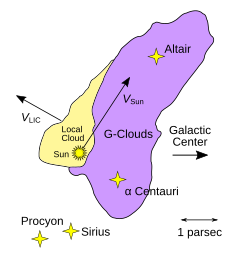
宇宙の構造を大きな視点から見ると、太陽系は局所バブル(Local Bubble)という、銀河系の中でも特に密度の低い巨大な空間の中にあります。そして、そのバブルの中に点在する、比較的密度の高い領域の一つが局所星間雲です。
太陽系がこの雲に進入したのは、およそ1万年前のことと考えられています。現在は、局所星間雲の内部にいるのか、あるいは隣接する「Gクラウド」という別の雲との境界領域に位置しているのかについて、研究者の間で議論が続いています。
物理的な特性と環境
局所星間雲の温度は約7,000Kに達し、これは太陽の表面温度に近い非常に高い数値です。しかし、1立方センチメートルあたりに存在する原子数はわずか0.3個と極めて希薄です。このため、温度は高くても物質としての熱を保持する能力(比熱容量)は非常に低くなっています。
この密度は、天の川銀河の平均的な星間物質(0.5個/cm³)よりは低いものの、周囲の局所バブル(0.05個/cm³)に比べれば約6倍も濃い領域と言えます。地球の大気圏外(高度450km)に存在する分子数(約5,000万個/cm³)と比較すると、いかに宇宙空間が空虚であるかが分かります。
星間雲のダイナミクスと地球への影響
この雲は、星形成領域である「さそり座ーケンタウルス座連星系」から外側に向かって流れ出しており、その方向は太陽系の移動方向とはほぼ直交しています。また、南極の氷床から検出された「鉄60(60Fe)」という放射性同位体は、この局所星間雲に関連する物質であると考えられています。
磁場による保護と相互作用
ボイジャー2号の観測データによると、この領域の磁場強度は当初の予想(180〜250ピコテスラ)を大幅に上回る370〜550ピコテスラであったことが判明しました。この強い磁場こそが、局所バブルを形成した激しい恒星風などの圧力から、局所星間雲が消滅せずに維持されている理由であるという説があります。
なお、星間雲が地球に直接的な影響を与えることはほとんどありません。なぜなら、太陽から吹き出す太陽風と強力な磁場がバリアとなり、星間物質の侵入を遮断しているからです。NASAのIBEX(インターステラー・バウンダリー・エクスプローラー)などの衛星は、この太陽圏の境界でどのような相互作用が起きているかを詳しく調査しています。
局所星間雲の概要まとめ
| 項目 | 詳細データ |
|---|---|
| 別称 | ローカル・フラフ(Local Fluff) |
| 推定サイズ | 約30光年 |
| 温度 | 約7,000 K |
| 粒子密度 | 約0.3 原子/cm³ |
| 所属領域 | 局所バブル > 極局所星間物質(VLISM) |
| 脱出までの期間 | 最大1,900年以内(推定) |
Frequently Asked Questions
局所星間雲とは具体的に何でできているのですか?
主に水素などの希薄なガスと微細な塵(ダスト)で構成されています。密度は非常に低いですが、宇宙空間の平均的な環境に比べれば、わずかに物質が濃い領域です。
太陽系がこの雲を抜けると何が起こりますか?
太陽系が雲を脱出し、別の領域(Gクラウドなど)へ移行しても、地球の環境に劇的な変化が起こる可能性は低いと考えられています。太陽圏(ヘリオスフィア)が外部からの物質を遮断し続けているためです。
なぜ「フラフ(綿毛)」と呼ばれているのですか?
非常に密度が低く、ふわふわとした希薄なガス状の構造であることから、比喩的に「Local Fluff」という愛称で呼ばれています。
ボイジャー探査機はこの雲の中にいますか?
はい。ボイジャー1号と2号はすでに太陽圏(ヘリオスフィア)の境界を越えて星間空間に到達しており、局所星間物質のデータを直接的に観測しています。
この雲はどこから来たものなのですか?
「さそり座ーケンタウルス座連星系」という星形成領域から流れ出してきたものと考えられています。
References
- "NAME LIC". . . Retrieved March 15, 2014.
- Gargaud, Muriel; et al., eds. (2011). "Solar Neighborhood". Encyclopedia of Astrobiology. pp. 1526–1527. :10.1007/978-3-642-11274-4_1460. . Retrieved 2022-07-01.
- Gilster, Paul (September 1, 2010). "Into the Interstellar Void". Centauri Dreams.
- Linsky, Jeffrey (2020-03-23), "What lies immediately outside of the heliosphere in the very local interstellar medium (VLISM): morphology of the Local Interstellar Cloud, its hydrogen hole, Stromgren Shells, and 60Fe accretion", Egu General Assembly Conference Abstracts, Copernicus GmbH: 1410, :2020EGUGA..22.1410L, :10.5194/egusphere-egu2020-1410, 226032795
- "Our Local Galactic Neighborhood". Interstellar Probe Project. NASA. 2000. Archived from the original on 2013-11-21. Retrieved 2012-08-08.
- Frisch PC, et al. (September 2011). "The Interstellar Medium Surrounding the Sun". Annual Review of Astronomy and Astrophysics. 49 (1): 252. :2011ARA&A..49..237F. :10.1146/annurev-astro-081710-102613. Retrieved 2021-12-28.
- Linsky JL, et al. (November 18, 2019). "The Interface between the Outer Heliosphere and the Inner Local ISM". The Astrophysical Journal. 886 (1): 41. :1910.01243. :2019ApJ...886...41L. :10.3847/1538-4357/ab498a. 203642080.
- Linsky JL, et al. (March 2020). "New results concerning the environment of the heliosphere, nearby interstellar clouds, and physical processes in the inter–cloud medium". Journal of Physics: Conference Series. 1620 (1) 012010. :2020JPhCS1620a2010L. :10.1088/1742-6596/1620/1/012010. 225188522.
- "Near-Earth Supernovas". NASA Science. NASA. January 6, 2003. Retrieved February 1, 2011.
- Boulanger, F.; et al. (2000). "Course 7: Dust in the Interstellar Medium". In ; Lequeux, J.; David, F. (eds.). Infrared Space Astronomy, Today and Tomorrow. Les Houches Physics School. Grenoble, France. August 3–28, 1998. Vol. 70. p. 251. :2000isat.conf..251B.
📸 フォトギャラリー