私たちの身の回りにある多くの物体は、力を加えると変形し、その力を取り除くと元の形状に戻る性質を持っています。この現象を物理学的に記述したのがフックの法則です。単純なばねの伸びから、巨大な建築構造物の設計、さらにはナノスケールの材料開発に至るまで、この法則は現代の工学と物理学の基礎となっています。
Key Facts
- 基本原理:弾性体への荷重による変形量は、加えられた力に比例する。
- 適用範囲:材料が「弾性限界(降伏点)」を超えるまで有効であり、それを超えると永久変形(塑性変形)が起こる。
- 主要指標:材料の硬さを表すヤング率(縦弾性係数)や、せん断に対する抵抗を示すせん断弾性係数が重要となる。
- 汎用性:マクロな機械部品から、ナノメートル単位のポリマー構造まで幅広く適用される。
弾性の基礎概念と線形ばね
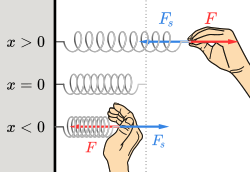
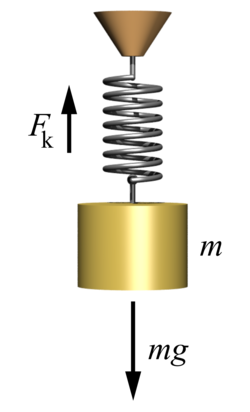
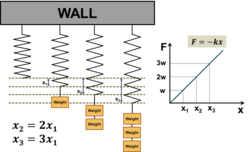
フックの法則の最もシンプルな形態は、線形ばねにおける力と変位の関係です。ばねに力を加えたとき、その伸び(または縮み)は加えた力に正比例します。この比例定数をばね定数(k)と呼び、材料の剛性を決定づけます。
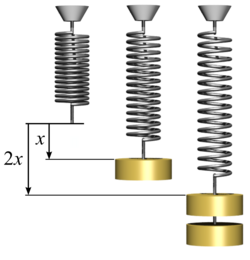
この原理は、単に引っ張る力だけでなく、回転させる力(トルク)に対しても適用されます。ねじりばねの場合、回転角に比例して復元トルクが発生します。このような線形応答は、物理学における「調和振動子」のモデルとして、質点ばね系などの解析に不可欠です。
実社会への応用例
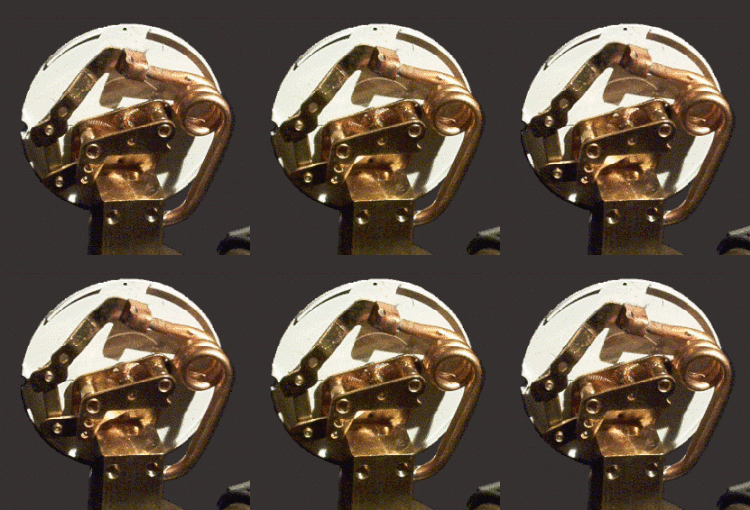
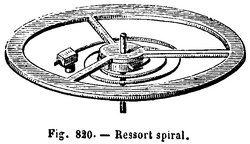
フックの法則は、精密な計測機器や時間計測デバイスに組み込まれています。例えば、ガス圧によって金属管がほどける仕組みを利用したブルドン管圧力計や、一定の周期で振動し時計の精度を保つ機械式時計のテンプ(バランスホイール)などは、すべてこの法則に基づいています。
連続体力学における応力と歪み
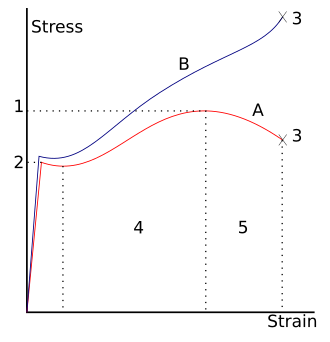
物体を単なる「ばね」ではなく、連続した物質の集まりとして捉える場合、力は応力(単位面積あたりの力)として、変形は歪み(元の長さに対する変化率)として定義されます。この関係を一般化したものが、連続体力学におけるフックの法則です。
材料に負荷をかけた際、ある一点を超えると元の形に戻らなくなる「降伏点」が存在します。フックの法則が成立するのは、原点からこの降伏点までの線形領域のみであり、それ以降は歪み硬化やネッキングといった塑性変形の領域へと移行します。
等方性材料と弾性係数
あらゆる方向に対して同じ物理的性質を持つ「等方性材料」では、ヤング率(E)とポアソン比(ν)という2つの定数を用いて、応力と歪みの関係を記述できます。また、体積変化に対する抵抗を示す体積弾性率(K)や、形状変化に対する抵抗を示すせん断弾性率(G)などのパラメータを用いて、より複雑な3次元的な変形を解析することが可能です。
高度な材料特性と異方性
現実の材料は必ずしも等方的なわけではありません。方向によって弾性特性が異なる「異方性材料」の場合、応力と歪みの関係は単純な係数ではなく、剛性テンソル(またはコンプライアンステンソル)という行列形式で表現されます。
- 直交異方性材料:3つの直交する軸方向でそれぞれ異なる性質を持つ材料。
- 横等方性材料:ある特定の対称軸を中心に回転させたときに性質が不変である材料。
近年では、この法則が極微小な世界でも成立することが証明されています。例えば、ナノスケールのポリマーばねにおいても、荷重に対する線形応答が確認されており、ナノテクノロジー分野での設計指針となっています。
![(a) Schematic of a polymer nanospring. The coil radius, R, pitch, P, length of the spring, L, and the number of turns, N, are 2.5 μm, 2.0 μm, 13 μm, and 4, respectively. Electron micrographs of the nanospring, before loading (b-e), stretched (f), compressed (g), bent (h), and recovered (i). All scale bars are 2 μm. The spring followed a linear response against applied force, demonstrating the validity of Hooke's law at the nanoscale.[5]](/images/8c/74/8c7429600d19c28477ec3d17b4950ab7bc41fc0b3ec83f131c5a72e4cfec32e3.jpg)
弾性パラメータのまとめ
| 係数名 | 記号 | 物理的意味 |
|---|---|---|
| ヤング率(縦弾性係数) | E | 引張または圧縮に対する材料の剛性 |
| せん断弾性係数 | G (μ) | せん断変形(ずれ)に対する抵抗力 |
| 体積弾性率 | K | 全方向からの圧縮による体積変化への抵抗 |
| ポアソン比 | ν | 縦方向に伸びた際の横方向の収縮割合 |
| ラメの定数 | λ, μ | 等方性弾性体の応力-歪み関係を記述する定数 |
Frequently Asked Questions
フックの法則はどのような時に適用できなくなりますか?
材料に加えた力が「弾性限界(降伏点)」を超えた場合に適用できなくなります。この点を超えると、力を取り除いても物体が元の形状に戻らない塑性変形が発生するため、線形な比例関係は崩れます。
ヤング率が高い材料とはどのような特性を持ちますか?
ヤング率が高い材料は、同じ力を加えても変形しにくい、つまり「剛性が高い」ことを意味します。例えば、ゴムよりも鋼鉄の方が圧倒的にヤング率が高いため、変形しにくい性質を持ちます。
ポアソン比とは具体的に何を指しますか?
物体を縦方向に引っ張ったとき、同時に横方向が細くなる現象があります。この「縦方向の歪み」に対する「横方向の歪み」の比率をポアソン比と呼びます。
ナノスケールの物体でもフックの法則は成り立ちますか?
はい、成り立ちます。研究により、ポリマーナノばねなどの極微小構造においても、適用される力に対して線形な応答を示すことが確認されており、ナノスケールでもこの法則の妥当性が証明されています。
等方性材料と異方性材料の違いは何ですか?
等方性材料は、どの方向から力を加えても同じ弾性特性(ヤング率など)を示します。一方、異方性材料は、方向によって硬さや変形しやすさが異なります。木材や複合材料などがその代表例です。
References
- ↑ The anagram was given in alphabetical order, ceiiinosssttuv, representing Ut tensio, sic vis – "As the extension, so the force": (1996). Invention by Design: How Engineers Get from Thought to Thing. Cambridge, MA: Harvard University Press. p. 11. .
- ↑ See http://civil.lindahall.org/design.shtml, where one can find also an anagram for .
- ↑ , De Potentia Restitutiva, or of Spring. Explaining the Power of Springing Bodies, London, 1678.
- ↑ Young, Hugh D.; Freedman, Roger A.; Ford, A. Lewis (2016). Sears and Zemansky's University Physics: With Modern Physics (14th ed.). Pearson. p. 209.
- ↑ Ushiba, Shota; Masui, Kyoko; Taguchi, Natsuo; Hamano, Tomoki; Kawata, Satoshi; Shoji, Satoru (2015). "Size dependent nanomechanics of coil spring shaped polymer nanowires". Scientific Reports. 5 17152. :2015NatSR...517152U. :10.1038/srep17152. 4661696. 26612544.
- ↑ Belen'kii; Salaev (1988). "Deformation effects in layer crystals". Uspekhi Fizicheskikh Nauk. 155 (5): 89. :10.3367/UFNr.0155.198805c.0089.
- ↑ Mouhat, Félix; Coudert, François-Xavier (5 December 2014). "Necessary and sufficient elastic stability conditions in various crystal systems". Physical Review B. 90 (22) 224104. :1410.0065. :2014PhRvB..90v4104M. :10.1103/PhysRevB.90.224104. 1098-0121. 54058316.
- ↑ Vijay Madhav, M.; Manogaran, S. (2009). "A relook at the compliance constants in redundant internal coordinates and some new insights". J. Chem. Phys. 131 (17): 174112–174116. :2009JChPh.131q4112V. :10.1063/1.3259834. 19895003.
- ↑ Ponomareva, Alla; Yurenko, Yevgen; Zhurakivsky, Roman; Van Mourik, Tanja; Hovorun, Dmytro (2012). "Complete conformational space of the potential HIV-1 reverse transcriptase inhibitors d4U and d4C. A quantum chemical study". Phys. Chem. Chem. Phys. 14 (19): 6787–6795. :2012PCCP...14.6787P. :10.1039/C2CP40290D. 22461011.
- ↑ Symon, Keith R. (1971). "Chapter 10". Mechanics. Reading, Massachusetts: Addison-Wesley. .
📸 フォトギャラリー