エストラジオール(Estradiol、略称:E2)は、人体において最も強力な活性を持つエストロゲンの一種であり、主に女性の生殖機能や身体的特徴の形成に不可欠なステロイドホルモンです。化学的にはEstra-1,3,5(10)-triene-3,17β-diolという名称で知られ、女性だけでなく男性の身体においても重要な役割を果たしています。
このホルモンは、単に生殖器系に作用するだけでなく、骨密度の維持、皮膚の健康、神経系の保護、さらには心血管系の調節など、全身の多岐にわたる組織に影響を及ぼします。

Key Facts
- 主要な役割: 女性の二次性徴の形成、月経周期の調節、生殖能力の維持。
- 化学的性質: 分子式 C18H24O2、モル質量 272.38 g/mol のステロイド化合物。
- 代謝経路: 主に肝臓で水酸化、硫酸抱合、グルクロン酸抱合を経て代謝される。
- 血中挙動: 約98%がタンパク質(アルブミンやSHBG)と結合しており、遊離状態にあるのはわずか2%である。
- 投与経路による半減期: 経口投与では13〜20時間、経皮ジェルでは36.5時間と投与法により大きく異なる。
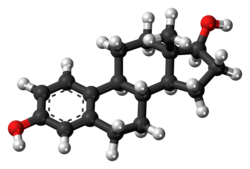
エストラジオールの生合成と化学的特性
エストラジオールは、コレステロールを起点とする複雑なステロイド合成経路(ステロイドジェネシス)を通じて生成されます。この過程で、プレグネノロンやプロゲステロンなどの前駆体を経て、最終的にエストラジオールへと変換されます。
![Human steroidogenesis, showing estradiol at bottom right.[60]](/images/df/e0/dfe05c29dcaaa3873d977481900b01859735b3faeabc5c2093f993d13f28bfcf.webp)
生体内での分布において、エストラジオールは高いタンパク質結合率を持ちます。具体的には、血中のアルブミンに約60%、性ホルモン結合グロブリン(SHBG)に約38%が結合しており、実際に生物学的な活性を持つ「遊離エストラジオール」はごく一部に限定されています。
月経周期における血中濃度の変動
女性の体内では、月経周期に合わせてエストラジオールの濃度がダイナミックに変動します。卵胞期(周期の初期)には比較的低いレベルで推移しますが、排卵直前の「プレオブラトリー・ピーク」において急激に上昇し、その後黄体期に入ると再び変動します。
![Estradiol levels across the menstrual cycle in 36 normally cycling, ovulatory women, based on 956 specimens.[72] The horizontal dashed lines are the mean integrated levels for each curve. The vertical dashed line in the center is mid-cycle.](/images/54/51/5451828438811a2581dd85ff800bda53537b6ed01c0162044f8b06d3c9d06449.png)
これらの変動は、卵胞の成熟や子宮内膜の増殖を制御するために不可欠です。一方で、閉経後の女性では卵巣機能の低下に伴い、血中濃度は著しく減少します。
![Reference ranges for the blood content of estradiol during the menstrual cycle - The ranges denoted By biological stage may be used in closely monitored menstrual cycles in regard to other markers of its biological progression, with the time scale being compressed or stretched to how much faster or slower, respectively, the cycle progresses compared to an average cycle. - The ranges denoted Inter-cycle variability are more appropriate to use in unmonitored cycles with only the beginning of menstruation known, but where the woman accurately knows her average cycle lengths and time of ovulation, and that they are somewhat averagely regular, with the time scale being compressed or stretched to how much a woman's average cycle length is shorter or longer, respectively, than the average of the population. - The ranges denoted Inter-woman variability are more appropriate to use when the average cycle lengths and time of ovulation are unknown, but only the beginning of menstruation is given.[92]](/images/4d/64/4d645e862c0df60bc8315cf00116dc9db20422261504302515d9b1da4965caa0.png)
生体への影響と生理的機能
エストラジオールは、細胞内のエストロゲン受容体(ER)や膜結合型のGタンパク質共役エストロゲン受容体(GPER)に結合することで、さまざまな生理作用を引き起こします。
生殖系と身体的発達
女性においては、乳腺の発達や子宮内膜の増殖を促進し、生殖能力を維持します。男性においても、骨の成熟や精子の生存維持に関与するなど、適切なレベルのエストラジオールが存在することが重要です。
その他の組織への作用
- 骨格系: 骨吸収を抑制し、骨密度の維持に寄与します。
- 神経系: 酸化ストレスによる神経細胞死からの保護作用や、気分調節に関わるセロトニン系への影響が報告されています。
- 心血管系: 血管の弾力性維持や脂質代謝に影響を与えます。
エストラジオールの血中濃度リファレンス
| 対象グループ | 状態・フェーズ | 参考濃度範囲 (pg/mL) |
|---|---|---|
| 成人男性 | 通常時 | 14 – 55 |
| 成人女性 | 卵胞期(5日目) | 19 – 140 |
| 成人女性 | 排卵前ピーク | 110 – 410 |
| 成人女性 | 黄体期 | 19 – 160 |
| 閉経後女性 | 通常時 | < 35 |
| 妊婦 | 第1三半期 | 1,000 – 5,000 |
| 妊婦 | 第3三半期 | 10,000 – 40,000 |
Frequently Asked Questions
エストラジオールとエストロンの違いは何ですか?
エストラジオール(E2)は最も活性が強く、主に生殖年齢の女性で分泌されます。一方、エストロン(E1)は活性が比較的弱く、閉経後の女性において主要なエストロゲンとなります。
血中濃度の測定で「遊離」と「総量」どちらが重要ですか?
多くの検査では総量(タンパク結合分を含む)を測定しますが、実際に組織に作用するのはタンパク質と結合していない「遊離エストラジオール」です。個々のSHBG濃度によって、総量と遊離量の比率は異なります。
妊娠中のエストラジオール濃度はどう変化しますか?
妊娠に伴い、エストラジオール濃度は劇的に上昇します。第1三半期から第3三半期にかけて、数千から数万pg/mLという非常に高いレベルに達し、胎盤などの影響を受けます。
エストラジオールは肝臓でどのように処理されますか?
主に肝臓のシトクロムP450(CYP1A2, CYP3A4, CYP2C9など)という酵素によって水酸化され、その後、硫酸抱合やグルクロン酸抱合を受けて水溶性に変換され、尿や便から排出されます。
📸 フォトギャラリー