生態学(Ecology)とは、生物同士の関わりや、生物とそれを取り巻く非生物的な環境との相互関係を研究する自然科学の一分野です。語源は古代ギリシャ語で「家」を意味する「oîkos」と「学問」を意味する「-logía」に由来しており、地球という大きな家の中で生命がどのように共存しているかを探求します。
この学問は単なる生物観察にとどまらず、個体から地球全体の生物圏に至るまで、異なるスケールでの組織化を分析します。また、進化生物学や遺伝学、行動学、生物地理学といった隣接分野と密接に連携しており、生物の分布やバイオマス(生物量)、個体数の変動などを環境の文脈から読み解きます。
Key Facts
- 多層的な分析: 個体、個体群、群集、生態系、そして生物圏という階層構造で生命現象を捉える。
- 相互依存のメカニズム: 競争、協力、捕食、寄生などの相互作用が生物の生存と分布を決定する。
- エネルギーの流れ: 太陽エネルギーを起点とした食物網を通じて、物質とエネルギーが循環している。
- 環境への適応: 生物は環境に合わせて進化するだけでなく、自ら環境を改変することもある(ニッチ構築)。
- 実用的応用: 保全生物学や天然資源管理、湿地管理など、地球環境の維持に不可欠な知見を提供する。
生命の組織化と階層構造
生態学では、生命を捉える視点を以下の階層に分けて整理します。まず、単一の個体から始まり、同じ種の集まりである個体群(Population)、異なる種が共存する群集(Community)へと視点を広げます。さらに、それら生物群集と非生物的な環境(水、土壌、気候など)を合わせた単位を生態系(Ecosystem)と呼び、最終的に地球上のすべての生態系を包含する生物圏(Biosphere)へと至ります。
生物が生存する場所は単なる「住処」ではありません。ハビタット(Habitat)が物理的な居住地を指すのに対し、ニッチ(Niche)はその生物が生態系の中で果たす役割や、利用する資源の範囲を指します。興味深いことに、一部の生物は自らの活動によって環境を物理的に作り変える「ニッチ構築」を行います。
例えば、サンゴは炭酸カルシウムの骨格を形成することで、自らの生存基盤を築くだけでなく、他の多くの海洋生物に住処を提供し、豊かな生物多様性を創出しています。
![Biodiversity of a coral reef. Corals adapt to and modify their environment by forming calcium carbonate skeletons. This provides growing conditions for future generations and forms a habitat for many other species.[9]](/images/4d/7e/4d7e6f22100f31ecdc703f1f878e26b5a12520e16693cc48c33d9f4c815ae1e8.jpg)
また、シロアリの塚のような構造物は、内部の温度やガス交換を精密に制御し、コロニー全体の生理機能を維持するための高度な環境制御システムとして機能しています。
![Termite mounds with varied heights of chimneys regulate gas exchange, temperature and other environmental parameters that are needed to sustain the internal physiology of the entire colony.[24][25]](/images/52/5c/525cdc3e15fbcb4fe5e304d518b28becce80c02be8dad4c5ecb8e87a8895e8d9.jpg)
生物間の相互作用とエネルギー循環
生態系の中では、エネルギーと物質が複雑なネットワークを通じて移動しています。これを食物網(Food Web)と呼びます。植物などの生産者が光合成によってエネルギーを取り込み、それを草食動物、さらに肉食動物へと受け渡していく栄養段階(Trophic Levels)が形成されます。
多くの陸上生態系では、植物のバイオマスが最大となるピラミッド構造を成しますが、湿地などの一部の環境では、植物の寿命や生産性の違いにより、厳格なピラミッド形状にならない場合もあります。
![A trophic pyramid (a) and a food-web (b) illustrating ecological relationships among creatures that are typical of a northern boreal terrestrial ecosystem. The trophic pyramid roughly represents the biomass (usually measured as total dry-weight) at each level. Plants generally have the greatest biomass. Names of trophic categories are shown to the right of the pyramid. Some ecosystems, such as many wetlands, do not organize as a strict pyramid, because aquatic plants are not as productive as long-lived terrestrial plants such as trees. Ecological trophic pyramids are typically one of three kinds: 1) pyramid of numbers, 2) pyramid of biomass, or 3) pyramid of energy.[39]: 598](/images/64/1f/641fb005c2fd427e80c5bc74a471c51af1c5c94180e946eb5520fa652ed91421.jpg)
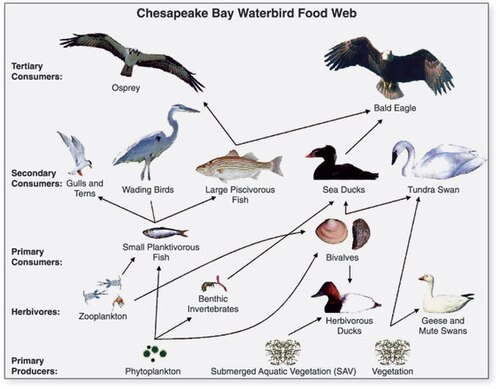
水鳥などの特定の環境における食物網は、地域の資源状況を反映した複雑なつながりを持っています。
共進化と適応戦略
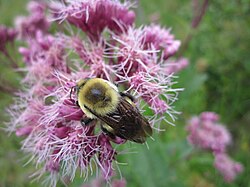
生物は互いに影響を与え合いながら進化します。これを共進化(Coevolution)と呼びます。例えば、特定の花とそれを媒介するハチは、互いの生存に不可欠な依存関係を築くことで共進化してきました。
また、生存戦略には多様な形態があります。カメレオンのように周囲の色に擬態して身を守ったり、個体間のコミュニケーションに色を利用したりする行動的な適応が見られます。
![Social display and colour variation in differently adapted species of chameleons (Bradypodion spp.). Chameleons change their skin colour to match their background as a behavioural defence mechanism and also use colour to communicate with other members of their species, such as dominant (left) versus submissive (right) patterns shown in the three species (A-C) above.[87]](/images/ce/8d/ce8d377b7283e2e2a13720259bee713e6d4958f7f7c3f7f75514545cae18daed.jpg)
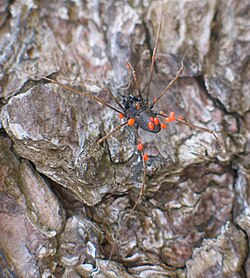
一方で、一方の生物が利益を得て、もう一方が不利益を被る寄生(Parasitism)という関係も存在します。例えば、ダニがザトウムシに寄生し、移動手段と食料を同時に得るケースが挙げられます。
生態系の安定性を支える要素
生態系の中には、その個体数こそ少ないものの、系全体の構造を維持するために決定的な役割を果たすキーストーン種(Keystone Species)が存在します。ラッコのような種が消失すると、食物連鎖のバランスが崩れ、生態系全体が劇的に変化してしまうことがあります。

また、生物は物理的な環境要因(水、重力、気圧、風、火災、土壌など)に強く影響されます。植物の葉は光合成の主戦場として最適化されており、イネ科の植物の花序は風による受粉(風媒)を効率的に行うため、自然選択によってその形状が決定されています。

![The architecture of the inflorescence in grasses is subject to the physical pressures of wind and shaped by the forces of natural selection facilitating wind-pollination (anemophily).[144][145]](/images/4d/56/4d5694495fbea32adbc7d0ea89fd26e2ad089c44d61df5c00a4a3d55e339e60b.jpg)
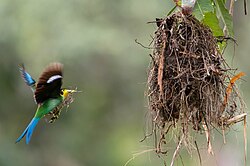
鳥類の中には、複雑な構造の巣を構築することで、次世代の生存率を高める適応を見せる種もいます。
近代的な生態学のアプローチは、19世紀初頭の実験的な試みにまで遡ります。異なる土壌に異なる種の混合物を植えてその成長を比較した初期の実験は、後のダーウィンによる進化論の考察にも影響を与えました。
![The layout of the first ecological experiment, carried out in a grass garden at Woburn Abbey in 1816, was noted by Charles Darwin in The Origin of Species. The experiment studied the performance of different mixtures of species planted in different kinds of soils.[176][177]](/images/1c/d9/1cd9171a73d8d41b2c3ff39653b4d71565a6be7dbefd89eaafa29cf604d2eed7.jpg)
生態学の概要まとめ
| 概念 | 定義・役割 | 具体例 |
|---|---|---|
| 個体群 | 同一種が集まった集団 | ある森に住むシカの群れ |
| ニッチ | 生物が生態系で占める役割・地位 | 夜行性で特定の昆虫を食べる鳥 |
| キーストーン種 | 系全体のバランスを維持する重要種 | ラッコ(ウニの増殖を抑制) |
| 共進化 | 相互に影響し合いながら進化すること | 花と送粉者の関係 |
| バイオマス | ある地域に存在する生物の総量 | 森林における樹木の総重量 |
Frequently Asked Questions
生態学と環境科学は何が違うのですか?
生態学は主に生物と環境の「相互作用」という生物学的メカニズムを研究する基礎科学です。一方、環境科学は生態学の知見を含みつつ、化学や物理学、社会科学などを統合して、汚染対策や資源管理などの環境問題の解決を目指すより応用的な分野を指します。
「ニッチ」とは具体的に何を指しますか?
ニッチ(生態的地位)とは、単なる場所ではなく、その生物が「何を食べ、いつ活動し、どのような温度帯を好み、どのような天敵を持つか」という、生存に必要な条件と役割のセットを指します。
キーストーン種がいなくなるとどうなりますか?
キーストーン種が消失すると、それまで抑制されていた特定の種が爆発的に増加し、結果として他の多くの種が駆逐されるなど、生態系の構造が根本から崩壊する「トロフィック・カスケード(栄養段階の連鎖的崩壊)」が起こる可能性があります。
共進化にはどのようなパターンがありますか?
互いに利益を得る「相利共生(例:花とハチ)」だけでなく、捕食者と被食者が互いに攻撃力と防御力を高め合う「軍拡競争」のような形での共進化も存在します。
生態学はどのようにして地球環境の保全に役立つのですか?
生物多様性のパターンや個体群の変動メカニズムを理解することで、絶滅危惧種の保護計画の策定や、破壊された自然を復元させる「復元生態学」への応用、持続可能な天然資源の利用方法の提案などに役立てられています。
References
- In Ernst Haeckel's (1866) footnote where the term ecology originates, he also gives attribute to : χώρας, : khōrā, 'χωρα', meaning "dwelling place, distributional area" —quoted from Stauffer (1957).
- This is a copy of Haeckel's original definition (Original: Haeckel, E. (1866) Generelle Morphologie der Organismen. Allgemeine Grundzige der organischen Formen- Wissenschaft, mechanisch begriindet durch die von Charles Darwin reformirte Descendenz-Theorie. 2 vols. Reimer, Berlin.) translated and quoted from Stauffer (1957).
- Foster & Clark (2008) note how Smut's holism contrasts starkly against his racial political views as the father of .
- First introduced in MacArthur & Wilson's (1967) book of notable mention in the history and theoretical science of ecology, .
- Aristotle wrote about this concept in (Quoted from The Internet Classics Archive translation by . Book VIII, Part 6): "To return to the difficulty which has been stated with respect both to definitions and to numbers, what is the cause of their unity? In the case of all things which have several parts and in which the totality is not, as it were, a mere heap, but the whole is something besides the parts, there is a cause; for even in bodies contact is the cause of unity in some cases and in others viscosity or some other such quality."
📸 フォトギャラリー